
Guitarist Gergely Szabo has an Advanced Diploma in Music Performance from Cambrian College where he majored in the classical guitar. Over his time there, he completed 2 years of comprehensive pedagogy courses. He also gained well grounded vocal skills, as well as basic knowledge on the piano. Outside of classical music, he exhibits a repertoire of skills and knowledge in playing the genres of rock, blues, and heavy metal music. He has experience in teaching the guitar and the ukulele to a range of people aged 6 to 54.
Gergely’s teaching methods include both the use of books and digital methods. The three main books he uses to teach guitar are as follows: “Guitar Method Book 1 by Will Schmid and Greg Koch,” “Four Star Sight Reading and Ear Tests RCM Level 1,” and “Classical Guitar Repertoire and Etudes RCM Level 1.” For teaching ukulele, he uses the book “Ukulele Songs for 1, 2, or 3 players by Elizabeth Ragsdale.” Aside from these, he frequently uses the Muse Score application as a play-along practicing tool.
Gergely’s passion for music and his dedication to growing the love of music in others are the biggest reasons why he teaches guitar and ukulele. His approach to teaching involves learning through play. The material he covers with his students is always delivered in a way that is highly interactive. Most of the assigned exercises he gives involve the elements of play that students can enjoy both in class and as homework.
Get to know Gergely…Beyond the Bio!
Coming soon!
Hobbies:
Musical influences:
Favourite food:
Least favourite food:
Favourite music:
Favourite album:
Favourite movie:
Favourite musical theatre/opera:
Best quote from your teacher:
Favourite quote:
Favourite book:
Latest Homework from Gergely
Is Gergely Your Teacher?
Sign up now to get your weekly assignments delivered, and never lose your homework sheet again!
Practicing during the break
Henry
How long to practice: 5-10 mins per day (when you have access to a piano)
What to practice:
- Continue with Stepping up Stepping down in A and C (Teaching Little Fingers to Play)
- Heart and Soul
How to practice:
- Stepping up Stepping down
– Follow fingering; keep fingers on keys, do not move
– Play all repeated notes
– Look at the music to pay attention to both of the above
- Heart and Soul
-Follow fingering on chart
How parents can support practice: Help him with the fingering of Heart and Soul, using the fingering chart. Remind him to keep the appropriate fingers on the right keys, not to forget repeated notes, and use the music for support.
Have a wonderful break Henry! Enjoy your trip and I’ll see you in January! :)
Tuesday, December 17
Hello! Jasmine (Chris’ substitute) here. Great work this week, hope you all have a lovely winter break! (Chris will be back in January)
Your lesson notes are as follows:
Josh
Warm-ups:
-continue with the exercises recommended by Chris: coordinating hands and feet with steady beats on the bass drum. BPM (beats per minute) that we started with was 55, working up to 75/80
–Integrating the metronome: metronome pulse can be used for warming up and practicing pieces. Find the “slow” tempo/BPM that you can play something comfortably at and the “fast” tempo where things can’t quite be played together — gradually work towards the fast tempo making sure that all limbs and rhythms are grooving together (watch out for tensing arms or legs as you increase speed)
I Had Some Help
-Great work on the verse and chorus groove!
-We worked on just playing one part (beginning kick, then adding snare, then adding hihat) and coordinating with the metronome. Count out loud as you play to line up your beats and gradually increase tempo. We started at 70 bpm, increased our way to 115 with just one part at a time.
-When adding all parts together, we were able to play through at around 95 bpm
-Over the break, continue working on coordination across the kit (with warmups+other grooves) and I Had Some Help
Myles
Xylophone
-G major technique: Great job! If you’re wanting to vary the way scales are practiced, try incorporating dynamics or different rhythmic patterns (doubling each note, swinging the notes going up and down)
-Reading at the keyboard: see image on anchor points and note acronyms on the staff
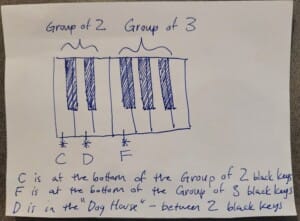
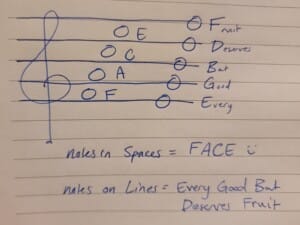
-Cirone Simple Steps: Awesome sight reading today! Continue working on your note recognition on the staff
-Over the break, focus on Weezer: My Name is Jonas and G major technique
Finn
Warmups (30sec each, counting aloud):
–Single Strokes
–Double Strokes
–8 on a hand
Visual Drummer: Drum Beats ex. 7-9
-When working through these, remember to count out loud and to practice one part at a time to get everything lined up. For exercise 7, see attached image on a groove that can be practiced on its own before adding the other sounds.
-Over the break, continue working through Joan Jett: I Love Rock and Roll and the next page of exercises on the Visual Drummer (exercises 10-12)
Noah
Warmups (1min each per practice session):
-Single paradiddles 75bpm
-Double Paradiddles 75bpm
-Triple Paradiddles 75bpm
-Combo exercise: four of each paradiddle w/o breaks — Great work on this! Accents are really popping. Challenge yourself by syncing up with a metronome and see how fast you can play the groove without tension/starts and stops
Paul Simon: Late in the Evening
-Awesome work on this!
-Try isolating different pairs of sounds in your practice: bass drum and LH tom, bass drum and RH clicks. Getting the tom and BD part to click will solidify the feel
-To get the rim clicks more comfortable/consistent, you can try playing the groove just on the rim of the snare — how consistent can you make the sound?
Mario
Warm ups
-Can integrate these exercises onto the kit to vary the practice (and to build more fluidity moving around the drums) — pulse quarter notes on the bass drum and work through hand warm ups on snare/toms/combination of both using eighth notes. Be mindful of tension and remember to shake out your arms and wrists periodically
4-Beat Fills, 4-6 (and beyond)
-Can alternate between one bar groove and one bar of fill to get used to moving around the kit
-Be mindful of keeping the pulse consistent when moving from groove to fill; the fill can be a moment of musical interest in the phrase, don’t be afraid to give it a dynamic shape/direction
-For more syncopated fills (8), you can add quarter notes on the bass drum to help line up the rhythm on the toms
Backbeat Patterns
-In working through these exercises, try isolating them by a single instrument at a time. Once that particular limb is settled, add in other elements. Strive for a consistent pulse as you’re moving through the exercises.
Preferred Books for Gergely’s Students
Click to buy them here, and they’ll come right to your house! What could be easier?
Hal Leonard Guitar Method
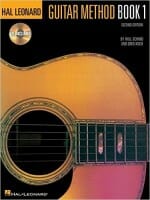
The second edition of this world-famous method by Will Schmid and Greg Koch is preferred by teachers because it makes them more effective while making their job easier. Students enjoy its easy-to-follow format that gives them a solid music education while letting them play songs right away. Book 1 provides beginning instruction including tuning, 1st position melody playing, C, G, G7, D7, and Em chords, rhythms through eighth notes, solos and ensembles and strumming.
Four Star Sight Reading and Ear Tests