
Guitarist Gergely Szabo has an Advanced Diploma in Music Performance from Cambrian College where he majored in the classical guitar. Over his time there, he completed 2 years of comprehensive pedagogy courses. He also gained well grounded vocal skills, as well as basic knowledge on the piano. Outside of classical music, he exhibits a repertoire of skills and knowledge in playing the genres of rock, blues, and heavy metal music. He has experience in teaching the guitar and the ukulele to a range of people aged 6 to 54.
Gergely’s teaching methods include both the use of books and digital methods. The three main books he uses to teach guitar are as follows: “Guitar Method Book 1 by Will Schmid and Greg Koch,” “Four Star Sight Reading and Ear Tests RCM Level 1,” and “Classical Guitar Repertoire and Etudes RCM Level 1.” For teaching ukulele, he uses the book “Ukulele Songs for 1, 2, or 3 players by Elizabeth Ragsdale.” Aside from these, he frequently uses the Muse Score application as a play-along practicing tool.
Gergely’s passion for music and his dedication to growing the love of music in others are the biggest reasons why he teaches guitar and ukulele. His approach to teaching involves learning through play. The material he covers with his students is always delivered in a way that is highly interactive. Most of the assigned exercises he gives involve the elements of play that students can enjoy both in class and as homework.
Get to know Gergely…Beyond the Bio!
Coming soon!
Hobbies:
Musical influences:
Favourite food:
Least favourite food:
Favourite music:
Favourite album:
Favourite movie:
Favourite musical theatre/opera:
Best quote from your teacher:
Favourite quote:
Favourite book:
Latest Homework from Gergely
Is Gergely Your Teacher?
Sign up now to get your weekly assignments delivered, and never lose your homework sheet again!
Thursday, May 7th
Josh
Josh is seeing great improvement with more consistent practising habit. We continue working on the few pre chorus bars. For this week the goal is to link up bar 34-36. As a reminder, bar 35 is a repeat of 34, and 36 is the bar that pairs with lyrics “like to say to you…”. Also work on the verse pattern as it comes back in later section.
Aleksander
We ended the class with a successful play through of the song Bring Me to Life. We will move on to Smell Like Teens Spirit next class. The score is available on the drive if he would like to start giving some read.
https://drive.google.com/file/d/1MwwUXU5Fo4L2iPh-f4Vked6Gy4uD4rtK/view?usp=sharing
Zico
We continued working on The Trooper. Through Stick Control practise, Zico is now in a good place to play the song. The section that could use some slow practising is the guitar solo 2 section, building up the endurance for the bass drum pattern. We will try a play through of the song next week.
Noah
We continued warming up with Stick Control. Seeing greater four way coordination with the drill. Then we segue into the pre chorus section of Smooth Criminal. Noah quickly picked it up, and with that I would like him to work through the chorus section this week.
Finn
Finn is seeing improvement in terms of the choppiness in his playing. The open hihat is now connecting smoothly into the buzz, creating a very cohesive timbre. Practise all the bracketed bars in repeat, and attempt connecting one to another, and we will work on building sections of the song next week.
Mateo
We spent the lesson putting some finishing note on Labios Compartidos. Once again I will like to reiterate, successful practising habit is highly dependent on picking out trouble spots and building upon it bit by bit, and getting comfortable with it. We will put a close to the song and move on to Sweet Child o Mine. Good job Mateo!
Koel
We went back to working on Fool in the Rain. While we work on this material, I would like Koel to also build upon this general technique working on the “Routine” Handout, and as fun, also work on the first 4 lines of the Samba Funk handout. In terms of the song, let’s now focus on Verse 4, and try out all the fills that John Bonham made up for each phrase ending.
Efe — May 9th
Hi Efe!
Here is what to look at for this week.
Artists to listen to
- Van Halen — Rock — Songs to try: Good Enough, Jump, Panama, Running with the Devil, Eruption, I’m the One, Jamie’s Crying, Atomic Punk, Ice cream man
- Joe Pass — Jazz — the link from today — We were about 1 minute in when you noticed a run on the guitar that you liked
- Django Reinhardt — Jazz — This man lost a finger on his left hand in a fire. And yet he still became a magnificent guitarist
Acoustic Open
- Continue to work on the first 16 bars. I saw some improvements today. — Make sure to try it without the video. Then do it with the video at 0.6x speed. I’ve slowed it down for this week. — If it is feeling super slow, raise the speed to 0.65x speed.
- Try the ending chords. Remember to make the last one cut completely short.
The above genres of music are full of countless things to discover and I hope those given songs inspire you to check out even more songs.
See you in a week!
Efe – Jan 31st
Hi Efe!
So sorry I couldn’t be at the lesson today. I should be well for next time.
This week’s Google Drive: Efe – Jan 31st
Here’s what to look at for this coming week.
Em pentatonic scale
- New backing track: Em Blues
- This backing track is a little faster than the one from before.
- Try bends and vibrato here, too. — A note: for the high E string, doing bends and vibrato down toward the floor is not possible, so only do these things upwards.— High E string vibrato: small pushes upward.
— High E string bends: pushing up with at least two fingers on the note.
I’ve added some new notes to your knowledge of this pentatonic scale. There’s a picture of them in the Google Drive. Keep improvising in the notes of this scale for this week.
E, A, and D chords
These are all major chords. I’d like you to get acquainted with playing them, and have an idea of the shapes of each chord. This video in the Google Drive what I’m asking you to play along with. Feel free to slow it down if it feels too fast.
- The best way to play this particular game is to remember that finger 1 of the Left Hand never leaves the G string. It shifts between some of the chords here, but it never “jumps.” The other fingers have to jump.
Have fun with this, Efe. We’ll be able to go over previous and new material in much more depth next class. See you in a week!
Efe – Jan 24th
Hi Efe and family! Wishing you guys a great week! Here is what to look at this week.
Em (E minor) pentatonic scale
Memorize the new frets added to this scale. — This Google Drive shows the frets.
https://drive.google.com/drive/folders/1faNAHa6PfakFLpwZRjcAnOtmbvmd74Os?usp=drive_link
Play with this scale over this backing track. The same as before. Slow Em Blues backing track
Experiment with:
- Different speeds. There is no such thing as “too slow” for this.
- Pull-offs
- Palm-muting
- Bending
- Vibrato
- Different rhythms
- The limiting yourself rule. Take any set of rules to limit yourself with. For example, play only two notes. Yes, its boring; but 2 things will come out of that: 1, you will get creative with what cool things you can do with only two notes. You would be amazed at how much you can actually make with just two possibilities of notes. You’ll make things up that you never thought of, and that you never thought you could do. But you can. Don’t underestimate the possibilities of using only two notes. 2, if you really can’t resist the temptation to play other notes, then this is okay, too. Playing this limiting game will inevitably make your mind think of other cool possibilities of notes to play. Feel free to get creative with this :) This, too, is a fascinating thing to see. Let yourself do it and don’t be afraid!
- And also the powerchords. Any of the notes of this scale on the lowest 3 strings (remember, we speak upside down in guitar :) can help you make a powerchord. The only one I want you to refrain from playing is the D5 chord; I haven’t explained that one yet.
— For the 0-fret root note powerchords A5 and E5. They’re named with fives because this chord only has the fifth of that letter. In these two cases: a’s fifth is e, and e’s fifth is b. the 0, the 2, and the 2. Ideally use fingers 2 and 3 for each of those chords.
— 3pm to 6pm type strumming. Remember: this is mostly because of follow through. — IF it’s not too uncomfortable, have your finger 3 touch the string below it. It will mute the string below. So, hitting four strings at once is now something you can do, since the fourth string won’t ring.
You don’t have to do all of the techniques listed here. But what I do want you to do is spend 15 minutes on the 2-notes-only game. Then 15 minutes on the game wherein you start with 2 notes, but allow yourself to play other ones if you feel the urge to do so.
Have fun with it!
A different guitar
As I explained, I strongly encourage you to go and get a guitar that is both smaller and has nylon strings. The current guitar has too many drawbacks that are preventing Efe from being able to progress efficiently. It is good for him to practice bending and vibrato, which a nylon string guitar would indeed not be a helpful guitar for. But besides that, its strings are just too heavy to be able to play most things we’ll be covering in class. Including Smells Like Teen Spirit.
The options you could look for:
Acoustic nylon string guitar
- Nylon strings — these are light compared to the steel strings
- Usable for multiple genres of music
- Good for long term pedagogical use — that is, it’s technically a better choice in terms of being able to play in (some) more genres. Things like classical and flamenco music are playable on this instrument. The electric guitar won’t be as good for this.
Electric guitar
- Varying gauges of steel strings — start with “nines.” (The music stores will know what you mean if you say this.) This is one of the most common gauges of strings and they’re quite light to play on.
- Bends and vibrato are much more doable.
- Great for additional effects to play with; like pedals and harmonics.
- Good for long term use in the following genre groups: rock, jazz, country. There are many, many sub-genres of these three groups. So this type of guitar is great for all of these things; it just won’t be able to fulfill all the needs that classical and/or flamenco music need.
- Knowing you, Efe, I think you are more interested in these types of music rather than classical or flamenco music.
For now, you don’t need a guitar that has more than 19 frets.
The music store I go to is called Snider School of Music, and it’s just north of Yonge and Lawrence. 3225 Yonge St, Toronto, ON M4N 2L3
This store may still give the option of giving them the guitar to be sold, through which you’ll get the majority of that money when the guitar is sold.
Their prices are usually cheaper than chains like Long & McQuade. Plus, if you get one that’s used, it will be even cheaper.
Renting a guitar is another option.
If getting a different guitar is not possible right now, the I understand. If this is the case then I’m going to think of a new solution.
Smells Like Teen Spirit — I have purposely left out Smells Like Teen Spirit this week, as it is not a reasonable thing to practice with your current guitar.
This was an awesome class today, Efe. Make sure you have fun with these improvisation games! See you in a week!
Preferred Books for Gergely’s Students
Click to buy them here, and they’ll come right to your house! What could be easier?
Hal Leonard Guitar Method
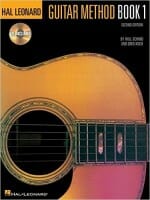
The second edition of this world-famous method by Will Schmid and Greg Koch is preferred by teachers because it makes them more effective while making their job easier. Students enjoy its easy-to-follow format that gives them a solid music education while letting them play songs right away. Book 1 provides beginning instruction including tuning, 1st position melody playing, C, G, G7, D7, and Em chords, rhythms through eighth notes, solos and ensembles and strumming.
Four Star Sight Reading and Ear Tests