
B.Mus (Humber) in-progress
Adina is a singer-songwriter based in Toronto completing her Bachelor of Music degree at Humber College in vocal performance. Trained classically in piano since the age of 5, she has branched out into pop and jazz as well.
Vocally she is well-versed in many genres including jazz (she loves to scat!), musical theatre, pop, singer-songwriter, country, R&B, and acappella. She has 7 years of choir experience in both chamber and jazz styles. Adina has been writing and singing original songs since the age of 12, and has two singles as well as an EP out on all platforms under the artist name Adina V.
She has performed all across southern Ontario singing with the Toronto All-Star Big Band, as well as at various venues in the GTA with her own jazz duos and trios. As a member of the Cawthra Park Chamber Choir she performed at Roy Thompson Hall with the TSO for two years in a row. At Humber College she is part of the Vocal Jazz Ensemble led by Lisa Martinelli; this group performs advanced repertoire at events like the Ontario Vocal Jazz Festival.
Adina has been teaching music for the past 7 years and loves helping students meet their personal goals while fostering a love of music that lasts forever!
Get to know Adina…Beyond the Bio!
Hobbies: reading, puzzles, video games, painting
Musical Influences: Ella Fitzgerald, Nancy Wilson, Doris Day, Joni Mitchell, Taylor Swift, John Mayer
Favourite Food: Pad Thai
Least favourite food: eggplant
Favourite music: Indie rock and folk
Favourite song: All I Need by Jacob Collier ft. Mahalia & Ty Dolla $ign
Favourite movie: Matilda
Favourite movie music: The Pirates of the Caribbean theme
Favourite Musical: Dear Evan Hansen or The Last Five Years
Best Quote from your teacher: “It’s an amazing and wonderful experience to be able to be intentional about, in the moment, making music”
Favourite Quote: “Even as we are, we are becoming”
Favourite Book: The Girl With the Dragon Tattoo trilogy – Stieg Larsson
Best thing about teaching at ABC: Sharing and fostering a love of music with students of all ages
Latest Homework from Adina
Is Adina Your Teacher?
Sign up now to get your weekly assignments delivered, and never lose your homework sheet again!
Sunday, February 14, 2021
Happy Valentine’s Day!
Emet
For your warmup this week, please play D major triads. The difference between these and your previous D minor triads is that F is now sharp. All fingerings should stay the same; just slide your hand further into the keys so it’s easier for thumb and finger 5 to reach the sharp.
Piano Man – Let’s play up until bar 17 hands separately. RH sometimes has two voices in one hand, which means there will be notes with stems going up and going down in the same bar. Make sure to hold all notes full value even when this is the case (for instance bar 6 that half note should continue to hold as the top note changes, etc.). LH watch the slur articulation – beat 1 is connected to beat 2. LH may continue to read on to page two, since there are patterns that repeat. RH’s part is much more involved, so only do the first page this week.
Please still practice Hunting Song, as we will start with that this week
Nathalia
For the warmup this week we are doing the G major scale hands separately. The fingering is the same as with C major, the one difference is we have an F#. If you feel comfortable as the week goes on, you may try it hands together.
Bye, Bye Love – This week play the entire verse hands together (so up until bar 18). RH do be careful with following the written finger numbers – they are there because it’s the easiest way to reach the notes. Like we did in lesson today, go back and forth between the two chords in bar 16 and 17 to get them feeling really comfortable. Please do still play the chorus hands separately, noticing what sixths look like on the music.
Kollel
This week our scale is E major (4 sharps – F#, C#, G#, and D#). Let’s actually go hands separately so that LH can be extra careful with crossing fingering.
Pachelbel’s Canon – The first 4 lines can absolutely be played hands together, as well as with pedal. Adding the pedal as soon as possible helps LH feel more legato even when there are big jumps in the part. RH, in line 4, try to stay up into the keys for the entire phrase as opposed to coming down for the thirds with 2 white keys, then having to slide back up every time there’s a sharp. This week let’s add line 5 in (hands separately). LH’s part in lines 5 and 6 is identical, so it’s only necessary to play the one line. LH notice your pattern: it’s always 1-5-1-3 (triad degrees) for each chord. RH, do your best to land on the finger numbers we wrote in for beats 1 and 2 in this line. As always don’t forget your key signature! F and C are sharps regardless of the octave.
Etude in G – The middle section could use some extra attention; play it a couple of times isolated before playing the whole piece through. RH be careful to still do the staccatos on beat 1 even if LH has the held dotted half note (this happens in bars like 11, 12, 20).
Next week we will pick a new studies piece.
Tuesday, January 19
Hello everyone! Thank you for being so prepared this week.
Ken
As a warmup this week, play around with starting the 5-finger scale (hands together) on different roots – use your ear and try getting both the major and minor sounds.
Song for a Scarecrow – When playing the staccatos in this song, make sure that beat 2 and beat 3 are nice and short. Use the saying “FACE in the Space” to find the space notes in treble clef.
“London” Symphony – This song is short and the notes are not too tricky, so the focus really is on the counting and articulation (staccatos and legatos). Especially bars 3-4 lets be super distinct with the quarter note vs. half note length.
Jazzy Joe – Whenever we play a piece we ideally want one tempo for the entire time – work on making the first half and second half sound unified by picking a starting speed that can work for both.
Ken is flying through the pieces in this book and will be ready in the next couple of weeks to move onto level 2 in the Piano Adventures series. We can discuss getting new books next class.
Steve
For our warmup this week, I think it would be more comfortable if we play our G (or C) major scale one hand at a time, really paying attention to the crosses. For RH the fingers are: 1-2-3-1-2-3-4-5 going up, and 5-4-3-2-1-3-2-1 going down. For LH it’s: 5-4-3-2-1-3-2-1 going up, and 1-2-3-1-2-3-4-5 going down. I’ve bolded the moments where we cross (either tucking the thumb under, or finger going over).
Skip to My Lou – Start this song just a bit slower so you can do your eighth notes comfortably, instead of them feeling rushed. When there are eighth notes in a piece we like to count 1+2+3+4+ (one “and” two “and” three “and” four “and”), where the “and”s are the half beats.
Leftover Popcorn – A circled finger number means your hand must lift and go to a new position. In bar 7, do your best to connect between the G and F# – moving your hand up into the keys will help with this. Beat four of bar 7 has a natural sign, which cancels out the F#.
Minuet – Please don’t get confused with the lyrics being numbers! Finger numbers are written above the staff for RH, and below the staff for LH. LH G (top space) is an important note this song and we keep coming back to it, so let’s try to memorize where it is on the staff. It’s not necessarily marked on the piece, but it should be played legato; please connect as much as possible including between the hands.
Gabe
I think it would be a good idea to play the Canon (in C) from your 2A book first, and then reading through the new Canon (in D). That way you can hear what the arrangement sounds like and it will serve as an aural guideline for the new key. Remember that in D major we have F# and C# in the key signature. Do pay attention to the finger numbers written since they will help you reach the right notes easily.
This week try to also practice the Theme From Don Giovanni alongside the songs from the earlier pages in the 2A book. Again, the finger numbers are there to help you so please use them! You can always start – especially less familiar songs – a little slower so you have more time to read the notes and counts.
Isaac
Please remember to do your 2 theory pages! (48-49). We also have a new song this week since we’ve moved on from Morning Greeting
Climb up on an Elephant – Before hopping in and playing the whole song through, isolate bar 19 hands together a few times so it gets more comfortable. Then, try playing the whole song hands together! Note where the hands play together, and when they are doing a call and response pattern. As always please watch your octaves – RH especially has a big range. Use Good Birds Don’t Fly Away to help you find the bass clef line notes.
Frere Jacques Stands on his Head – This piece is a round, meaning one hand starts the melody then continues on as the other hand plays the initial melody underneath. Each melodic idea is 2 bars, with RH leading. Feel free to play the song hands separately once before trying it hands together. Start a bit slower than you might want to so that you’ll be able to keep up when the eighth notes start in line 2. Most of the piece is legato but there are a few important staccatos to watch for!
Wednesday, May 26th, 2021
Dvorah
Recommended minutes to practice: 10-15 minutes a day
What to practice: C major scale (RH), Allegro, and Elephant Ride
How to practice it most effectively: The C major scale goes from C stepping all the way up to the next C then back down. For RH, the fingering is 1-2-3-1-2-3-4-5 (so you tuck your thumb under finger 3 between E and F). The way down is the exact same thing but backwards (so finger 3 crosses over your thumb between F and E). In Allegro, the hands play together in bars 1,2 and 5,6. LH, please make sure you ground down and hold the whole note for the full bar, even though RH is playing other notes. Our skips in this song go from line to line. For Elephant Ride, our skips go from space to space – bars 1, 3, and 5 are all skips and all the same!
Diya
Recommended minutes to practice: 15-20 minutes a day
What to practice: “na na na” warmup (steps then skips), Best Day of My Life, Never Enough, Ferris Wheel
How to practice it most effectively: For the “na na na” warmup, start by going up in steps (so C-D-E, E-D-C etc.), then after 5 or 6, switch to skips (C-E-G, G-E-C etc.). For Best Day of My Life, focus on the verse lyrics – one day only practice verse 1 a bunch of times, the next only practice verse 2, etc. In the chorus, try adding a gentle H to the “li-i-i-i-i-i-fe” part to avoid too many glottals. For Never Enough, we spoke about staying on the previous note for the words “way” and “now”, where the melody goes too low. On the word “enough”, make sure your vowel is nice and long, just like you’re already doing on the word “never”. For Ferris Wheel, you can use your finger #s as well as sayings to help you find notes. Please play everything but the last line hands together, doing your best to connect under the slurs.
Marco
Recommended minutes to practice: 15 minutes a day
What to practice: C’s Rock, Mozart’s Five Names, and Paper Airplane
How to practice it most effectively: C’s Rock is a warmup piece that helps us practice knowing where our 3 C’s are (bass C, middle C, and treble C). Remember to be extra bouncy on those staccatos! Mozart’s Five Names has a lot of the hands playing together in unison (meaning they are playing the exact same notes). RH has a new note D – the 4th line of treble clef, between the C and E of FACE in the space. Watch out for the hands’ position switches! For Paper Airplane, we circled whether each bar for RH is moving in steps or skips. Use this as a guide as we play in treble C position. The third line is the hands playing in unison once again.
Alice
**Alice will need the next piano book in the series soon, since we are a couple of weeks away from finishing the Primer Level. Here is a link to the Piano Adventures Level 1 Lesson book: https://www.amazon.ca/Level-Lesson-Book-Piano-Adventures/dp/1616770783/ref=sr_1_1?crid=2FYV290TRU07R&dchild=1&keywords=piano+adventures+level+1&qid=1622080895&sprefix=piano+adven%2Caps%2C177&sr=8-1
Recommended minutes to practice: 15-20 minutes a day
What to practice: Copycat, Grandmother, and Little Do You Know
How to practice it most effectively: For Copycat, really watch your steps versus skips, especially in lines 2 and 4 where there is a very slight difference. Remember, LH is always copying RH! For Grandmother, there are lots of skips – in the bottom line the hand are sometimes playing together, so please be extra careful with which hand plays which notes. The ending is in harmony, with both hands stepping down and making quite a nice sound. For Little Do You Know, please sing with the karaoke this week. Remember you get 3 beats and then you’re in with what’s called a “pickup” line (the “little do you-“). Watch out for Sierra’s verse lines that go really high! Please brainstorm a song or two you’d like to start working on next week.
Linda
Recommended minutes to practice: 20 minutes a day
What to practice: Calico Cat, Pyranese Melody, and I’ve Got You Under My Skin
How to practice it most effectively: Calico Cat is quite close to being done; just double check the RH rhythms in bars 9, 10, 13, and 14. Pyranse Melody is in A major, meaning we have F#, C#, and G# in the key signature. Try reading through this one hands separately this week. For Under My Skin, we spoke about the D-7b5 to G7b9 cadence and why it’s actually quite easy for your RH to play these two chords in succession: D-7b5 is D-F-Ab-C in the RH (with LH playing a D root), and G7b9 is D-F-Ab-B in the RH (with LH playing the G root). Only your RH pinky has to move down 1 semitone between these chords! This same concept occurs between E-7b5 and A7b9. Technically, what your RH is playing (D-F-Ab-B) is a D diminished 7 chord. The F diminished 7 chord on page 2 is the same notes just with F as the root, so feel free to play the exact D-F-Ab-B shape in RH with an F in LH.
Emet
Recommended minutes to practice: 20 minutes a day
What to practice: B minor triads (1 octave hands separately), Walk Don’t Run, and Tarantella
How to practice it most effectively: For the B minor triads, we use the same fingerings as other triad families – keep your hand high up into the keys so it’s easier to play that F#. For Walk, Don’t Run please isolate bars 9 and 11 for the rhythm between the hands; it will help to say the counting with ands out loud. The whole piece may be played hands together now! For Tarantella, you can start playing the entire form through (including the DC al Coda). Please double check your octaves for the coda section. There are some pretty dramatic dynamics in this piece – let’s add them in this week.
Kollel
Recommended minutes to practice: 20 minutes a day
What to practice: B major triads (hands together, 1 octave), The Black Pony, look at Allegretto in C Major if you want to try reading something new
How to practice it most effectively: For the B major triads, the same fingerings are used, just now there are 2 black keys (D#, F#) per triad. For The Black Pony, try isolating bars 13-16 three times before playing the whole thing through so that section can catch up in speed with the rest of the piece. You can add pedal now in the sections shown by the brackets. At the ending, a tempo senza rit means “at tempo, without a rit”, so hold the quarter rest for a full “1e+a” before coming in with the last 4 notes. I will try to get an intermediate version of The Entertainer for you next week.
Preferred Books for Adina’s Students
Click to buy them here, and they’ll come right to your house! What could be easier?
Alfred's Basic Piano Library Lesson Book 1A
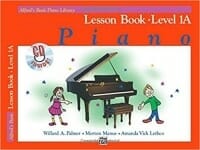 This easy step-by-step method emphasizes correct playing habits and note reading through interval recognition. Lesson Book Level 1A begins by teaching basic keyboard topography and fluent recognition of white key names in relation to black keys. It focuses on simple rhythms and prepares students for intervallic reading with entertaining songs that focus on “same,” “stepping up” and “stepping down.” It then introduces lines and space notes in treble and bass clefs, melodic and harmonic intervals of 2nds, 3rds, 4ths and 5ths, and graduates to reading on the grand staff. It also introduces the flat and sharp signs. This course is most effective when used under the direction of a piano teacher or experienced musician. Songs Include: Balloons * Batter Up! * The Donkey * A Friend Like You * Hand-Bells * A Happy Song * Horse Sense * Totem Pole Song * It’s Halloween! * Jingle Bells! * Jolly Old Saint Nicholas * July the Fourth! * Just a Second! * Love Somebody * Merrily We Roll Along O’er the Deep Blue Sea * Mexican Hat Dance * My Clever Pup * My Fifth * My Robot * Old MacDonald * Old Uncle Bill * Play a Fourth * Raindrops * Rain, Rain! * Rockets * Rockin’ Tune * Rock Song * Sailing * Sea Divers * See-Saws * Skating * Who’s on Third? * Willie and Tillie * Wishing Well * The Zoo
Alfred's Adult Basic All-In-One

Alfred’s Basic Adult All-in-One Course is designed for use with a piano instructor for the beginning student looking for a truly complete piano course. It is a greatly expanded version of Alfred’s Basic Adult Piano Course that will include lesson, theory, and technique in a convenient, “all-in-one” format. This comprehensive course adds such features as isometric hand exercises, finger strengthening drills, and written assignments that reinforce each lesson’s concepts. There is a smooth, logical progression between each lesson, a thorough explanation of chord theory and playing styles, and outstanding extra songs, including folk, classical, and contemporary selections.
The Brown Scale Book
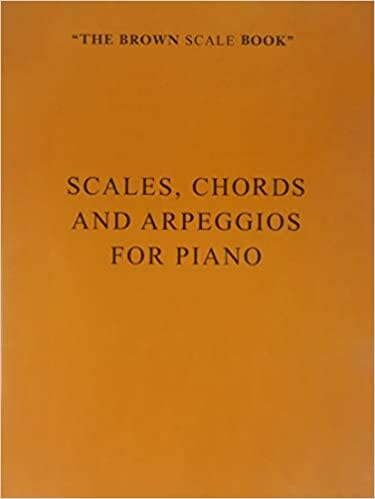
This essential resource includes all major and minor scales, triads, arpeggios, dominant sevenths, and chromatic scales organized by key. A favorite for decades, The Brown Scale Book belongs in every student’s library.
The Real Vocal Book

The Real Vocal Book has many of the selections from Volumes 1 and 2 of the instrumental Real Books, but now with complete lyrics added to the pre-existing melody line. This edition features 300 essential songs arranged for low voice, including: Alfie * All of Me * Autumn Leaves * Bewitched * Bluesette * Don’t Get Around Much Anymore * Fever * Georgia on My Mind * Misty * Moon River * My Funny Valentine * Satin Doll * and more. Looking for a particular song? Check out the Real Book Songfinder here.