ARCT • Teachers’ Diploma (RCM) in-progress
Trained Music Together Teacher
Erin Plank (they/he) is a passionate young piano teacher. For their professional development, Erin received the highest exam scores in all of Canada last year for “Teaching Elementary Piano” with the RCM.
Erin’s main goal is to turn students into lifelong music lovers, not just pianists. I seek to provide them with the tools to practice efficiently at home, sight read a song at their friend’s piano, learn the melody to a song off the radio by ear, and nurture a technical foundation that lasts a lifetime so it’s “just like riding a bike” to play the piano. And even better, they’ll want to.
Get to know Erin…Beyond the Bio!
Hobbies: Piano, weightlifting, playing with my cat, and hanging out with friends
Musical influences: Ben Folds, Brad Mehldau, Edvard Grieg
Favourite food: Fried chicken sandwich
Least favourite food: snap peas, because I ate too many as a kid one time and threw up and now I dislike the smell
Favourite music: Romantic era piano music, Beach Boys and similar era music, math rock
Favourite song: “How Dare You Want More” by Bleachers
Favourite movie: Sing Street
Favouirite movie music: main theme for “Eternal Sunshine of the Spotless Mind” or anything Star Wars
Favourite musical theatre/opera: Wozzeck
Best quote from your teacher: “Don’t show the audience you messed up, they won’t know! Keep going!”
Favourite quote: “That’s what life is, Happy Sad”
Favourite book: Recursion by Blake Crouch
Best thing about teaching at ABC: Getting to reach and connect with so many lovely people!
Latest Homework from Erin
Is Erin Your Teacher?
Sign up now to get your weekly assignments delivered, and never lose your homework sheet again!
Thursday December 8 Lessons – Erin P
Hello everyone! Your Christmas pieces are all sounding AWESOME! Proud of everyone <3
Fiona
Jingle Bells. Sounding great! Make the “Jingle Bells” part more bouncy and light so it sounds like actual bells.
Mixed Up Song. Good work reading this one. Be sure to keep your wrists in line with your forearms and don’t let them sag down off the edge of the keys.
C Major 1-octave scale. We learnt this with both hands today! A very exciting mile stone. Be very picky with the fingering, because you’ll do this scale for life and we don’t want to confuse your brain. RH is 123 12345. LH is 54321 321.
Marita
Jingle Bells. This was so good today! I was really impressed. Keep playing it and work to keep it all nice and steady. Notice the dynamics more as well – ex. the first “Jingle Bells” is marked mp, and the second one is marked forte.
Joy to the World. ***DOWNLOAD HERE*** Get dramatic with this one! Play deep into the keys like you’re playing for an entire hall. A lot of the parts with many notes are just entire (or pieces) of C Major scales so don’t be afraid!
C Major broken triads, hands seperate. A triad is a group of three notes from a scale. The C Major triad uses the 1st, 3rd and 5th note = C, E and G. With your one hand moving parallel like a crab walking, you’re going to play C E G, then E G C, then G C E, now you’re at the beginning again! I described it today as a cat walking, and how their back feet step exactly where their front feet just did – this is what your fingers will be doing. RH fingering is 135, 125, 135. LH fingering is 531, 531, 521. Here is a lovely video to watch/play along with.
Sara
Jingle Bell Rock. Great work! Keep playing to keep it polished, and perhaps a little more solidifying is still needed for some transitions. Let’s do a nice recording of this one next week!
Lemon Sherbet Rag. Great attention to the detailed articulations, keep being picky with yourself. It’s an amazing habit to hold yourself to this high standard.
In the Spirit. Play the LH lots by itself. It that tricky middle part, the LH is the only thing consistently on the downbeats to keep us grounded so get it so secure you don’t even have to think about it. Great work. You can learn the last little bit as well, add some swing to those 8th notes.
Twelve Days of Christmas. ***DOWNLOAD HERE*** Have fun with it! And don’t feel pressured to do all 12 repeats that’s torturous sometimes :D
Julian
Rudolph the Red Nosed Reindeer. Great work! Be aware of the skips that trip you up. Here is a video at a slower tempo that you can play along with. Repetition will make you be able to play it all the way through!
Ode to Joy. I like our arrangement of the LH we did today. It is awesome you have opinions on how music sounds, and now how to get what’s in your head onto the page. Please practice this entire piece hands together, but don’t play beginning to end all in one go, as it is long. Break it into a few smaller chunks and practice those chunks, then chunk it in a different way and play it like that. You will have much more enjoyable practice and better progress this way.
Sina
When Our Band Goes Marching By. Today you fixed the issue of not noticing the RH rests, so keep that fixed and with a little more practice this will be awesome! If you can try and make the LH more bouncey, as it is representing the drummers of the marching band. Your RH is being the horns and other melodic instruments.
Jingle Bells. ***DOWNLOAD HERE*** You read this so easily today! Proud. Page 1 is in “thumbs sharing middle C” position and page 2 both hands are in their own C position.
Preferred Books for Erin Students
Click to buy them here, and they’ll come right to your house! What could be easier?
BOOK TITLE
COMING SOON
Faber Piano Adventures

The 2nd Edition Level 1 Lesson Book introduces all the notes of the grand staff, elementary chord playing, and the concept of tonic and dominant notes. Students play in varied positions, reinforcing reading skills and recognizing intervals through the 5th. Musicianship is built with the introduction of legato and staccato touches. This level continues the interval orientation to reading across the full range of the Grand Staff. The 5-finger approach is presented here in a fresh, musically appealing way.
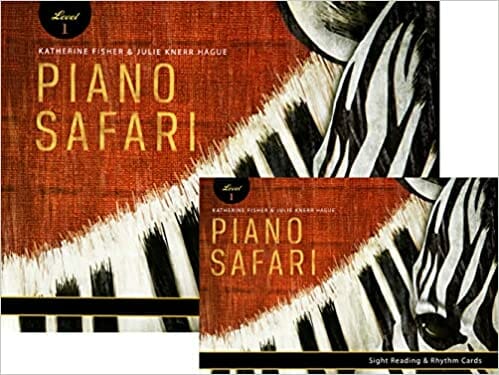
Piano Safari