

ARCT • Teachers’ Diploma (RCM) in-progress
Trained Music Together Teacher
Erin Plank (they/he) is a passionate young piano teacher. For their professional development, Erin received the highest exam scores in all of Canada last year for “Teaching Elementary Piano” with the RCM.
Erin’s main goal is to turn students into lifelong music lovers, not just pianists. I seek to provide them with the tools to practice efficiently at home, sight read a song at their friend’s piano, learn the melody to a song off the radio by ear, and nurture a technical foundation that lasts a lifetime so it’s “just like riding a bike” to play the piano. And even better, they’ll want to.
Get to know Erin…Beyond the Bio!
Hobbies: Piano, weightlifting, playing with my cat, and hanging out with friends
Musical influences: Ben Folds, Brad Mehldau, Edvard Grieg
Favourite food: Fried chicken sandwich
Least favourite food: snap peas, because I ate too many as a kid one time and threw up and now I dislike the smell
Favourite music: Romantic era piano music, Beach Boys and similar era music, math rock
Favourite song: “How Dare You Want More” by Bleachers
Favourite movie: Sing Street
Favouirite movie music: main theme for “Eternal Sunshine of the Spotless Mind” or anything Star Wars
Favourite musical theatre/opera: Wozzeck
Best quote from your teacher: “Don’t show the audience you messed up, they won’t know! Keep going!”
Favourite quote: “That’s what life is, Happy Sad”
Favourite book: Recursion by Blake Crouch
Best thing about teaching at ABC: Getting to reach and connect with so many lovely people!
Latest Homework from Erin
Is Erin Your Teacher?
Sign up now to get your weekly assignments delivered, and never lose your homework sheet again!
Thursday November 30 Lessons – Erin P
Hi Everyone! If you are reading this, THANK YOU, and please click this link to confirm this was seen.
I hope everyone has a fun first week of December and your advent calendars are good to you (if you do that sort of thing). You’re all sounding GREAT!
Liam
Silent Night – nice work. Let’s work on putting the “B section” hands together now. I circled some of the fingering that will make legato phrasing much easier. Good job on the dotted quarter rhythms.
*New* Walk the Talk – m1-12. Start hands seperate. RH be very picky about articulation. LH be very picky about fingering so your initial muscle memory is accurate (annoying to have to unlearn bad habits!). Watch your Bbs and have fun! Here is a recording to look to.
Solace – don’t push the tempo, this is a cool and laidback groove. Good job putting the LH notes in the correct places. Work to eliminate hesitations at barlines, practicing entering and exiting new sections. I circled two notes in the 2nd to last line that you’ve been playing in the wrong order, easy fix.
If there is time, you can play the Pronto Prep for Rage over a Lost Penny.
We didn’t discuss this in class, but this is a video of all the Ear requirements on the grade 3 exam that you can try. There is nothing in it we haven’t done before – the intervals are minor 3rd (I am Iron Man/Oh Canada), major 3rd (triad), perfect 4th (Here Comes the Bride/O Christmas Tree) and perfect 5th (Star Wars).
Katarina
*New* Jingle Bells – your reading is really improving! All thanks to keeping your eyes on the page when playing :) Each time you play “Jin-gle Bells” the LH also plays a C chord in this piece. In the other phrases, the LH does not play. Ensure you are playing evenly and counting 1 2 3 4.
Play by Ear handout – We filled out the first one together in class today. Please complete the other 2 and return them to lesson next week. The _ _ _ are to write the letter names of the note, and the staff is to draw the notes in. The first note has been done for you on each of them.
Last week’s worksheets – Step/Skip/Same? and matching keyboard to staff. Please complete and return.
Sara
Maple Leaf Rag – page 2 is sounding great! This is so satisfying and rewarding to see you tame this beast. I am sure you have gained a lot of insight as to how to learn a piece from this!
*New* Somersault King – This piece begins with a pop sounding I-vi-ii-V (C-Am-Dm-G) progression. Light and bouncy is key here (think somersault) and crisp clarity to the triplets brings it to life. Play the coda part by itself hands seperate like its a technical exercise first, same goes for the switch between triplets and 8th notes.
Sonatina in C – You can begin some hands together work. Practice the phrases with the “turns” by themselves first, ensuring that the ornament is not messing up the rhythms. They all use 4323 as the turn fingering and turns should be played lightly (afterall, they are just there to enhance the existing line).
Midnight Clear – Thanks Dad for the pedalling tips! Exactly – pedal with your ear and change it when the harmonies change. This is beautiful, perhaps we can record it, even though I know you are playing it for Grama at Christmas anyways.
Link to YouTube ear training – just 5 minutes of your week :) Answers are provided in the video after they give you silence to answer.
Marco
Crash Landing – great job learning this one on your own! The 1st and 2nd endings are notated a bit oddly, but it is to show that the 2nd ending seamlessly continues into the ending of the piece. Pay attention to the dynamics this week. We played the parallel motion HT part on the second page together today and were able to get a great diminuendo happening!
By My Side – Great 6/8 feel in the RH! Go team! Nice attention to fingering too. Let’s get this one hands together, by playing one line at a time getting the hands together correctly and repeating it several times. This and Crash Landing will take up most of your practice time this week.
Back to the Future – Nice work adding in the intro chords. Experiment with adding in the root notes (circled ones) in the LH, I think you will really like the harmonies it adds.
Totoro – I didn’t hear this one this week, but I am excited to hear it next week! Our goal is minimizing the hesitation between LH chords as much as possible.
Link to YouTube ear training – just 4 minutes of your week :) Answers are provided in the video after they give you silence to answer.
Daniel
Invention in A minor – You’ve got the notes and timing for this one down! Work on this hands together slowly this week. The fingerings are there to help you, they make transitioning from one position to the other seamless and are therefore important to the success of the piece.
Winterstorm – you’re right this does have some epic sounding harmonies! The LH power chords are quite repetitive, D – C – Bb – C often. You can totally handle this hands together. Dynamics are key here, imagine you are the soundtrack to an epic movie scene. It starts unassuming and quiet like a twinkle in the distance, and grows and grows to an epic carol, before retreating once more.
Waltz that Floated Away – this LH is also a lot of power chords! Sometimes there just hidden by being played broken. Hands seperate practice this week. Fingerings are also helpful here as both hands are constantly shifting downwards.
Link to YouTube ear training – just 4 minutes of your week :) Answers are provided in the video after they give you silence to answer.
P.S – LOVE the video of your rock band! I love playing keyboard standing up too and I love how you gave the camera some attention! Rock star status and thank you for sharing! <3
Marita
Bird in the Bebop – Play the circled parts 3 times correctly each practice session. Speed is not important, but correct rhythms is.
Candlelight – woohoo! Look at you go! Begin to add in the dynamics to really bring the drama. You are reading the notey part at the bottom of page 1 correctly, so trust yourself. The amount of zig-zagging this section does is to build intensity and hype, which is why the crescendo is notated here. Lean into it!
Bb major triads – solid and broken. Use fingers 135, and when it feels more ergonomic to do so, finger 2 (instead of 3).
Greta
Celebration – Here is a recording to refer to. This piece has 3 sections. The opening C and D rhythm groove, the descending part with pedal beginning on F and walking downwards, and the loud Bb and D quarter notes. Every single interval in this piece is a 5th (except for the one I circled in the middle of the piece) so the notes we’ve written in is the bottom one.
Candlelight – Awesome progress! Great work! At the top of page 2, be sure to conect the “rocking” notes and use a loose rotating wrist like you’re opening a door handle. You can experiment with adding pedal too because it will add to the angelic feel.
Saturday November 11 Lessons – Erin P
Hi everyone! Hope you had awesome weeks!
Hakim
Bingo and Yankee Doodle – both these pieces are in Middle C position where the thumbs share middle C.
Soldier of Dance – I wrote out the “chorus” of this piece for you on staff paper. I wrote the letter names on the staff so you can use directional reading.
C major scale – hands separate. This uses the standard scale fingering 12312345 in the RH. LH uses also standard fingering of 54321321. Descending is the same but in reverse.
C F G triads. This is a super common chord progression called I-IV-V-IV. It’s called that because it uses notes from a major scale to build triads on the first note, fourth note, and fifth note. Practice playing these solid chords with both hands. Listen to the song “Louie Louie” to get real world inspiration of how this might be used.
Maria
Etude in D Major – Hands Together 16 bars!Practice in small chunks. The LH reuses a lot of its chords, and changes if they’re solid or broken. Noticing this will make it come easier because it will be familiar.
Arctic Voices – 4 lines. The middle of the 3rd line will need spot practice (the only non-5ths) to get the fingering correct so those notes can be legato.
Witches and Wizards OR Tattoo (with quarter notes as the bass line) – as much as you can, have fun!
Shakira
Bloom – Keep your hand in C position (one finger per white key) and you will begin to build muscle memory. I wrote the finger numbers above some specific notes. Thumb is 1, pinky is 5.
C major scale RH. This uses a standard scale fingering that goes 123 12345. This means you’ll be tucking your thumb under your hand and putting it on F, and then immediately realigning your hand. Go slow and steady.
Noreet
C major scale RH – this uses the standard scale fingering of 12312345. Your thumb will tuck under and land on F, then you can use all your fingers to play up to C.
Classical Dance – this piece is in 3/4, like a waltz. Count 1-2-3. This piece combines smooth legato notes (curved line) and detached staccato notes (dots underneath), pay attention to which is which. You also noticed that their are different dynamics to play when it repeats! Nice eye!
First line of Young Hunter – New note alert! Treble A. This piece the RH plays A with finger 4, and LH thumb is on middle C. There are lots of details in this line. Where I drew these orange lines, you will break the sound (detach the notes from each other). The notes that are connected by curved lines should have no hole between them, imagine someone singing them both in one breath.
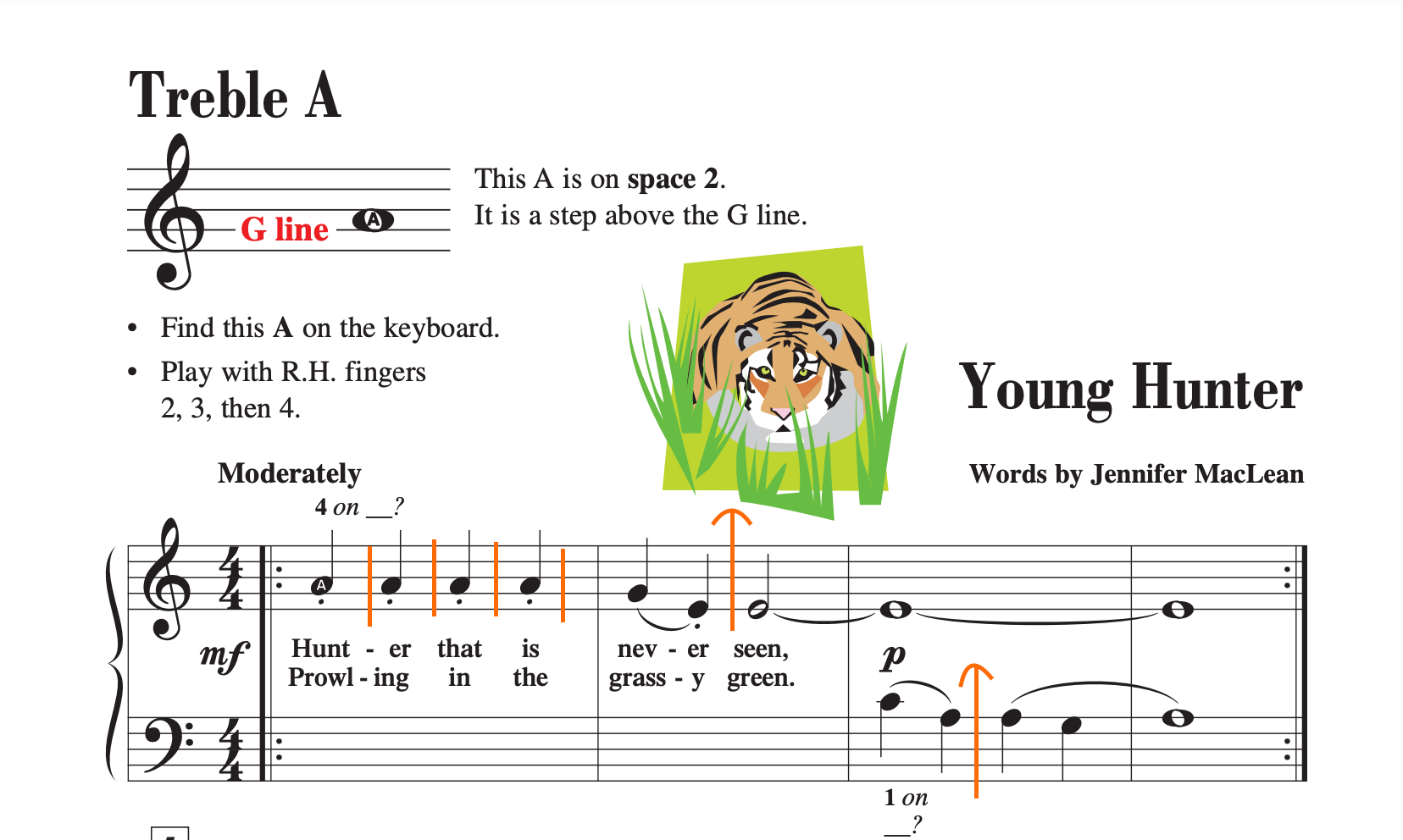
Practice tips: Playing through all of this would take between 5-10 minutes, which is a perfect daily practice goal! Warmup with your C scale 3 times with correct fingering, then play each line of Classical Dance 3 times, then play the Young Hunter line 3 times correctly and you’re done!
Preferred Books for Erin Students
Click to buy them here, and they’ll come right to your house! What could be easier?
BOOK TITLE
COMING SOON
Faber Piano Adventures
The 2nd Edition Level 1 Lesson Book introduces all the notes of the grand staff, elementary chord playing, and the concept of tonic and dominant notes. Students play in varied positions, reinforcing reading skills and recognizing intervals through the 5th. Musicianship is built with the introduction of legato and staccato touches. This level continues the interval orientation to reading across the full range of the Grand Staff. The 5-finger approach is presented here in a fresh, musically appealing way.
Piano Safari