

ARCT • Teachers’ Diploma (RCM) in-progress
Trained Music Together Teacher
Erin Plank (they/he) is a passionate young piano teacher. For their professional development, Erin received the highest exam scores in all of Canada last year for “Teaching Elementary Piano” with the RCM.
Erin’s main goal is to turn students into lifelong music lovers, not just pianists. I seek to provide them with the tools to practice efficiently at home, sight read a song at their friend’s piano, learn the melody to a song off the radio by ear, and nurture a technical foundation that lasts a lifetime so it’s “just like riding a bike” to play the piano. And even better, they’ll want to.
Get to know Erin…Beyond the Bio!
Hobbies: Piano, weightlifting, playing with my cat, and hanging out with friends
Musical influences: Ben Folds, Brad Mehldau, Edvard Grieg
Favourite food: Fried chicken sandwich
Least favourite food: snap peas, because I ate too many as a kid one time and threw up and now I dislike the smell
Favourite music: Romantic era piano music, Beach Boys and similar era music, math rock
Favourite song: “How Dare You Want More” by Bleachers
Favourite movie: Sing Street
Favouirite movie music: main theme for “Eternal Sunshine of the Spotless Mind” or anything Star Wars
Favourite musical theatre/opera: Wozzeck
Best quote from your teacher: “Don’t show the audience you messed up, they won’t know! Keep going!”
Favourite quote: “That’s what life is, Happy Sad”
Favourite book: Recursion by Blake Crouch
Best thing about teaching at ABC: Getting to reach and connect with so many lovely people!
Latest Homework from Erin
Is Erin Your Teacher?
Sign up now to get your weekly assignments delivered, and never lose your homework sheet again!
Thursday November 2nd Lessons – Erin P
Hi everyone! Glad to hear you all had a safe and fun Halloween :)
Grace
Sonatine Bureaucratique – m17-18 use finger 2 on the B whole note and finger 1 on the D# whole note for legato. Same thing when it appears in the recapitulation. Do more hands separate practice.
Liam
Sonatina by Clementi – nice work! This week we will add on the development section. At the top of page 2, when RH has the repetitive octaves, the LH is the melody and should be louder. Watch which notes are staccato.
*New* Heroic Symphony by Beethoven – page 1. This is in 2/4 (count 1 2 1 2) and also both clefs are treble. We wrote in the rhythms for 2 16th notes attached to an 8th note (“but-ter scotch”/1 e +). Ensure your RH is still the louder one.
Major triads from your chart. Bb, D and F. – do these both broken and solid with both hands separately. They will all use the same fingering, even though they are all built with different combinations of white and black notes. For broken triads, prioritize a consistent triplet feel over speed.
Jadon
Shadow Walker – this piece is in D minor, but uses it’s relative major (F) to create some major moments. Count yourself in, otherwise it’s hard to get into the feel when the first note is 3 beats long.
Gravity Falls theme – this is super exciting! Keep working at it. I’d love to hear.
Sara
Maple Leaf Rag – try tapping rhythms hands together. You can also simplify RH into just top notes to get hands together coordination. This is awesome!
*New* Gavotte – more RH solo practice especially in the B section. Remember to be aware of your phrases (especially since the 2 beat pickup shifts everything over 2 beats). When a phrase is ending, you can taper off slightly, and really announce when you are beginning a phrase. Nice work being aware of the 2 note slurs.
Yaya Sonhado – Listen to it. Counting and accenting beginning of phrase will be very important here, even though it doesn’t start on beat 1. The A section has a very subdude melancholy feel, but when the 16th notes come in, it gets a lot more whimsical and louder.
Technique – solid triads more practice. Try practicing them hands separate with a metronome. Hands together you can also try just going between root position and 1st inversion a bunch, and then between 1st and 2nd.
Marco
Totoro – all. You’re making great progress with this! Definitely begin putting more hands together. I know these triads can be tricky, but you actually *know* what triad you are playing, rather than just reading notes, and will pay off IMMENSELY! This piece alone has taught you so many chords, and your fingers how to play them! Keep it up:)
Lunar Eclipse – First 16 bars. Evenness is the goal here (think Goblin Party even 8th notes). Also the LH notes (whether they are above or below the RH) is the melody. Those should be the loudest notes.
Daniel
Entree in A Minor – the opening of this piece does not need to be so loud. Think harpsichord volume. Take a good look at the fingering too, there are more efficient ways to finger many places than what you played today.
Breezy – great job! Now let’s add in the remaining notes to make it truly hands together.
*New* Invention in C – hands separate first so you can hear what melody is being passed back and forth.
***App to check out*** “Chet” on the Apple store is an ear training app that also has a guitar riff section where it will play a small recognizable riff or bass line and you play it back on the onscreen keyboard. I think you’d really enjoy this.
Greta
New Shoes – nice! Your project this week is to imagine your LH has sticky glue on it and can only play the most beautiful legato rocking back and forth notes. There should be *no gap* between the LH notes. Like when someone’s walking, the first foot only lifts once the other has made contact with the ground. (be aware that sometimes when getting used to this feeling, we press hard into the keys which creates tension in the hand, watch out for this, and mentally relax your hand, or stop! Tension is bad).
*New* Raptors – page 1. Most all notes are staccato. The collection of 2 notes that have a slur marking over them are called 2 note slurs and require a specific down-up wrist movement to execute. It feels like bringing a yo-yo back up, or drawing a check mark. The down on the first note accents it, and the up creates a light staccato second note.
Saturday October 14 Lessons – Erin P
Maria
Home Run – opening line fix 1st and 3rd bar rhythm, the E with the accent should be the longest note creating a short-long-short rhythm. In lines 3 and 4, fix the syncopation. Your LH will always play on the strong beats (1 and 3), while your RH often plays on the “and of 2” so just before beat 3. Listen here if you need reminding.
Etude in D minor – great note reading! Bring out bottom note to create a kind of melody. If you play just the bottom notes throughout, you will be able to hear the harmonic progression. Try blocked practice, either blocking all 4 notes (with the correct hands playing their notes with correct fingering), or have the LH loudly play the bottom note and the RH take the other 3 notes quieter, so you can get used to how it sounds.
*New* Etude in D Major – Articulation is so important here, so go slow and be really picky. Hands separate practice. Notice the accents on the upbeat, and resist the urge to thump the thumb on the staccato notes. Your thumb is a very strong finger so it will take effort to play these light detached.
Shakira
My Invention – landmark notes practice. To practice this, you have choices:
1. with the piano (regardless of if it produces sound) locate the correct notes (F for LH. C with RH thumb and G with RH pinky) and then play it with the correct rhythms while saying the note names aloud.
2. look at the sheet music while sitting at a table. Place your hands approximately the same distance apart as they would be at the keyboard. LH middle finger (finger 3) should tap the table to do the F notes, and then RH thumb (finger 1) for C and RH pinky (finger 5) for G. The fleshy part of your finger is what is “playing” the key. Say the note names aloud as you play.
4four.io – This is an amazing website with rhythm and notation resources I love! This week, run this exercise to drill your landmark notes. (I wish I could make it only have the 3 notes we’re learning, but due to how you program in the note ranges, it will include a G just above your landmark F in the bass clef, as well as the F just below your landmark G in the treble clef, oh well. Bonus notes for your brain!)
The website also has a lovely “Gentle Start” button (on the homepage. Click the top left corner to get to the homepage) that will teach you note types gradually. I highly recommend you check that out :) digital resources are our friends! Website works great on mobile or desktop.
Noreet
The Spook LH – this piece is in D position and uses only your LH. Focus on keeping each of your fingers on one white key each and keeping them their so muscle memory can help you. The notes that have a beam connecting them are called 8th notes and 2 of them is equal to 1 quarter note. (If you lose the paper, print another here if possible)
Ferris Wheel – page 1 is your homework this week. Notice the phrase markings (curved lines) connecting some of the notes together even when they go from RH to LH? Create a smooth sound by using your walking legato fingers to eliminate any holes in the sound.
C Major Scale RH – This scale fingering I have taught you will stay the same even when you play scales starting on different notes.
123 12345 is the fingering. Your hand will look like a crab moving laterally up the keys, even you tuck your thumb under, it shouldn’t be a big movement and should feel easy. If the palm of your hand aches when you do this thumb under motion, you are too tense or staying in that cramped position for too long without opening up.
Gerardo
Home Run – great work! For the smooth section (lines 3 and 4) just focus on getting the LH super solid by itself so that when you layer the melody overtop the coordination is accurate. The RH syncopated notes will fall before the LH plays on beat 3.
*New* Infinity Session – This pieces LH movement is similar to the harmonic progression of The Swing, however this uses accidentals rather than a key signature. When doing the repeated notes with the LH thumb, be careful not to thud/play too loudly, especially since its on beats 2 and 3 (weak beats in 3/4 time).
Preferred Books for Erin Students
Click to buy them here, and they’ll come right to your house! What could be easier?
BOOK TITLE
COMING SOON
Faber Piano Adventures
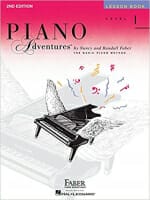
The 2nd Edition Level 1 Lesson Book introduces all the notes of the grand staff, elementary chord playing, and the concept of tonic and dominant notes. Students play in varied positions, reinforcing reading skills and recognizing intervals through the 5th. Musicianship is built with the introduction of legato and staccato touches. This level continues the interval orientation to reading across the full range of the Grand Staff. The 5-finger approach is presented here in a fresh, musically appealing way.
Piano Safari