
ARCT • Teachers’ Diploma (RCM) in-progress
Trained Music Together Teacher
Erin Plank (they/he) is a passionate young piano teacher. For their professional development, Erin received the highest exam scores in all of Canada last year for “Teaching Elementary Piano” with the RCM.
Erin’s main goal is to turn students into lifelong music lovers, not just pianists. I seek to provide them with the tools to practice efficiently at home, sight read a song at their friend’s piano, learn the melody to a song off the radio by ear, and nurture a technical foundation that lasts a lifetime so it’s “just like riding a bike” to play the piano. And even better, they’ll want to.
Get to know Erin…Beyond the Bio!
Hobbies: Piano, weightlifting, playing with my cat, and hanging out with friends
Musical influences: Ben Folds, Brad Mehldau, Edvard Grieg
Favourite food: Fried chicken sandwich
Least favourite food: snap peas, because I ate too many as a kid one time and threw up and now I dislike the smell
Favourite music: Romantic era piano music, Beach Boys and similar era music, math rock
Favourite song: “How Dare You Want More” by Bleachers
Favourite movie: Sing Street
Favouirite movie music: main theme for “Eternal Sunshine of the Spotless Mind” or anything Star Wars
Favourite musical theatre/opera: Wozzeck
Best quote from your teacher: “Don’t show the audience you messed up, they won’t know! Keep going!”
Favourite quote: “That’s what life is, Happy Sad”
Favourite book: Recursion by Blake Crouch
Best thing about teaching at ABC: Getting to reach and connect with so many lovely people!
Latest Homework from Erin
Is Erin Your Teacher?
Sign up now to get your weekly assignments delivered, and never lose your homework sheet again!
Thursday September 14 Lessons – Erin P
Another beautiful week, and cooler fall weather is approaching! Yippee! I appreciate all of you already working hard on your musical journeys :)
Grace
To a Wild Rose – Today we received clarity by playing the voices separate (especially m39 onwards). Be sure to ensure you’re using the best fingering for achieving maximum legato feel. Focus on not splitting the notes, even if it means you have to play a little louder, that’s okay. Aligning your wrist to the fingers that are actively playing will help with splitting.
Chopin Prelude – Nice! Practice leaps at m17 and 18 with LH to gain kinesthetic memory. Isolate and practice 3 against 2 rhythm in measure 18 slowly.
Liam
River Dance – really good reading! You now know how to play the entire piece. Begin adding the dramatic dynamic swells and careful articulation.
Aria by Mozart in Bastien lesson book – This piece is in Eb and uses familiar triad shapes in the RH.
Metronome chart – Begin at the slowest tempo so you can ensure a strong foundation of accuracy across the keys. Then, some keys will naturally be easier to play faster than others, so this chart will help to highlight which keys are your strengths and which are weaknesses. Place a check mark in the box when you can reliably perform that scale multiple times with 90-100% accuracy. Playing it once correctly at the speed does not equal a check mark, you just got lucky ;) You can tape it inside the front cover of a book if you prefer.
*NEXT POSSIBLE BOOK: Here’s some ideas, look over them, and we can make a plan together!*** Also, I will continue to supplement whatever book we choose with other fun resources and pieces.
I really am intrigued by Supersonics, but the ones at Liam’s level are behind their subscription model paywall unfortunately :(
Piano Pronto Movement 4
Wunderkeys Intermediate Pop Studies 2
RCM Level 2
Jadon
Your method book has been ordered and will arrive at L&M within the week and I will bring it next lesson.
Endgame m1-24 – Whenever there’s 8th note rests or any dotted rhythms, count carefully. Awesome job reading this today!
Katarina
Men from Mars – RH plays first line, then LH second. Both hands are in C position. 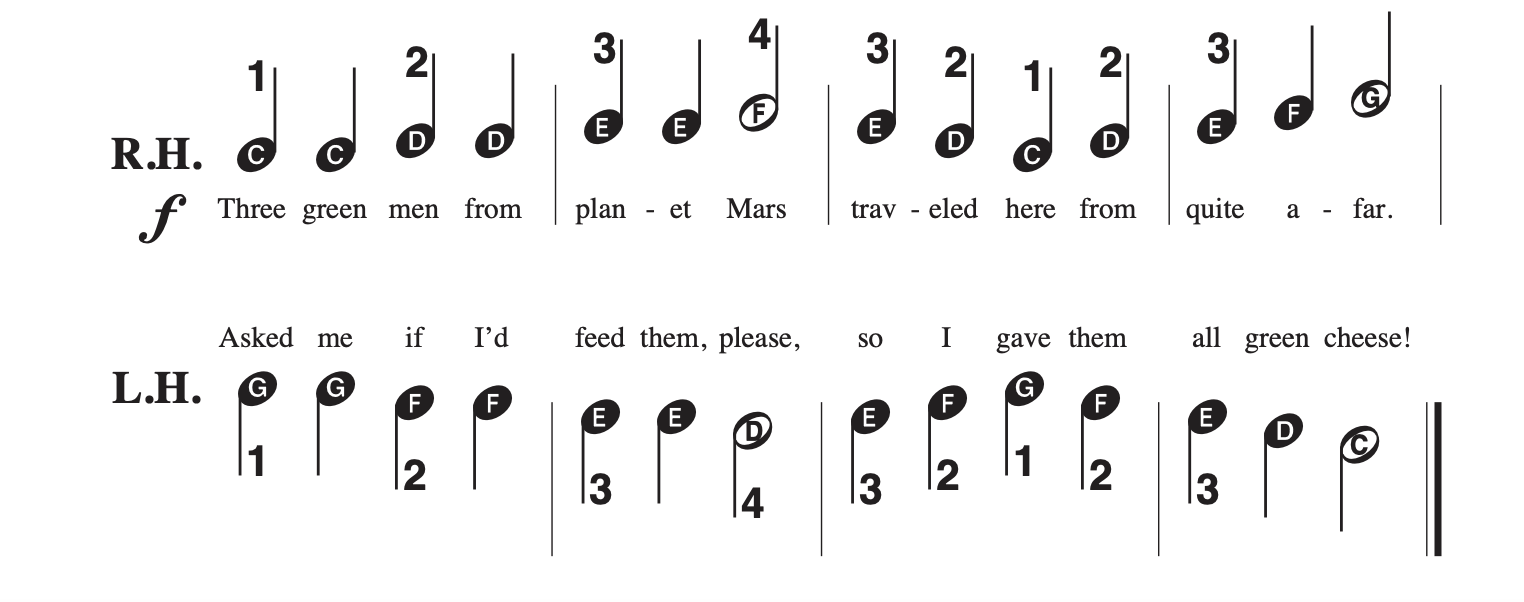
Ode to Joy – LH plays first line then RH plays second. Both hands are in C position. 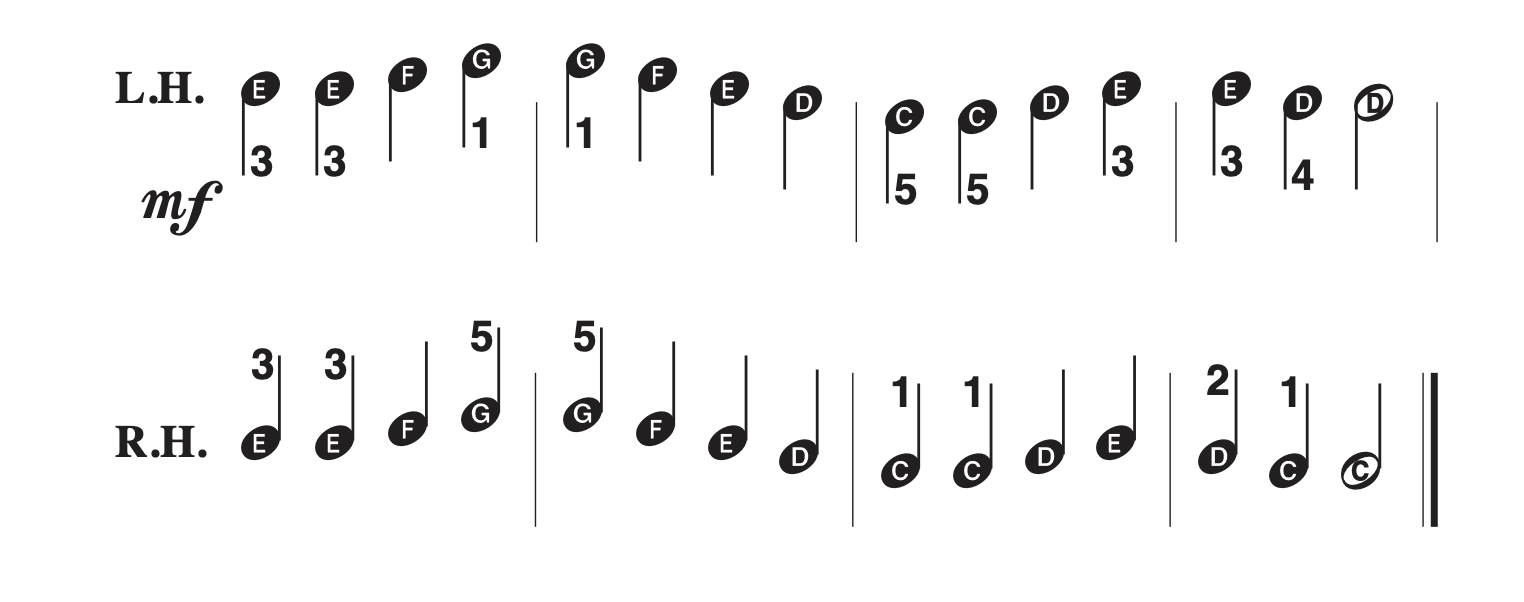
Parental involvement: Draw her attention to what direction the notes are going (up or down) and help to foster the connection between Up on page = Up in sound = to the right on the piano. Down on page = Down in sound = to the left on the piano.
Also, either you, or herself as she’s playing (or both!) can say the note names aloud to create the connection between keyboard note and note Name.
Play along tracks can be found here to accompany your playing and they have full orchestras! Super fun!
*I gave Marita a laminated Practice Prompts poster to put up near the piano for both the girls*
Sara
*New* Maple Leaf Rag – just LH. Practice this in small chunks and be sure your arm does not have unnecessary tension in it. Tempo is not important yet, neither is getting through all 3 pages. Instead, prioritize building fluency and comfort within small sections.
Air in B flat major – Notes that are stepwise can be played legato, but notes that skip or leap should be detached. Explore how this sounds on your harpsichord/clavichord setting!
Sonatina – as a whole, go slower. Choose a tempo slow enough that nothing trips you up so you can build fluency of getting in and out of trickier sections
Victress Session – Nice! Start thinking about if you’d like to use pedal throughout. Also try to play the RH louder than the rest so the melody floats on top.
Marco
What Lies Ahead m1-20. Great job playing hands together, I knew you could do it! Keep it up! I highly encourage you to see if you can learn past measure 20, because it’s a lot like the beginning, but with the hands rocking back and forth.
All grade 1 triads – these are all white key triads. Practice them solid AND broken. Your physical apprach is great – your hand should look like a crab walking up and down the keyboard.
*You don’t need to bring this technique chart to lessons. It should be accessible at home. You could tape it inside the cover of a book or just set it on the keyboard at home*
Daniel
*New* Final Countdown page 1 – this arrangement is in the real key of the recording, F# minor. But you know all your major scales so this key signature is just your A major scale. This does include rhythms that aren’t in your usual pieces, but you know how the song goes, so you can make the connection between the visual and how it sounds. If in doubt, think of 16th notes going throughout the entire piece, and compare them to the written rhythms to figure out what gets played, and what is silent.
Zum Gali Gali – nice! The legato lines (3 and 6) need extra attention. Be sure they are very smooth and syrupy, as the contrast between that and the short percussive staccato sections is part of this piece’s charm. Good evenness on the RH 8th notes.
Grade 2 harmonic and melodic minor scales – Dm, Em and Gm. Harmonic minors have the stereotypical “Egyptian sound” that is created by using a raised 7th (the 7th that belongs in the major scale). So a harmonic minor scale is a normal plain minor scale until the 7th note, which is the major 7th.
Melodic minor is the only scale that is different going up than going down. Going up both the 6th AND 7th are raised (like they would be in the major scale) and then going back down they are lowered (like in a normal plain minor scale). Remember to use your classic scale fingering!
Marita
*New* On Your Mark – This piece is in G minor. This is below your reading level so this is known as a “quick study” piece. Use a careful eye to notice patterns or familiar shapes that will make reading easier. Your goal is page 1 hands together SLOWLY next week.
*New* Crazy Comics m1-4 – Practice super slow and controlled hands together, as the RH needs some LH downbeats to bounce off of. The beginning of the 2nd measure can be thought of as L R L R Together, and they’re all 8th notes.
Atacama Desert – If you have access to this book this week, please practice this one. This piece is absolutely beautiful, I’d love to explore its full potential with you.
Saturday June 17 Lessons – Erin P
Jadon
Canon in C – Chord progression is I-V-vi-iii-IV-I-IV-V. Amazing work on the transposition.
O Canada – keep plugging away. Ensure the melody is at the forefront of the sound, no matter which hand is playing it. Maybe I can hear it next week before summer!
Grace
Feel better this week!
Explore Moment Musicale this week and focus on the different textures in the hands.
Marco
Mist – awesome work!! You know all the notes both hands. This week when you work on combining the hands, do it one phrase (4 bars a time). This will get you fluent quicker, as well as
help to shape the rise and fall of each phrase.
Going Undercover – sounds so great! Nice and steady. Now work on combining the two halves into a cool arrangement of your choice… maybe the first half is slow and moody and then second half takes off faster! Up to you!
Indiana Jones – woohoo! Keep up the hard work. Remember the Db chord is Db F Ab (it is not a D minor chord).
Julian
Snake Charmer – This piece uses part of the “harmonic minor” scale where one note is raised and it creates this “Egyptian” sound. Here that raised note is C#. There will be no B or C naturals in this whole piece. Notice the light and detached LH pattern, keep it light and bouncy. The RH gets louder as it gets higher and the constant louder and softer swelling illustrates the snake moving around, unsure of its next move.
Take Me Out to the Ball Game – good! I know that the position this piece is in is unlike how your book typically positions songs, but it is a good piece to break habits and realize that any finger can play any note and we don’t need to be stick in position based playing. Focus on keeping your fingers on the same keys throughout the piece so your brain can make the connection and play the appropriate note. Trust your skills:)
Preferred Books for Erin Students
Click to buy them here, and they’ll come right to your house! What could be easier?
BOOK TITLE
COMING SOON
Faber Piano Adventures
The 2nd Edition Level 1 Lesson Book introduces all the notes of the grand staff, elementary chord playing, and the concept of tonic and dominant notes. Students play in varied positions, reinforcing reading skills and recognizing intervals through the 5th. Musicianship is built with the introduction of legato and staccato touches. This level continues the interval orientation to reading across the full range of the Grand Staff. The 5-finger approach is presented here in a fresh, musically appealing way.
Piano Safari