

ARCT • Teachers’ Diploma (RCM) in-progress
Trained Music Together Teacher
Erin Plank (they/he) is a passionate young piano teacher. For their professional development, Erin received the highest exam scores in all of Canada last year for “Teaching Elementary Piano” with the RCM.
Erin’s main goal is to turn students into lifelong music lovers, not just pianists. I seek to provide them with the tools to practice efficiently at home, sight read a song at their friend’s piano, learn the melody to a song off the radio by ear, and nurture a technical foundation that lasts a lifetime so it’s “just like riding a bike” to play the piano. And even better, they’ll want to.
Get to know Erin…Beyond the Bio!
Hobbies: Piano, weightlifting, playing with my cat, and hanging out with friends
Musical influences: Ben Folds, Brad Mehldau, Edvard Grieg
Favourite food: Fried chicken sandwich
Least favourite food: snap peas, because I ate too many as a kid one time and threw up and now I dislike the smell
Favourite music: Romantic era piano music, Beach Boys and similar era music, math rock
Favourite song: “How Dare You Want More” by Bleachers
Favourite movie: Sing Street
Favouirite movie music: main theme for “Eternal Sunshine of the Spotless Mind” or anything Star Wars
Favourite musical theatre/opera: Wozzeck
Best quote from your teacher: “Don’t show the audience you messed up, they won’t know! Keep going!”
Favourite quote: “That’s what life is, Happy Sad”
Favourite book: Recursion by Blake Crouch
Best thing about teaching at ABC: Getting to reach and connect with so many lovely people!
Latest Homework from Erin
Is Erin Your Teacher?
Sign up now to get your weekly assignments delivered, and never lose your homework sheet again!
Thursday June 1 Lessons – Erin P
Have a great PA day tomorrow everyone! Soak up the sun :)
Liam
Major scales – articulated by 2 legato notes, then 2 staccato notes. Make sure you are doing 2 of each texture. Do any major scales you like in this manner and I’ll colour them in when you play them for me next week.
Imperial March – Today we learnt the B section, go very slowly and accurately for this. The LH is all D notes, so hands together shouldn’t be too tricky. Good reading today!
Stars and Stripes Forever – This piece has the alberti bass pattern in the LH, but now in the key of G. The melody has a pickup beat. Notice the accidentals in the RH and go slowly, I would do a day or two of hands seperate practice before going hands together.
Marita
Je Te Veux – Keep the C-EG waltz rhythm going throughout, ignore where the LH beat 1 rests are written. You can practice in 8 bar chunks like we did today, to get comfortable playing each phrase.
Swiss Cuckoo – Nice work! Practice this one in 2 chunks. For the last line where the phrases begin to overlap, isolate those to practice and notice that the other hand always interrupts the descending 5 note D scale on E. This is a fun video of a child playing this folk tune on a piccolo, it really brings out the singsongy children’s song nature of it!
Sara
Tempos of your pieces are all sounding great!
Arabesque – needs more drama in the dynamics. Today we made a story of 3 people sharing secrets and freaking out about the news when the piece grows to mf or forte. Think of this story in your mind and try to put it into the audience’s mind through dynamics and shaping. Start quietly as the begin to whisper the secret.
Sonatina – ensure you hit beat 1 of the second page in time by subdividing the triplets in your head for the long notes.
G Minor broken triad – experiment with playing it in different ways like solid first and then broken for each inversion, or playing the inversion and then the starting note of the next inversion and stopping on it.
Ear and sighteading – keep going with the home practice, it’s going great. Perhaps an entire session with Dad of doing just major 3rds vs perfect 4ths, and then a second session of just minor 3rds vs perfect 4ths would help build your confidence in these. Don’t forget to do descending ones too :)
Daniel
*New* On the Right Lines – ***DOWNLOAD HERE***. Count very carefully and go slowly! If the RH notes do not directly line up with the LH notes, ensure they are being played in between the beat! The LH groove of 1356 only happens in 2 different positions: G and C. You’ll notice if this paper had have been laid out with 4 bars each line instead of 3, you would see that it is a 4 bar pattern that repeats twice almost exactly the same (only the LH changes) and then a 3rd time completely to end the piece dramatically. Here is Christopher Norton himself playing it.
Crocodile Teeth – nice reading!! Proud. For the chromatic 16th note measure, make sure LH is playing F# up to A, and then RH is playing A# to C# to create a continuous chromatic line between the 2 hands. Be picky about which notes are staccato as well.
Harmonic minor scales – Great! Remember these are normal minor scales that use the notes of the major neighbour 3 doors away (3 half steps above), and what makes it a harmonic minor is the raised 7th note. For example: E minor will use G major’s notes, so EF#GABCDE, and then raise the 7th also, so D# instead of D. Practice them hands together this week please and I’ll show you melodic minor in person :)
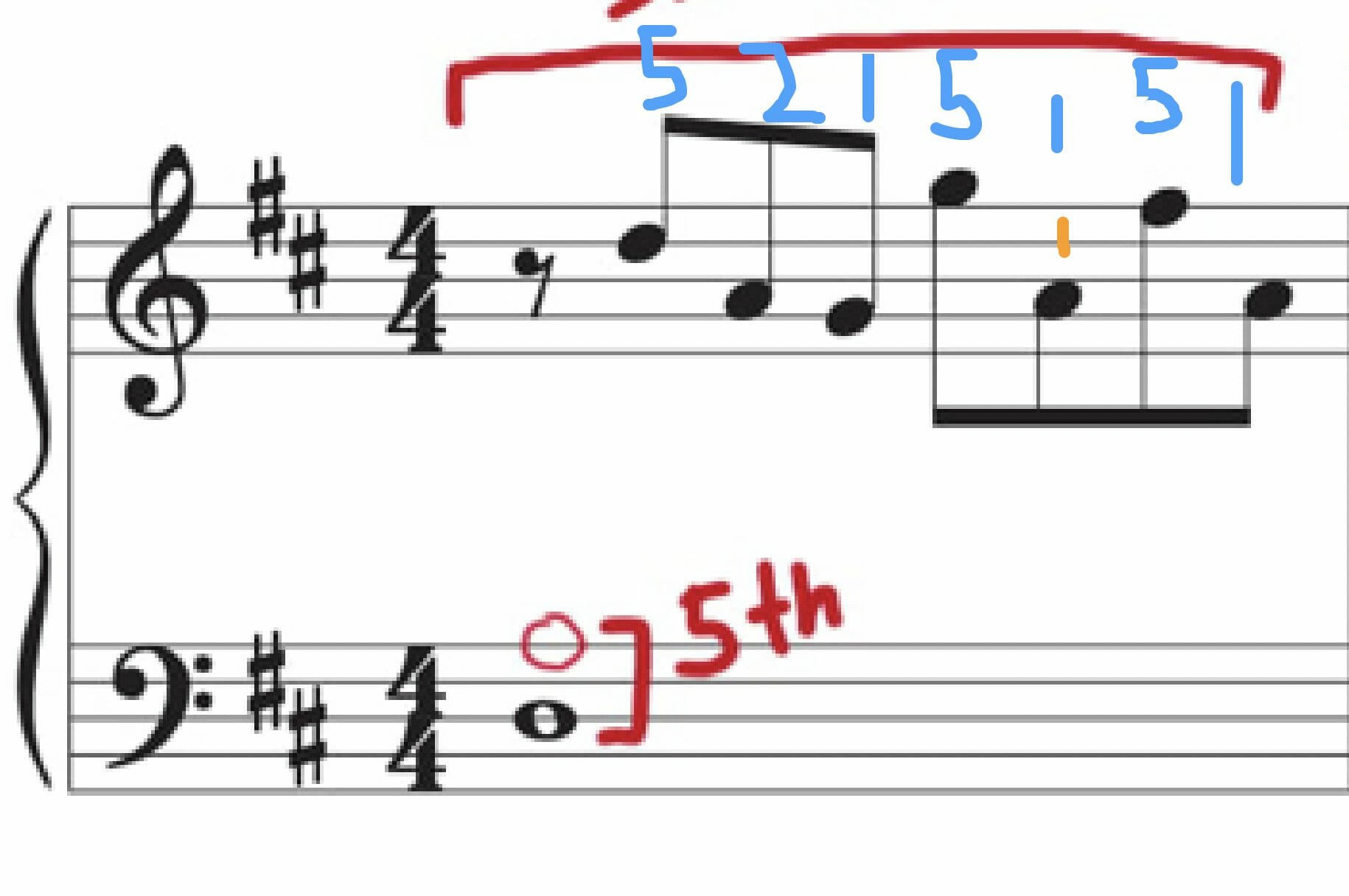
To the right is the opening riff to Sweet Child of Mine by Guns and Roses. This is not homework, just supplemental fun. The LH stays on a D power chord for 2 repetitions and then moves up to E power chord. Have fun!
Saturday April 22 Lessons – Erin P
Have a great week everyone :)
Daniel
Formula pattern in G major now too. Today you missed the first “up” motion after the first “in and out”, but great job otherwise. Note that when your hands are going apart the same fingers will be playing at the same time, and the thumbs will go under at the same time. This is helpful when beginning to deal with black keys.
Ditty of Yimeng Mountain. Keep plugging away with the correct fingering, I have circled it. It will really help! Nice job on the rolled chords, I look forward to hearing those last 8 bars next week.
Allegretto – Great articulations! Keep being picky with them. Isolate the B section like we did today and practice 2 bars at a time. Still play the A section, but spend more time isolating the B.
Isabella
Lemonade Stand. Count yourself in with 1-2-3. Remembering your rounded fingers means to play with the tip of the finger, like the first knuckle is standing up.
A major scale. This scale has 3 black keys. C#, F#, and G#. It uses the same fingering as your other scales: RH 123 12345. LH 54321 321.
Julian
Aardvark Boogie – great! Watch the individual notes that end each pattern and ensure you’re playing what’s written. Isolate lines 3 and 5 to practice by themselves until they are smooth.
Page 1 of Whirling Leaves – Play the melody louder than the repeating left hand pattern, as the lefthand part is the sound of the constant whirling leaves. Keep your wrist nice and loose like you’re painting circles with each phrase. Notice the C#s.
Preferred Books for Erin Students
Click to buy them here, and they’ll come right to your house! What could be easier?
BOOK TITLE
COMING SOON
Faber Piano Adventures

The 2nd Edition Level 1 Lesson Book introduces all the notes of the grand staff, elementary chord playing, and the concept of tonic and dominant notes. Students play in varied positions, reinforcing reading skills and recognizing intervals through the 5th. Musicianship is built with the introduction of legato and staccato touches. This level continues the interval orientation to reading across the full range of the Grand Staff. The 5-finger approach is presented here in a fresh, musically appealing way.
Piano Safari