

ARCT • Teachers’ Diploma (RCM) in-progress
Trained Music Together Teacher
Erin Plank (they/he) is a passionate young piano teacher. For their professional development, Erin received the highest exam scores in all of Canada last year for “Teaching Elementary Piano” with the RCM.
Erin’s main goal is to turn students into lifelong music lovers, not just pianists. I seek to provide them with the tools to practice efficiently at home, sight read a song at their friend’s piano, learn the melody to a song off the radio by ear, and nurture a technical foundation that lasts a lifetime so it’s “just like riding a bike” to play the piano. And even better, they’ll want to.
Get to know Erin…Beyond the Bio!
Hobbies: Piano, weightlifting, playing with my cat, and hanging out with friends
Musical influences: Ben Folds, Brad Mehldau, Edvard Grieg
Favourite food: Fried chicken sandwich
Least favourite food: snap peas, because I ate too many as a kid one time and threw up and now I dislike the smell
Favourite music: Romantic era piano music, Beach Boys and similar era music, math rock
Favourite song: “How Dare You Want More” by Bleachers
Favourite movie: Sing Street
Favouirite movie music: main theme for “Eternal Sunshine of the Spotless Mind” or anything Star Wars
Favourite musical theatre/opera: Wozzeck
Best quote from your teacher: “Don’t show the audience you messed up, they won’t know! Keep going!”
Favourite quote: “That’s what life is, Happy Sad”
Favourite book: Recursion by Blake Crouch
Best thing about teaching at ABC: Getting to reach and connect with so many lovely people!
Latest Homework from Erin
Is Erin Your Teacher?
Sign up now to get your weekly assignments delivered, and never lose your homework sheet again!
Thursday April 6 Lessons – Erin P
Enjoy the long weekend! Happy Easter <3
Liam
*New* March of the Triplets – Triplets are when you make 3 notes fit into one beat equally. All 3 of the triplet notes should be exactly equal. Learn the LH part seperate first and be sure to play it lighter than the RH melody, or it will drown it out! (3 notes vs one note!)
C Major and A minor broken triads. We are doing these this week to further cement your feel of triplets. Think “blue ber-ry” for each triad grouping. Remember to keep playing the same 3 notes in different orders and that the shape will change! CEG EGC GCE all make different shapes but they’re all C major.
Microjazz 1 – HT practice of the real song now. You’ve got the rhythm and articulation down, now put it together. Amazing determination on the ending too :)
In regards to Reign, we discussed the physical approach to playing long pieces without pain. The key points to take away are:
-Use arm weight. Leting your whole arm and gravity do the work (you just need strong fingers to land on)
-Relax your hand whenever possible. Do not keep it extended or contracted for longer than absolutely necessary
-For repeated notes, combine arm weight and a loose, knocking wrist (like knocking on a door)
-Channel your inner concert pianist that makes playing piano look like the easiest thing you’ve ever done. Be loosey goosey and have no tension in your body. My cues to look for are 1. Am I breathing? 2. Do my forearms feel tight? 3. Have my shoulders risen to my ears?. The answers should be Yes, No, No.
Fiona
*New* The Party Song – New concept = flats! This piece uses Eb and Bb. It has a bluesy sound and uses triad patterns. There are lots of skips so be sure to look for skips vs. steps. This is in thumbs share middle C position but the LH thumb does not need to play. This one is soooo fun to play, enjoy it! You can use this video to play along with if you need.
Sara
Keep plugging away at the 5/4 jazz tune. I can hear some of it next week:)
Sunset at the Beach – Louder louds especially at top of page 2, you can do a bigger mezzo forte as I think this is the climax of the piece prior to the coda. Larger, more dramatic ritarando at the ending.
Sonatina mvt 2 – no faster than 66 bpm. Fix high G in m.10. Ensure timing is accurate in m17 where I drew the bubbles by accenting the biggest bubble as that chord falls on beat 3. I think playing that one louder will help you get the timing accurate as well because it’s now a target both in timing and volume. This is sounding really great, trust the process of memorizing and go easy on yourself.
Clowns – no faster than 104 bpm for now. I would practice hands separate with the metronome until LH chords are in time at m13-16. Great work! Your dynamics have improved!
Sina
Movin’ On – This is a bluesy style piece that uses the minor and major version of chords to sound jazzy. It begins in G position with both hands, and later the LH will move to C position for 2 bars, but return. Things to pay attention to are: tied notes (when a curved line connects the same note, and adds the note values together, like whole note tied to quarter note = 5 counts), and flats/sharps/naturals.
*New* D Major scale. This scale has the same fingering as your other ones. RH 123 12345. LH 54321 321. It begins on D and has two black keys = F# and C#. You can refer to this chart for help. Great work today!
Saturday February 25 Lessons – Erin P
Enjoy the snow everyone! And stay safe out there <3 I appreciate everyone’s hard work.
Jadon
Lead sheets – Eerie Canal and Happy Birthday. Explore using the voicings of the chords where your LH moves as minimal as possible, while playing the melody with the RH. Experiment with different accompaniment rhythms, groups of notes.
Avatar – Begin from where we circled. Work out how the 6 RH notes align with the 3 LH notes in each beat. This section is in 9/8. Use your chord blocking technique from before to become familiar with the Eb-, Db, Ab, Eb- chord progression. You’ve got this!
Marco
All of Boat of Tai Lake. A lot of the sections are repetitions of earlier phrases so you know the whole piece! Practice will make this more comfortable. A great practice technique is to play each line multiple times until it is fluent and then move on to the next line. To cap off that practice session, connect the 2 lines together and play that. Rinse and repeat with another 2 lines the next practice session! This should all be hands together practice. Try to keep your eyes on the paper as much as you can.
Rhythm worksheet – This will benefit Never Gonna Give You Up as it is dotted quarter note practice. One hand is always a steady beat, and the other hand does the syncopated rhythms. Go very slow and don’t allow yourself to become frustrated, once you get it it will be so groovy and your brain will turn off :) Do both the ones I connected with lines so each hand gets a turn being the syncopated one.
D Major scale.
Daniel
Be sure to practice your technique (scales + triads) for the mock exam next week :) You’re going to be great!
Angelfish – evenness, no swinging of the 8th notes. Practice playing quieter to convey the emotion and mood of this piece more accurately.
Detectives – focus on dynamics this week! Each line has dynamic swells, go to the high point and then back off of it to create that sneaky feeling. Good job keeping up the staccato touch!
Ecossaise – I circled a part in the last line where you struggle to “land” the high F consistently, so practice getting in and out of this spot. I think this piece would benefit from a calmer approach and perhaps slightly slower tempo.
The Snake – Nice work! Start quieter so you have room to grow. Good fix on the last line.
Julian
Spring – Awesome job reading this one! You picked up all the details so quick! Make sure to keep paying attention to the staccato notes, and the 2 or 3 note slurs. If you need a reminder how it sounds, just look up Spring from the Four Seasons as it is so famous.
A Major scale. 3 sharps = C#, F#, G#. Same fingering as your other scales for both hands.
Preferred Books for Erin Students
Click to buy them here, and they’ll come right to your house! What could be easier?
BOOK TITLE
COMING SOON
Faber Piano Adventures
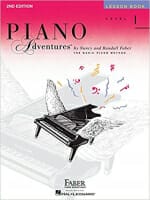
The 2nd Edition Level 1 Lesson Book introduces all the notes of the grand staff, elementary chord playing, and the concept of tonic and dominant notes. Students play in varied positions, reinforcing reading skills and recognizing intervals through the 5th. Musicianship is built with the introduction of legato and staccato touches. This level continues the interval orientation to reading across the full range of the Grand Staff. The 5-finger approach is presented here in a fresh, musically appealing way.
Piano Safari