ARCT • Teachers’ Diploma (RCM) in-progress
Trained Music Together Teacher
Erin Plank (they/he) is a passionate young piano teacher. For their professional development, Erin received the highest exam scores in all of Canada last year for “Teaching Elementary Piano” with the RCM.
Erin’s main goal is to turn students into lifelong music lovers, not just pianists. I seek to provide them with the tools to practice efficiently at home, sight read a song at their friend’s piano, learn the melody to a song off the radio by ear, and nurture a technical foundation that lasts a lifetime so it’s “just like riding a bike” to play the piano. And even better, they’ll want to.
Get to know Erin…Beyond the Bio!
Hobbies: Piano, weightlifting, playing with my cat, and hanging out with friends
Musical influences: Ben Folds, Brad Mehldau, Edvard Grieg
Favourite food: Fried chicken sandwich
Least favourite food: snap peas, because I ate too many as a kid one time and threw up and now I dislike the smell
Favourite music: Romantic era piano music, Beach Boys and similar era music, math rock
Favourite song: “How Dare You Want More” by Bleachers
Favourite movie: Sing Street
Favouirite movie music: main theme for “Eternal Sunshine of the Spotless Mind” or anything Star Wars
Favourite musical theatre/opera: Wozzeck
Best quote from your teacher: “Don’t show the audience you messed up, they won’t know! Keep going!”
Favourite quote: “That’s what life is, Happy Sad”
Favourite book: Recursion by Blake Crouch
Best thing about teaching at ABC: Getting to reach and connect with so many lovely people!
Latest Homework from Erin
Is Erin Your Teacher?
Sign up now to get your weekly assignments delivered, and never lose your homework sheet again!
Thursday May 2nd Lessons – Erin P
It was a fun candy filled day today! Yay!
Liam, Sara, Marco and Danny you will be performing this Sunday – see you then!
Katarina and Marita – we implore you to come cheer on and be inspired by your peers! There will be guitar, drums and violin students there too!
Liam
Sonatina in G major – Really nice! I liked your dynamics and your balance between hands is really improving. Memorize now.
Walk the Talk – Beauty! Think dynamics dynamics dynamics these next few days so you can really wow Sunday’s audience. Memorize now.
Minuet in G – Big improvement! Great work. Let’s not do the ornaments. Memorize now.
Witches and Wizards – We did it to 108bpm and it was awesome! The only part you tend to miss an 8th note is transitioning out of the middle part and into the descending RH scale. Watch the B and A in the LH at the very end!
Prelude VII – 1. Pedal – you can practice the pedal with just the LH to get it easier, think as soon as your LH pinky plays, raise and lower the pedal. Try and do it only enough that the sound breaks, and not big enough that the actual pedal mechanism makes a clunk. 2. Rhythm of dotted half note and then quarter note, just play on beats 1 and 4. 3. Fix the RH rhythm at the end, quarter note needs its full time. Listen here.
***Technique – Today we did a candy challenge by reviewing alllll the technical requirements. The only things that needed work and did Not earn you candy were as follows:
F major scale – under tempo. Work to get to 8th notes at 80 bpm.
B minor harmonic scale – fingering was goofing you up. LH is 4321 4321. RH is normal.
D formula pattern – fingering was messing you up
G minor triads
Katarina
Today we played C and G major scales a bunch AND you learnt the F major scale. It is all white keys except for Bb. LH is normal fingering. RH goes 1234 1234.
We sightread a ton of stuff together too.
Next week we’ll play the game that concludes the current unit in your Wunderkeys book.
Marita
Today we played a jazzy blues piece in a high level piano adventures book.
You also played ALL 12 MAJOR SCALES!!! And won candy because of it. Congrats!
Sara
Air in Bb – Great! I would start slightly louder so when it comes back, you can play it softer. “Go to” the bubbles in the A section a bit more (grow to them).
Sonatina in C – Yes repeats and yes dynamic variation. Isolate beat 3 of m7 (where the trill is, and where I wrote beat to beat) to ensure you are exiting the trill at the same time with both hands. Balance is sounding a lot better.
Nighttime – I’ll hear next week.
Cloud Dance – Great. Find a way to make the opening line and final line different dynamics, one is mp, one is p.
Ballade – LOVELY! You also were able to self reflect and course correct your own balance while playing! :)
Technique is all great, you got candy for everything today because it was all accurate and you could play it immediately after I specified what to do.
https://www.rhythmrandomizer.com?s=34020608403010205060d0e10
Marco
Minuet – LOVE the steady and slow work you’ve put in! SO helpful. This week, when you get to line 2, remember that the quarter notes are still the SAME tempo, just now the RH is playing 8th notes. It will switch from walk-walk-walk to run-ning-run-ning-run-ning to fill one measure. It is only going to go about 10 bpm faster than you are currently playing so don’t stress.
The Snake – I’ll hear this next week! eliminate hesitation between when one hand stops and the other ends. LH line I circled some notes you forgot to play.
Song of the Dark Woods – I’ll hear this next week! LH fingering in the 3rd line is necessary for legato. Do not bump the last LH note of each line, float off beautifully. Start quiet so you have somewhere to grow.
Morning Fanfare – Great job! As far as the dotted rhythm goes, you eliminated it from over half of the LH spots! Yay! Remember the 16th note in the RH is ALWAYS alone.
Superman – Watch this video of me to see the one thing you need to practice these next few days, otherwise you’ve got this!
*** Technique – Great! Today the things that did NOT earn you candy and need more practice are:
F major scale – LH is normal fingering (Bb, otherwise all white keys), RH is 1234 1234.
E minor harmonic scale – Remember what it’s relative major is = G major. Therefore, always F#. Then we raise the 7th note to make it harmonic and snake sounding.
D minor natural scale – Remember what it’s relative major is = F major. Therefore this is just an F major scale starting on D. DEFBA Bb CD.
Daniel
Periwinkle – OH heck yeah! This is great. Be a little more dramatic with the getting quieter each time dynamics, and then SPOOK the audience with the big “rest, DA DUM!” ending,
Breezy – I’ll hear this next week. Attention to detail.
Entree – Nice job with everything, just be sure you are not late to LH quarter notes when doing the trill, or the final repeated RH notes. LH must always be on time.
The Wind – Nice job getting the LH fingering. For the last line, each hand and each clump of 8th notes is in a different octave, they do not “overlap” or “repeat” each others positions.
*** Technique – Great! Big improvement! Today the only things that did NOT earn you candy and need more practice are:
Bb major scale – fingering. RH is 4123 1234. LH is 321 4321 3. Cues are Don’t start with thumbs, fingers 3 and 4 on the black keys.
D minor melodic scale – always has a minor 3rd, but the top portion of the scale going UP will be major, and then get lowered when going DOWN.
Greta
Minuet in F – Nice! This week, play through it once and then lightly circle all the places that you have to hesitate to find the next note. Then, just practice going between those 2 or 3 notes without hesitating. Loop it multiple times until it’s easy. Then do that to the other circles.
Follow the Leader – I’ll hear this next week.
Red Satin Jazz – This week let’s pay close attention to the rests. I like to see what note IS played when my other hands rest begins, and coordinate it like “when I play that note, I stop holding down this note”. Keep your eyes on the page.
Detectives – Nice reading! Practice the opening line RH by itself. 42 13 42 35. You can also practice doing this on your lap/desk and you want the two notes to go down at the same time, not “split”.
***Technique – Today you did great in the candy challenge. The things you did NOT earn candy for and need more practice are the minor scales. Before playing all scales, think, what black keys will I play?
A minor natural and harmonic – relative major is C. Natural will be C scale notes, but starting on A. harmonic will be that PLUS a raised 7th note.
D minor natural and harmonic – relative major is F. Natural will be F scale notes (including Bb), but starting on D. harmonic will be that PLUS raised 7th.
E minor natural and harmonic – relative major is G. Natural will be G scale notes (including F#), but starting on E. harmonic will be that PLUS raised 7th.
Saturday April 13 Lessons – Erin P
Everyone’s sounding great!! I love getting to hear about all your week’s, brings a big smile to face working with all of you <3
Hakim
*New* Lost Woods – get used to playing the melody with just the RH, I wrote in the fingering I like to use, but you had some pretty smart fingering choices that involved crossing over or under that I liked – once you finalize which fingering you want to use, write it in.
Then get used to playing the LH by itself. The first half is F and a C major inversion. The second half is D minor-G7-C-A minor in a different rhythm. Go as slow as you need to to change positions without a big coffee break.
Keep your C major triads, C and G major scale, and A and E minor scales fluent.
Maria
Viva la Vida – use a click track or metronome at 70 and feel two clicks per measure. Your tendency is to rush at the chorus. Remember to vary the dynamics so it doesn’t sound monotone.
*New* Somersault King – this piece uses various articulations and triplets to create a happy go lucky mood. The trickiest measure is the one that alternates between triplets and plain 8th notes – as long as you keep a steady pulse in the LH, you will have no trouble alternating between the two. think “Bee-tho-ven Ap-ple Bee-tho-ven Ap-ple”. The form of the piece is: play from beginning to end, go back to beginning and continue until the sign that looks like a bullseye, which teleports you to the other bullseye symbol (called the coda) which is a special outro.
Shakira
Today we experimented with white key triad patterns up and down the keyboard with both hands which you had great success with.
We also tried alternating between notes a step apart which also went well.
Due to this, I think any note inaccuracies while reading are less about you physically struggling to execute the notes, and more about lacking a physical connection of what the note looks like on the page and where it is on the keyboard. Let’s start to say the note names aloud as we play them to help strengthen those connections in your brain.
Noreet
*New* Runaway Rabbit – after just one listen you were able to sing this piece perfectly!! Sing along the lyrics on pitch as you play. You noticed that the first line of the piece has a 2 bar phrase that is played and then repeated 1 white note higher. You also noticed that the second half of the piece has the LH copy that same opening melody, just with a slightly different ending (I wrote “different” on that measure). Be sure to do the big contrasting dynamics at the end for drama!
*New Scale* G Major. Same fingering as your C scale, just it starts on G and plays F# instead of plain old F.
C Major triads – today you stated that it’s a big help when you say the note names you need to find. Great idea! Sing CEG, EGC, GCE, CEG. You can play them solid (all at once) or broken (crab style).
Preferred Books for Erin Students
Click to buy them here, and they’ll come right to your house! What could be easier?
BOOK TITLE
COMING SOON
Faber Piano Adventures

The 2nd Edition Level 1 Lesson Book introduces all the notes of the grand staff, elementary chord playing, and the concept of tonic and dominant notes. Students play in varied positions, reinforcing reading skills and recognizing intervals through the 5th. Musicianship is built with the introduction of legato and staccato touches. This level continues the interval orientation to reading across the full range of the Grand Staff. The 5-finger approach is presented here in a fresh, musically appealing way.
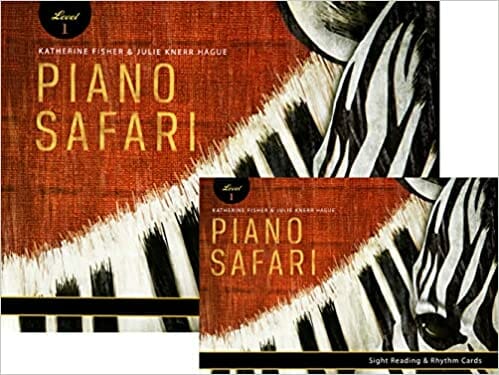
Piano Safari