

ARCT • Teachers’ Diploma (RCM) in-progress
Trained Music Together Teacher
Erin Plank (they/he) is a passionate young piano teacher. For their professional development, Erin received the highest exam scores in all of Canada last year for “Teaching Elementary Piano” with the RCM.
Erin’s main goal is to turn students into lifelong music lovers, not just pianists. I seek to provide them with the tools to practice efficiently at home, sight read a song at their friend’s piano, learn the melody to a song off the radio by ear, and nurture a technical foundation that lasts a lifetime so it’s “just like riding a bike” to play the piano. And even better, they’ll want to.
Get to know Erin…Beyond the Bio!
Hobbies: Piano, weightlifting, playing with my cat, and hanging out with friends
Musical influences: Ben Folds, Brad Mehldau, Edvard Grieg
Favourite food: Fried chicken sandwich
Least favourite food: snap peas, because I ate too many as a kid one time and threw up and now I dislike the smell
Favourite music: Romantic era piano music, Beach Boys and similar era music, math rock
Favourite song: “How Dare You Want More” by Bleachers
Favourite movie: Sing Street
Favouirite movie music: main theme for “Eternal Sunshine of the Spotless Mind” or anything Star Wars
Favourite musical theatre/opera: Wozzeck
Best quote from your teacher: “Don’t show the audience you messed up, they won’t know! Keep going!”
Favourite quote: “That’s what life is, Happy Sad”
Favourite book: Recursion by Blake Crouch
Best thing about teaching at ABC: Getting to reach and connect with so many lovely people!
Latest Homework from Erin
Is Erin Your Teacher?
Sign up now to get your weekly assignments delivered, and never lose your homework sheet again!
Thursday February 2 Lessons – Erin P
Hi everyone! Happy February :)
Liam
*New Piece* Major-Minor Bop. Ensure you play very staccato, but not with a tense arm. The RH will be finger staccato which feels like scratching a spot of the keys, or your fingers runnin gon a treadmill. The LH will be doing wrist staccato which involves strong finger joints, and a fluid wrist like when you knock on someone’s door.
Continue work on Going Undercover. Some ideas could be: getting it faster. Creating your own arrangement (you wanted to slow down during the 2nd line and then speed up line 3 to the end – cool!). Transposing to another key, maybe G? Pick something like this and work towards it this week.
Great job with Gb Major scale! Your next challenge is doing LH 8th notes, RH quarter notes on C major. You can do it the other way around, now work on this! Be sure to start with hands 2 octaves apart.
Fiona
Lightly Row hands together. Think of this like 4 little songs put together for practice sake. Treat each line like one of our sightreading flashcards and work to make it the best you possibly can during each practice session. You *know* how to play this entire song perfect, with a little practice you can connect the puzzle pieces!
*New Piece* first 12 bars of Forest Song. Awesome sightreading!! This song is in D position, and therefore is D minor. I really like this piece (I remember learning it myself!) and I think you’ll have a great time making beautiful music out of it. The new concept here is half rests, so be sure to count 2 beats of silence for each half rest.
Keep playing your C and G major scales.
Marita
Minuet – first half HT now, second half HS. Really good work on the notes here!
Lunar Eclipse – be confident! You play this way better than you think you do. Give the ending section a little more love and you’ll have an awesome piece! Have fun adding the sustain pedal.
Young Ludwig – Trust the process with this one, the reason pieces like this where the hands copy each other are introduced this early is so it’s not so hard and scary when you get to harder music that includes it. Music almost always will have melodies that cascade over each other, and it’s better to learn the coordination necessary for this with easier notes than being overwhelmed later on. You’ve got this one!!!
I wrote the keys you should practice your scales and triads in in the front of your repertoire book :)
Sara
Chinese Kites – awesome notes and rhythms!! Woohoo! Now let’s add in the articulations. Pay careful attention to the staccatos and the slurs.
Harlequinade – Really good attention to detail! I like your lively, bouncy touch! Great fix on the evenness. You can start thinking of what story this piece brings to mind, and therefore how you want to shape it further dynamics wise.
Sonatina Mvt. 2. Nice! Keep plugging away at this one to get it even more fluent, but awesome fixes on the legato and the dynamics! You made very attentive observations of the performance we listened to of this one, I think you CAN do better dynamics than that YouTube lady did! Let’s shoot for the moon with beautiful dynamics in this tender Adagio :)
Next week I will look at your technical exercises (scales, triads etc) and look at your physical approach to it as well.
Sina
*New Piece* Boogie Boarding. This piece introduces the idea of broken and blocked/solid triads. It uses C Major. Be sure to count accurately, particularly to notice the tied quarter notes on beats 4+1. Pay attention to the dynamics in this one since the notes are objectively not that tricky. Start loud, line 3 get a little quieter and then crescendo to a big finish!
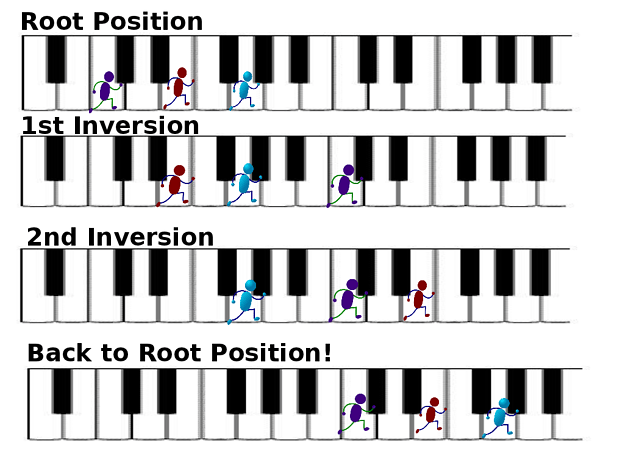
*New Technical Exercise* C Major triads. A triad exercise is moving through all the different “inversions” of a chord. In this case we are doing C Major, like the diagram below shows. This is CEG, EGC, GCE, then CEG again. Same notes just in different orders. For the RH I like using fingers, 135, 125 (because of the larger gap between notes), 135, 135. LH would be 531, 531, 521 (because of the larger gap between notes) 531. Practice slow and steady, imagine your hand is a crab walking up the keyboard.
December 18 Make-up lessons – Erin P
Marco, Daniel, Julian:
Marco
Keep working on your C and also G major one octave HS scales :) RH fingering is 12312345 and LH is 54321 321 for both. G major is all white keys except for F#. Focus on having as little movement in your arm as you tuck your thumb under. Pretend that tucking your thumb under is the easiest thing in the world and that you can do it without anyone even noticing. A relaxed arm and wrist will achieve this.
Daniel
Keep working on your C, F, G major triads. A broken triad is a lateral movement like a crab where your fingers only play the triad notes (1,3,5) over and over. for example: CEG EGC GCE then CEG. You should use the most ergonomic fingering which is RH: 135 125 135 135. LH it’s 531 531 521 531. The same fingering is used for the solid version also – it is played in a “quarter note, quarter note rest” alternating pattern.
Julian
I’ll hear your pieces on Thursday:)
Today we did note reading, counting, and 5note scales. Great job!
You know your C major one octave scale fingering really well! This winter break, you can take that same fingering and learn the G major scale. It is all white notes except for F#. RH 123 12345. LH 54321 321.
Preferred Books for Erin Students
Click to buy them here, and they’ll come right to your house! What could be easier?
BOOK TITLE
COMING SOON
Faber Piano Adventures
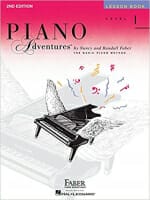
The 2nd Edition Level 1 Lesson Book introduces all the notes of the grand staff, elementary chord playing, and the concept of tonic and dominant notes. Students play in varied positions, reinforcing reading skills and recognizing intervals through the 5th. Musicianship is built with the introduction of legato and staccato touches. This level continues the interval orientation to reading across the full range of the Grand Staff. The 5-finger approach is presented here in a fresh, musically appealing way.
Piano Safari