

ARCT • Teachers’ Diploma (RCM) in-progress
Trained Music Together Teacher
Erin Plank (they/he) is a passionate young piano teacher. For their professional development, Erin received the highest exam scores in all of Canada last year for “Teaching Elementary Piano” with the RCM.
Erin’s main goal is to turn students into lifelong music lovers, not just pianists. I seek to provide them with the tools to practice efficiently at home, sight read a song at their friend’s piano, learn the melody to a song off the radio by ear, and nurture a technical foundation that lasts a lifetime so it’s “just like riding a bike” to play the piano. And even better, they’ll want to.
Get to know Erin…Beyond the Bio!
Hobbies: Piano, weightlifting, playing with my cat, and hanging out with friends
Musical influences: Ben Folds, Brad Mehldau, Edvard Grieg
Favourite food: Fried chicken sandwich
Least favourite food: snap peas, because I ate too many as a kid one time and threw up and now I dislike the smell
Favourite music: Romantic era piano music, Beach Boys and similar era music, math rock
Favourite song: “How Dare You Want More” by Bleachers
Favourite movie: Sing Street
Favouirite movie music: main theme for “Eternal Sunshine of the Spotless Mind” or anything Star Wars
Favourite musical theatre/opera: Wozzeck
Best quote from your teacher: “Don’t show the audience you messed up, they won’t know! Keep going!”
Favourite quote: “That’s what life is, Happy Sad”
Favourite book: Recursion by Blake Crouch
Best thing about teaching at ABC: Getting to reach and connect with so many lovely people!
Latest Homework from Erin
Is Erin Your Teacher?
Sign up now to get your weekly assignments delivered, and never lose your homework sheet again!
Thursday November 10 Lessons – Erin
Hello everyone :) Thanks for your time spent practicing!
Fiona
You’re working on Panda Party. The most important part of this piece is hearing the difference between the staccato and the legato. Be very picky with this! On the first note that is legato you can dip your wrist down into it, and then float your wrist up on the second legato note.
Have a great trip this weekend and then get some practicing in each weekday until I see you again :)
Marita
You’re working on the first 8 measures of Song of the Dark Woods. Notice how the LH D is tied for 3 whole measures, just play it once then hold it down. Use the written fingering for the top LH notes, the finger 2 plays the Bb like we did today, think of it like pivoting and not like stretching. The fingering for the RH melody is there to help you, use the 1-3-1 like they say. Start quiet and follow the shape of the phrase = louder as it gets higher and then quieter as it lowers back down.
Great job figuring out those Christmas tunes by ear today! I will have Christmas pieces for you next week.
Sara
Great job with the Clair de Lune pop arrangement, just hold the LH half notes longer so we get to hear their sound mix with the RH notes.
For Arctic Voices, I still would like the opening LH chords to be thicker and take longer. Also where it says subito pianissimo that means *suddenly* quiet, work to add this in.
Shift your focus to Arabesque this week before we record it. Keep working to have the LH be quiet like a backing track in the A section. Think about squishing the keys rather than like hitting them, and maybe that will help. I’m excited to hear it again next week.
For the Coraline song, do whatever you like! It’s for your enjoyment so explore the bass notes and then the orange ones I highlighted that are the singers. Note the key signature, it has Cb.
Julian
You’re working on the Elf’s Silver Hammer. This piece is very percussive, like we are making the sounds that the Elf’s hammer makes as he does blacksmith stuff. Therefore our notes are light and staccato, or accented and strong. You did a great job playing this as a duet with me today while you learnt the LH. Learn the hands seperate first and then put them together. Make sure when you play two notes at the same time, that they are played at the exact same time and they don’t split.
Have fun putting Jingle Bells in different keys!
Sina
You’re working on French Lullaby. The hands move in parallel (same) motion. Be aware of the form and follow the red text – it goes beginning to end, back to the beginning and play until Fine (end of line 2).
Really good job naming the landmark notes today!
See if you can figure out Jingle Bells by ear starting on E and only using the C 5-finger scale notes this week.
*** As we reach the end of his method book, I would like to move into this book next. ***
October 1 Saturday Lessons – Erin P
Happy October 1st! 30 sleeps until Halloween!
Jadon
You’re continuing to work on My Heart Will Go On. Isolate measure 5 and practice it in time 5 times before going to work on other sections. Same with measure 25 on page 2 to get used to tucking the thumb under. I really like how you worked stuff out on your own and then came to me with questions – an excellent habit!
You’re also working on B Major scales. Practice these hands seperate with correct fingering. RH is 123 1234 5. LH is 4321 4321. Thumbs on the white keys (except to begin the LH). Play these legato (smooth) and staccato (detached). You can play these over any drumbeat on Youtube too, to make it more stimulating.
Daily practice: 20-25 minutes
How parents can support: Ask to hear his scales. Do they sound even, like every finger is just as strong as the others?
Grace
Missed you this week :) Excited to resume our work on Playful Snakelets next week. Take care.
Marco
You’re working on Choose Your Own Song. This song as written is in D minor, if you want it to be in D Major – add sharps to Every F note in the piece. Then circle the lyrics you’d like to use and practice it while singing along!
You’re also working on F Major and minor pentascales. The key of F has Bb in it always. When it’s minor you add Ab also, you could tell that with your ear! Keep your hand “in” the keys (closer to the board at the back of the keys) so that you don’t have to reach awkwardly whenever you encounter a black key. Play these hands separate, staccato and legato.
When you review through Haunted Harp, always play it with dynamics ! It’s not spooky if it’s monotone, the audience knows what to expect. Sneak up on them instead by starting very quietly!
Daily practice: 20-25 minutes
Ways parents can support: For the Choose Your Own song, if he chooses to make it major, remind him that he will have to add sharps to every F note!
Daniel
You’re working to compose “Jimmy the Toaster’s” Jig. Use any white notes you want with the written rhythms to create your own Irish-style jig. The first two bars that they wrote for us can be inspiration. I’m so excited to hear the jig!
You’re also continuing to work on Morning Greeting hands together. Great, great work on the consistent fingering and the syncopation!
You’re also working on B Major scales. The RH uses 123 1234 5 fingering. The LH uses 4321 4321. Thumbs on the white keys (except to begin the LH). Play these legato (smooth) and staccato (detached). You can play these over any drumbeat on Youtube too, to make it more stimulating.
Daily practice: 25-30 minutes
Ways parents can support: He may need some reminders about how the Jig worksheet works. The instructions explain themselves well, but he may need a refresher. Remind him that the note choosing process will be improv, but then you’ll write it down, and it will no longer be improv – but a composition!
Isabella
You’re working on I Won A Prize. Great job sight reading the notes today. The hollow notes with stems are worth 2 beats (they’re called half notes because they take up half the bar) and the big round one with no stem is 4 beats (a whole note). For these longer notes we imagine someone is singing and they’re continuing to sing the same note, so we don’t press the note again, we just hold it down. Play through this piece counting 1 2 3 4 so you can be sure you’re getting all 4 beats. Don’t forget to fill in the blanks of the lyrics and the title !
You also learnt what “magic finger circles” are. This is when you press the tip of each of your fingers into your thumb and make sure your last knuckle joint is staying strong and round – to make a circle! It shouldn’t collapse (and make a shadow puppet mouth) but it might for some fingers because they’re not used to having to be strong and tall! This is a workout for your fingers :) You can use these strong round fingers when doing the In and Out exercise I showed you.
Daily practice: 10-15 minutes
Ways parents can support: Encourage her to fill in the blanks on her I Won A Prize song and play it for you. You could also sing the words, or count 1234 along with her playing. Ask what magic finger circles could possibly be! If either parent has short fingernails, give it a try! Can you make circles with all 4 fingers and the thumb? Or do your little finger joints collapse?
Shelton
It was lovely to meet you today! Your homework is to teach your Mom how to sit at the piano properly. This looks like feet flat on the ground (strong tree roots in the ground) and nice proud posture. Our shoulders should be relaxed. Our forearms should be parallel to the ground, and our wrist relaxed and parallel to the ground. Our fingers curve nicely so our fingerTIPS touch the piano. There is a little hamster that lives underneath each of our hands, and we can’t have our fingers or wrist collapse because we’d squish him!
You’re also working on Charlie Chipmunk. Play this song on the black keys so you don’t forget it! I want to duet again with you next week.
Whenever you’re bored at school you can give your fingers a workout with the “magic finger circles”. This trains that tiny last finger joint to be nice and strong and stay rounded. Press each finger (including the pinky) into your thumb and make nice firm circles.
Here you can find a link to a backing track if you’d like to improvise on black keys.
Daily practice: 10-15 minutes
Ways parents can support: Look for a consistent hand shape: rounded fingers that are playing on their tips (except for the thumb, it is olaying on it’s “corner”). Encourage ANY piano playing as long as it’s with proper posture.
Preferred Books for Erin Students
Click to buy them here, and they’ll come right to your house! What could be easier?
BOOK TITLE
COMING SOON
Faber Piano Adventures
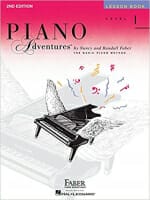
The 2nd Edition Level 1 Lesson Book introduces all the notes of the grand staff, elementary chord playing, and the concept of tonic and dominant notes. Students play in varied positions, reinforcing reading skills and recognizing intervals through the 5th. Musicianship is built with the introduction of legato and staccato touches. This level continues the interval orientation to reading across the full range of the Grand Staff. The 5-finger approach is presented here in a fresh, musically appealing way.
Piano Safari