
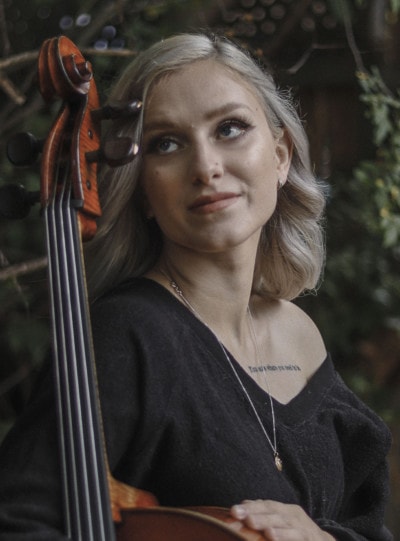
Kendra Grittani is an experienced cellist, having started playing at only four years old. Kendra has completed her Masters in cello performance at McGill University with accomplished symphonic and chamber musician, and cello professor, Elizabeth Dolin.
Kendra has performed with various orchestras including the Toronto Symphony Orchestra, the McGill Symphony Orchestra, the McGill Opera Orchestra, the Kitchener Waterloo Symphony, the Thunderbay Symphony Orchestra, and the National Youth Orchestra of Canada.
Recently, after forming the piano trio, Trio Meira, the chamber group swept the McGill Chamber Music Competition 2018, being awarded 1st prize. Along with a debut performance in Montreal, Trio Meira was awarded a week long residency at the Mozarteum in Salzburg, Austria.
Kendra has also had the privilege to perform alongside accomplished professionals such as Axel Strauss, Stephane Lemelin, Elizabeth Dolin, Ariel Barnes, Riko Higuma and many more. Kendra is currently a substitute musician with the Toronto Symphony Orchestra cello section, the Kitchener Waterloo Symphony cello section, and the Thunderbay Symphony Orchestra cello section. Kendra is working as a freelance cellist, chamber musician and as a private teacher in Toronto.
Get to know Kendra…Beyond the Bio!
Hobbies: Aerial Acrobatics, animal care.
Musical influences: Johannes Moser and Santiago Cañon-Valencia
Favourite food: Sushi
Least favourite food: onion
Favourite music: Esperanza Spalding and Ariana Grande
Favourite song: Midnight in Harlem – Tadeschi Trucks Band
Favourite musical theatre/opera: Hamilton
Favourite book: The Book Thief
Best thing about teaching at ABC: Exchanging teaching techniques with other excellent teachers
Latest Homework from KENDRA
Is Kendra Your Teacher?
Sign up now to get your weekly assignments delivered, and never lose your homework sheet again!
Dec 5th – Matthew
C major – 2 octaves one note per bow and 2 notes per bow
- fully extend the arm on the A string. Make sure your elbow isn’t bent when you’re playing at the tip of the bow
- try to keep the bow in the “middle lane” – half way between the end of the fingerboard and the bridge
- Left hand fingers should be fully rounded as you push down the string
- try not to change the bow speed when you put down a different finger/change a note
- Down bow bow distribution looks great! Try to do the same on the up bow. Imagine there’s a peice of tape on the middle of the bow stick, when you reach the tape, change the note
G and D major – work on 4 notes per bow
- try to increase the speed of your left and right hand
- try not to stop the bow on the string crossing
EE study book – how to read bass clef
- double dots next to a double bar line = repeat. Repeat back to the beginning or the other repeat sign
- quarter notes and quarter rests have the same value
- pizz first then try adding the bow. When using the bow stay in the middle 3rd of the bow. Don’t stop the bow in between notes, only for rests (silence)
- Think 1stfinger LOWER and 4th finger HIGHER
- This week work on 33, 34, 36, 40-42
Song of the Wind
- don’t forget about the rests! full quarter rests
- 1st finger lower
- practice with a metronome 52-62. The main melody is mostly eighth notes, meaning that you will play TWO notes for every ONE metronome beat.
- Start adding the bow at a slower tempo – RETAKE: bring your bow back to the frog during the rest or at the end of a phrase
- Work on eighth notes being half the length of quarters
- when you retake your bow, make sure the bow is fully in the string before starting to play again. No bouncing!!!
Lightly Row
- Slower bow speed on the half notes
- connect your half notes into the next phrase, don’t stop the bow
- make sure to turn the corner with teh bow on the A string
Start listening to Go Tell Aunt Rody (spotify or youtube)
- listening is a great way to learn a new piece. See if you can pluck along without the music
- starts on Fsharp
Preferred Books for Kendra’s Students
Click to buy them here, and they’ll come right to your house! What could be easier?
Suzuki Cello School
Teach cello with the popular Suzuki Cello School. The Suzuki Method(R) of Talent Education is based on Shinichi Suzuki’s view that every child is born with ability, and that people are the product of their environment. According to Shinichi Suzuki, a world-renowned violinist and teacher, the greatest joy an adult can know comes from developing a child’s potential so he/she can express all that is harmonious and best in human beings. Students are taught using the “mother-tongue” approach.
Suzuki Cello School
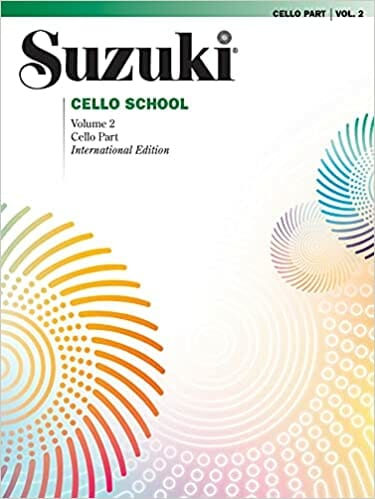
Teach cello with the popular Suzuki Cello School. The Suzuki Method(R) of Talent Education is based on Shinichi Suzuki’s view that every child is born with ability, and that people are the product of their environment. According to Shinichi Suzuki, a world-renowned violinist and teacher, the greatest joy an adult can know comes from developing a child’s potential so he/she can express all that is harmonious and best in human beings. Students are taught using the “mother-tongue” approach.
Suzuki Cello School
Teach cello with the popular Suzuki Cello School. The Suzuki Method(R) of Talent Education is based on Shinichi Suzuki’s view that every child is born with ability, and that people are the product of their environment. According to Shinichi Suzuki, a world-renowned violinist and teacher, the greatest joy an adult can know comes from developing a child’s potential so he/she can express all that is harmonious and best in human beings. Students are taught using the “mother-tongue” approach.
I Can Read Music
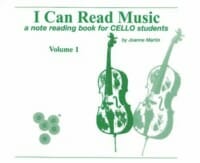
These easy-to-read, progressive exercises by Joanne Martin develop a student’s reading skills one stage at a time, with many repetitions at each stage. I Can Read Music is designed as a first note-reading book for students of string instruments who have learned to play using an aural approach such as the Suzuki Method(R), or for traditionally taught students who need extra note reading practice. Its presentation of new ideas is clear enough that it can be used daily at home by quite young children and their parents, with the teacher checking progress every week or two.
Position Pieces for Cello
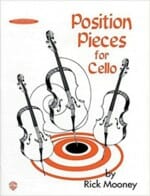
Position Pieces for Cello is designed to give students a logical and fun way to learn their way around the fingerboard. Each hand position is introduced with exercises called “Target Practice,” “Geography Quiz,” and “Names and Numbers.” Following these exercises are tuneful cello duets that have been specifically composed to require students to play in that hand position. In this way, students gain a thorough knowledge of how to find the hand positions, and once there, which notes are possible to play.