
B.Mus (U.Regina)
M.Mus (UofT)
Shelley has recently graduated with a Master of Teaching from OISE. She is qualified to teach music and drama. Shelley did her undergrad at the UofT Faculty of Music where her main instrument was piano. She sang in the Women’s Chamber Choir, where she got the opportunity to perform Cherubini’s Requiem at the Lincoln Center. Shelley also studied multiple genres of voice, especially classical, musical theatre, and jazz. She has performed in multiple revue/cabaret shows and was a soloist in the Hart House Jazz Ensemble. Shelley has also taken courses in the UofT Drama department and directed two of her original plays on campus.
As an emerging music educator, Shelley would like to expose her students to a wide variety of different musical genres/styles including classical, jazz, pop, musical theatre, folk, and contemporary, and teach them techniques such as reading notation, reading degree numbers, and learning by ear. She aspires to create a space that students enjoy because they get to explore their own musical identity and interests by choosing the music style(s) they like. By encouraging and giving students opportunities to engage in and develop their own skills in an area of their choice, Shelley believes students will be more likely to want to continue with music in their lives beyond the studio.
Get to know Shelley…Beyond the Bio!
Hobbies: Singing, playing piano, guitar and ukelele, acting, dancing, songwriting, story writing, playwriting, screenwriting, choreographing, travelling
Musical influences: Chopin, Sondheim, Larson, ABBA
Favourite food: Pasta
Least favourite food: Salad dressing
Favourite song: What Doesn’t Kill You Makes You Stronger by Kelly Clarkson
Favourite movie: The Sound of Music
Favourite movie music: The Lion King
Favourite musical theater/ opera: Wicked, Don Giovanni
Best quote from your teacher: “It’s not just about practicing, it’s the way you practice”
Favorite quote: “Don’t work hard, work smart”
Favourite book: Between the Lines by Jodi Picoult and Samantha Van Leer
Best thing about teaching at ABC: Passing my love of music to students
Latest Homework from Shelley
Is Shelley Your Teacher?
Sign up now to get your weekly assignments delivered, and never lose your homework sheet again!
Homework for Sept 23-30
Hakim
Great work today Hakim! Here is your homework for this week:
Duration of practice: 15-20 min per day
What to practice- Gymnopedie 1, review video game pieces
How to practice Gymnopedie:
– Practice slowly. Isolate the parts that are more challenging (for example, bar 6) and practice them at a slower tempo. Review the placements of where left hand moves so that you can do it automatically, and when you put the hands together, keep an eye on left hand as there is more movement.
– Follow the dynamics written in the score.
– Play around with rubato. Think of which parts you want to slow down (be more expressive) and which parts you want to speed up (catch up to tempo).
See you next week :)
Homework for April 22-29
Nova
Rec min to practice: 15-20 per day
What to practice: Ode to Joy for concert
How to practice:
Song structure:
Theme x2
Bridge
Theme x2
Bridge
Final Theme
Continue with the dynamic buildup. For the beginning, play the softest you can without losing sound quality. By the second theme, it should already be in the moderate loud range. Make the final theme a 10/10 on a scale from soft to loud, so that it’s epic. Practice the final chord.
Eighth notes in Bridge: Practice with funky rhythms both ways a few times and then do it normally. Round fingers will make for greater control.
How parents can support practice: Listen and guide as needed. Specifically give feedback on gradual buildup of dynamics (soft to loud) in Ode to Joy.
Maya
Rec min to practice: 10-15 min per day
What to practice: C-D-E
How to practice: Remember that notes with white heads have two beats. Count out loud while practicing, and use a metronome to make sure you are playing the correct rhythm.
How parents can support practice: Make sure she uses the metronome, and help her with rhythm, especially when it comes to fixing the half notes. Make sure she understands the difference between half notes and quarter notes.
See you next week:)
Homework for April 15-22
Maya
Great work today Maya!! Here is this week’s homework:
Recommended min to practice: 10-15 per day
What to practice: C-D-E, Rainbow, Baby Bear (spend more time on C-D-E because you are playing that for the the recital)
How to practice:
C-D-E- focus on rhythm. Know when you are playing quarter notes and when you are playing half notes. Practice with the metronome, and follow the clicks exactly, do not rush or lag behind.
Baby Bear- line 3 remember the pattern -C-D-E going up, then C, then E-D-C going down.
How parents can support practice- listen and guide. Help with preparation of the recital. Supervise her progress in the rhythm of C-D-E, making sure she practices correctly and uses the metronome.
See you next week :)
Homework for April 1-8
Dear students,
Great work today!! Here is your homework for this week:
Nova
Recommended minutes to practice: 20-30 min per day
What to practice: Halftime Show, Matchmaker, Ode to Joy, C triads
How to practice:
Halftime Show- great work on first two lines! Remember to repeat them. Distinguish between slurred staccato at the beginning of the third line (detached) to actual staccato at the end (sharper). Also distinguish between forte dynamic in the first two lines and mezzo forte dynamic in the third line. Practice the syncopation in the third line.
Matchmaker- Great memorization! Again, practice the slurred vs short staccatos. Think of beat 1 being the longest (connects to beat 2), beat 2 being shorter (detached; staccato and slur pretty much neutralizes it), and beat 3 being the shortest (full on sharp staccato). Pay attention to dynamics. Line 2 repeats but the first repetition is mezzo forte while the second is piano, think of it as a soft echo. Practice top of page 2 and transitions to first and second endings so that you’re as confident with them as you are on page 1 and don’t have to stop between bars.
Ode to Joy- review for recital
C triads- review
How parents can support practice- listen and guide as needed
Maya
Recommended minutes to practice: 10-15 minutes a day
What to practice: The Rainbow, Baby Bear
How to practice:
The Rainbow- good work! Have both hands on the keys to start so that left hand is ready to play right after right hand. The final note on line 1 should be held for 3 counts; be careful not to rush it. Left hand should go right after beat 3. Do not skip any notes.
Baby Bear- Great work on first four bars! The last four bars are as follows: bars 5-6 are C-D four times, do not skip the last D! Bars 7-8 have: Skip down up step down. There is also a pattern connecting 7-8 to the last two notes of bar 6: C-D-E-C-E-D-C
How parents can support practice: Playing with her works very well, continue doing so!
See you next week :)
Homework for March 25-April 1
Dear students,
Great work today! Here is this week’s homework:
Nova
Recommended minutes to practice: 15-20 per day
What to practice: Halftime Show, Matchmaker, Ruler of my Heart, C triads
How to practice:
Halftime Show- hold tied notes for two bars, pay attention to articulations. Familiarize yourself with the song.
Matchmaker- Staccatos are better, keep practicing! Now practice with the written dynamics, as well as repetitions with 1st and 2nd endings.
Ruler- review, bring for next week
Triads- play ascending one octave, then repeat top note and descend back to wheee you started. Practice so that it flows without you having to stop.
How parents can support practice: Listen and guide as needed. Remind them to bring theory book, ruler of my heart, as well as matchmaker and halftime show music.
Maya
Recommended minutes to practice: 5-10 per day
What to practice: The Rainbow, Baby Bear
How to practice:
The Rainbow- do not skip the third note in bar 3 both lines.
Baby Bear- familiarize yourself with the song. A lot of 12 or 23 fingering. Count, especially with the new 4-beat note.
How parents can support practice: Listen and guide as needed with notes, rhythm and fingering.
See you next week :)
Homework for March 11-25
Maya
Great work today Maya!! Here is your homework for the next two weeks:
Recommended minutes to practice: 5-10 per day
What to practice: Gallop Away, Rainbow
How to practice:
-Rainbow- review
-Gallop- no stopping between lines. When you finish reading line 1, go back to the beginning of line 2. Do not forget the first two bars of line 2. Second last bar, the D has two beats and the B has one beat; make sure the rhythm is exact and do not play it early. Also, review when you’re playing right hand and when you’re playing left hand.
How parents can support practice: Listen and guide for notes and rhythm. Put on the metronome, and make sure she has priority for the piano!
See you in two weeks :)
Homework for Mar 4-11
Dear students,
Great work today! Here is this week’s homework:
Nova
Recommended minutes to practice: 15-20 per day
What to practice: Juggler, Matchmaker, Ruler of my Heart, C broken triad hands separate
How to practice:
-Juggler/Ruler of my heart- review
-Matchmaker- Emphasize beat 1 of the three beats, staccato with a slur is still a stacatto just not as short as staccato without a slur, a lot of the bars repeat the notes but change the dynamics. Posted in google drive
– triads- play fingers 1,3,5; except right hand first inversion 1,2,5 and left hand second inversion 1,2,5
How parents can support practice- listen and guide as needed
Maya
Recommended minutes to practice: 5-10 per day
What to practice: Gallop Away, The Rainbow
How to practice:
Gallop Away- the E in line 2 is one beat, no overlapping; do not rush second last bar. The D is Beats 1 and 2; the B is beat 3. Practice with metronome.
The Rainbow- good reading! Right hand is the top line, left hand is the bottom line; they are the same except upside down. Remember note reading in left hand- middle C has its own special line, A is on the top line. Make sure there is connection between all notes; no stopping between lines. Once one note is done, the next note follows.
How parents can support practice: Listen and guide as needed. Help her practice the songs with the metronome.
See you next week :)
Preferred Books for Shelley Students
Click to buy them here, and they’ll come right to your house! What could be easier?
RCM Voice Repertoire

A Comprehensive Voice Series serves as the official resource for voice assessments of the Royal Conservatory Music Development Program. Featuring an outstanding selection of voice literature and supporting materials, this series offers a truly enriched learning experience to help ensure student success. As in previous editions, Resonance encompasses a rich and varied selection of Repertoire, Vocalises and Recitatives that students of all ages and voice types will find appropriate to their musical interests and level of technical ability.
Hal Leonard Vocal Method

The Complete Method for Singers
Kodály Approach
Belting - A Guide to Healthy Powerful Singing

Belting is a strong way of big singing that has become very popular in contemporary styles. It is heard in everything from rock to hip-hop to pop to musical theater to the plethora of award shows. However, not only is there much confusion and misinformation about how to belt well, if done poorly belting can actually damage the voice. Numerous famous singers have belted their way to injury or even lost their voices, sometimes permanently. Many voice teachers believe (incorrectly) that belting is simply bad, physically and aesthetically. So, singing students are getting mixed messages. They hear their favorite artists belt-singing throughout their favorite music, yet the resources teaching healthy belting techniques are few and far between. Belting for the Contemporary Singer seeks to remedy the situation. The fact is, belting can be done well and without causing injury. This book presents the facts about belting, what approaches work and which to avoid. Its online video and audio demonstrate good techniques and exercises.
15 First Lessons - Voice
The First 15 Lessons series provides a step-by-step lesson plan for the absolute beginner, complete with audio tracks, video lessons, and real songs! Designed for self-teaching or for use with an instructor, you’ll build a solid foundation as you work through each lesson, learning the basics of singing and music reading while practicing the many exercises, concepts and song excerpts within. Each book in the series features must-know instruction so you can start performing right away, with a free online metronome! The voice book features lessons on: full-body singing, breathing, finding your voice, vocal warmups, the vocal break, caring for your voice, diction, music literacy, building skills, working on a song, dealing with nerves and more.
Teach Yourself to Sing
Learn to sing and open up a brand new world of musical knowledge with this exciting method from Alfred Music. Beginning with the fundamentals, you will learn about equipment used by singers, vocal health, and getting acquainted with reading music. You will then move right along to breathing, vocalizing, proper warm-ups, and singing songs, lesson by lesson, all while continuing to increase your knowledge of reading and understanding music. You will learn to sing an array of musical styles including pop, jazz, classical, and musical theater. Near the end of the book, you will be introduced to the idea of individual interpretation, which will help you color your songs with your own unique style.
Folk Songs for Solo Singers vol. 2
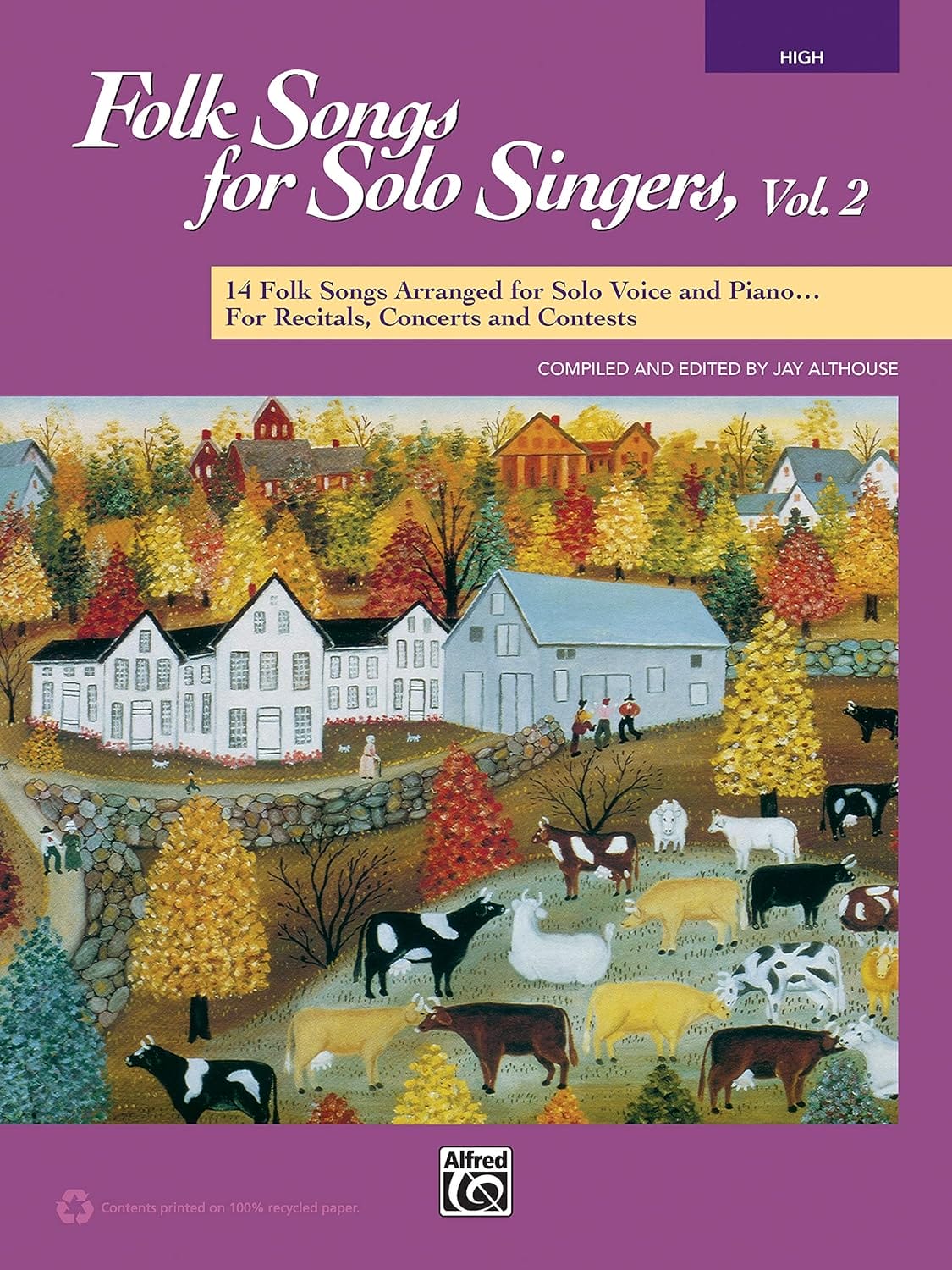
A new high edition of our popular vocal collection, this volume of best-loved folk songs for solo voice and piano contains fourteen memorable works arranged by three of Alfred Music’s top writers: Jay Althouse, Mark Hayes, and Ruth Elaine Schram. The CD includes a piano accompaniment track for each song.
Elementary Rudiments of Music
This series organizes concepts into three progressive levels with an Answer Book. Designed for intermediate to late-intermediate level students, it teaches the basic elements of music theory and complements the study of all instruments.
The Brown Scale Book
This essential resource includes all major and minor scales, triads, arpeggios, dominant sevenths, and chromatic scales organized by key. A favorite for decades, The Brown Scale Book belongs in every student’s library.
Dozen A Day
The Dozen a Day books are universally recognized as one of the most remarkable technique series on the market for all ages! Each book in this series contains short warm-up exercises to be played at the beginning of each practice session, providing excellent day-to-day training for the student.
Faber Piano Adventures

The 2nd Edition Level 1 Lesson Book introduces all the notes of the grand staff, elementary chord playing, and the concept of tonic and dominant notes. Students play in varied positions, reinforcing reading skills and recognizing intervals through the 5th. Musicianship is built with the introduction of legato and staccato touches. This level continues the interval orientation to reading across the full range of the Grand Staff. The 5-finger approach is presented here in a fresh, musically appealing way.

