

ARCT • Teachers’ Diploma (RCM) in-progress
Trained Music Together Teacher
Erin Plank (they/he) is a passionate young piano teacher. For their professional development, Erin received the highest exam scores in all of Canada last year for “Teaching Elementary Piano” with the RCM.
Erin’s main goal is to turn students into lifelong music lovers, not just pianists. I seek to provide them with the tools to practice efficiently at home, sight read a song at their friend’s piano, learn the melody to a song off the radio by ear, and nurture a technical foundation that lasts a lifetime so it’s “just like riding a bike” to play the piano. And even better, they’ll want to.
Get to know Erin…Beyond the Bio!
Hobbies: Piano, weightlifting, playing with my cat, and hanging out with friends
Musical influences: Ben Folds, Brad Mehldau, Edvard Grieg
Favourite food: Fried chicken sandwich
Least favourite food: snap peas, because I ate too many as a kid one time and threw up and now I dislike the smell
Favourite music: Romantic era piano music, Beach Boys and similar era music, math rock
Favourite song: “How Dare You Want More” by Bleachers
Favourite movie: Sing Street
Favouirite movie music: main theme for “Eternal Sunshine of the Spotless Mind” or anything Star Wars
Favourite musical theatre/opera: Wozzeck
Best quote from your teacher: “Don’t show the audience you messed up, they won’t know! Keep going!”
Favourite quote: “That’s what life is, Happy Sad”
Favourite book: Recursion by Blake Crouch
Best thing about teaching at ABC: Getting to reach and connect with so many lovely people!
Latest Homework from Erin
Is Erin Your Teacher?
Sign up now to get your weekly assignments delivered, and never lose your homework sheet again!
Thursday November 23 Lessons – Erin P
What a great week! Holiday pieces are sounded great! Stay warm everyone <3
Grace
Sonatina Bureacratique – first scalic passage is in A major. The rest of them are modes of E major, you can tell by the D# accidental.
Beethoven op. 49 no. 2 – practice the triplet LH line that begins on the 2nd beat of the triplet group, you can tap the downbeat with your RH.
G and D major scales in triplets to warmup for Beethoven. A and E major scales in 8ths/16ths for Satie.
Liam
Sonatina by Clementi – great! Fix some LH fingering to become even more efficient. You can begin to add more dynamic like in each of the scalic passages. you can get louder as it ascends. Listen to this recording for inspiration.
Solace – nice! Listen to recording (the melody that’s in your piece starts at 0:45). Put hands together. LH most often falls in between the melody. Your fingering is totally fine, but use finger 2 in the solid 3rds section so each of the bottom notes gets it’s own finger, more smooth.
Silent Night – great job learning the melody. Now notice how they’ve arranged it around the keyboard and with which hand. The opening the RH will have to be soft like bells for the LH melody to shine above.
Jadon
Candlelight – listen here for inspiration. The LH here is very simple, even when the rhythms become more complex, the notes remain the same.
*New* #8 in Fired Up – This piece is in E minor and uses expanding intervals in the LH. First a 5th, and then a 6th, then 7th. When you can play it fluently, add pedal, experiment with tempo.
Gravity Falls – remember each chord repeats for 2 bars, not just one.
Katarina
*New* We Wish You a Merry Christmas – please look at the page while playing. Fingers share middle C position. Singing along is encouraged :)
2 Sided Worksheet – PLEASE COMPLETE AND RETURN TO LESSON. One side is matching notes on the staff to the keyboard. One side is identifying direction of notes.
Parental involvement: If you have a few moments, do these two exercises (One, Two) on an electronic device and have her identify notes. I have turned the “helpers” on, on the side because she expressed interest today in “Every Good Boy Deserves Fudge” line method instead of the landmark system we had been using. Whatever gets the job done, but consistent note naming practice is necessary.
Sara
Maple Leaf Rag – keep doing what you’re doing! Sounds awesome!
Gavotte – Phrasing is the main focus this week. The phrases are 4 measures long, and should be seperated by a breath. You did a much better job this week of making the sequencing pop out for the listener, it is ineresting how the performer’s awareness of repeated phrases and shaping makes it aware to the listener as well… Here are 2 different performances to look into: One, Two.
Midnight Clear – you did this very well! Here is the official recording you can look to for further inspiration.
*New* Sonatina in C by Wesley – Begin hands seperate. The LH will be understated and quiet as it has a ton of alberti bass and is much more notey than the RH melody – keep that in mind while preparing hands seperate. You can practice the ornaments isolated, but play the melody just as written this week so we know which note is “the main one”.
Marco
Totoro – WOOHOO! Very nice progress! I think the next part you’ll want to get fluent without hesitation is the “main melody” at the top of page 2. I am very proud of your work on this piece.
Back to the Future – Awesome! Add in the LH chords in the intro. You can begin to slowly add whole notes/half notes in the LH by reading the circled notes. Just choose an octave you think suits the piece and play the root in the LH. No hurry.
By My Side – Resist the urge to swing the melody when it comes up and continue with consistent 8th notes (Away in a Manger is traditionally notated in 3/4 with some dotted quarter notes, not in 6/8 which is why this distinction is important). Play through the LH this week, it only uses 3 chords (C, F and G). You have two choices of goals this week: learn the whole piece hands seperate, OR learn page 1 hands together slowly. You can listen to it here.
*New* Any new piece from Fearless Fortissimo – Your choice! Give it your all :)
Daniel
Invention in A Minor – refamiliarize yourself with this hands seperate in the first practice session so you can hear each line, then go hands together. When playing an invention you should always be able to hear the mini melody that is begin passed around and know which hand has it. Listen here.
*New* Winterstorm – this is the Carol of the Bells inspired piece. Dynamics dynamics dynamics! Tell the listener a story by starting quiet and growing to a climax. You can listen here.
*New* Waltz that Floated Away – measures 1-12 is your assignment. The first 8 bars are marked piano. Ensure you are sustaining the initial LH note of each bar for all 3 beats.
Marita
Bird in the Bebop! – measures 1-12 is your assignment. There is a lot of F major triad shapes used here, and a constant Db added in. You know the spots you find the trickiest, so play those two bars 5 times every practice session. Watch your staccatos.
Candlelight – This is based on Angels We Have Heard on High. You’ve got this! You can listen here. We read through this whole piece in lesson, so I know you can do it :) It is in D position the entire time (uses several different octaves though).
Formula in G – go slow and steady. When having to do a scale longer than one octave, finger 4 is your best friend. RH will play finger 4 and then the thumb will land on the root again, ready to do another octave.
Greta
*New* Candlelight – You can listen here. This is inspired by Angels We Have Heard on High. Both hands stay in D position (in various octaves of the keyboard). Spend a few practice days hands seperate, then you can begin putting small chunks together.
*New* Celebration – this piece uses the interval of a 5th a TON! The note names we wrote in are for the bottom note, then you will figure out the 5th above. This piece has 3 distinct chunks: 1- the initial groove of L RR L RR L R and its following arpeggios. 2- the up and down syncopated sequence that steps downwards. 3- the Bb major 7th accented quarter notes that interrupts groove 1. Practicing the chunks without connecting them together is totally fine for this week.
Saturday November 4 Lessons – Erin P
Glad to hear you all had safe and fun Halloween nights!
Hakim
My City and Largo – these pieces are your note reading practice for the week. Your RH thumb should be on middle C when playing these pieces, and your RH finger 5 (pinky) on G. Resist the urge to cross your index finger over your thumb!
C Major Scale – the scale fingering I taught you today is used for almost every single major scale that starts on a white key! RH will use fingers 123 and then tuck the thumb under onto F. The full fingering is 123 12345. Going back down is the *exact* same, but in reverse. 54321, then cross finger 3 over onto E, then 2 1.
LH is very similar. Use all 5 of your fingers, 12345, then cross finger 3 over onto A, then 2 1. Full fingering is 54321 321. You guessed it, going down is the same! 123, thumb under onto G, then 2345.
Watch this video if you need help, though DO NOT put it hands together yet! Just watch one of his hands at a time and work on that hand :)
Sailor’s Dance from Team Fortress – there is nothing wrong with learning songs from YouTube, especially as we work to catch up your note reading to your playing skills. What I will guide you is making logical fingering choices for pieces like this. Keep in mind that playing two notes with two different fingers is usually way faster, and easier, than frantically hopping the same finger to the next note. Today in lesson we looked at the first 4 bars of this melody. Use your thumb on white keys, and remember to keep rounded strong fingers :) Have fun!
Maria
Etude in D Major – nice work on the tricky bits! When putting this hands together, really look to the notes on the main beats and focus on getting those hands together. You will notice these main notes often move in parallel motion (each hands notes moving the same direction) even though all the notes in between might zig zag. It is totally okay to simplify pieces to get the coordination hands together, and then add the extra stuff in after. Another technique you could try is tapping the LH notes while playing the RH, or humming the RH melody while playing the LH. Believe in yourself!
Arctic Voices – opening 2 lines. The letter names I have written in are the root of each chord, and they are all perfect 5ths. Listen here if you need a reminder to get your brain “in it”.
*New* Witches and Wizards – this is your fun piece! Do as much as you like. Watch the opening, both clefs are bass clefs, and then it switches to treble later. Notice the 6/8 time signature and the accents, they are very important to giving this piece its rhythmic drive. Here is a video.
Technique practice will resume next week :)
Preferred Books for Erin Students
Click to buy them here, and they’ll come right to your house! What could be easier?
BOOK TITLE
COMING SOON
Faber Piano Adventures
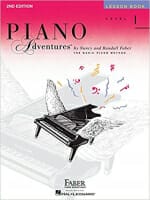
The 2nd Edition Level 1 Lesson Book introduces all the notes of the grand staff, elementary chord playing, and the concept of tonic and dominant notes. Students play in varied positions, reinforcing reading skills and recognizing intervals through the 5th. Musicianship is built with the introduction of legato and staccato touches. This level continues the interval orientation to reading across the full range of the Grand Staff. The 5-finger approach is presented here in a fresh, musically appealing way.
Piano Safari