
ARCT • Teachers’ Diploma (RCM) in-progress
Trained Music Together Teacher
Erin Plank (they/he) is a passionate young piano teacher. For their professional development, Erin received the highest exam scores in all of Canada last year for “Teaching Elementary Piano” with the RCM.
Erin’s main goal is to turn students into lifelong music lovers, not just pianists. I seek to provide them with the tools to practice efficiently at home, sight read a song at their friend’s piano, learn the melody to a song off the radio by ear, and nurture a technical foundation that lasts a lifetime so it’s “just like riding a bike” to play the piano. And even better, they’ll want to.
Get to know Erin…Beyond the Bio!
Hobbies: Piano, weightlifting, playing with my cat, and hanging out with friends
Musical influences: Ben Folds, Brad Mehldau, Edvard Grieg
Favourite food: Fried chicken sandwich
Least favourite food: snap peas, because I ate too many as a kid one time and threw up and now I dislike the smell
Favourite music: Romantic era piano music, Beach Boys and similar era music, math rock
Favourite song: “How Dare You Want More” by Bleachers
Favourite movie: Sing Street
Favouirite movie music: main theme for “Eternal Sunshine of the Spotless Mind” or anything Star Wars
Favourite musical theatre/opera: Wozzeck
Best quote from your teacher: “Don’t show the audience you messed up, they won’t know! Keep going!”
Favourite quote: “That’s what life is, Happy Sad”
Favourite book: Recursion by Blake Crouch
Best thing about teaching at ABC: Getting to reach and connect with so many lovely people!
Latest Homework from Erin
Is Erin Your Teacher?
Sign up now to get your weekly assignments delivered, and never lose your homework sheet again!
Thursday November 16 Lessons – Erin P
Hey everyone! Great work on the Dozen a Day exercises! This is the first week of playing Holiday themed pieces, if there is a specific carol you are interested in playing, let me know and we will work it out! The goal is to explore more than 1 holiday piece this winter.
Grace
Sonatina Bureaucratique – nice progress! I wrote in the fingering in a few spots, notice that. At the bottom of page 1, ensure your LH arpeggios are the exact same speed as the RH 8th notes were in the line before. Do not rush them.
*New* Beethoven Sonatina op.49 no.2 – when tackling the LH triplets, keep a loose rotating feel in your wrist. Your wrist will be at it’s highest point when playing the middle finger, creating a little hill from left to right each triplet group.
G major scale in triplets – these are found verbatim in the Beethoven piece so warmup with them and get comfy with it. Do 3 octaves to have a rhythmically satisfying turn around and ending.
Liam
Sonatina op 36 no 1 – HT. You can totally handle hands together, just take it slightly slower. You have done an excellent job of including details when playing hands seperate. This is a very playful piece, so prioritze evenness along with your accurate articulation to bring the character to life. LH notes can be thick but detached, they shouldn’t be stacatto, but you need not connect them.
*New* Solace – try practicing just the notes that change with the written fingering for each little motive. Then add in the repeated notes, ensuring your hand remains as free of tension as possible (practice this in small chunks, or do some of it, then a different piece and circle back). We want to hear the changing notes louder than the repeated ones, so keep that the back of your mind. Hands seperate this week and go slow. The melody in your arrangement begins at 0:47.
*New* Silent Night – this arrangement is in F major and begins with a LH melody. Play the RH chords delicately. Taper off the ends of phrases for a beautiful melodic line.
Jadon
*New* Candlelight – pop fusion of Angels We Have Heard on High. This piece is in D Major, watch your F#s. There are moments that the original carol’s melody is exactly as you’d expect, and other moments it deviates, so read carefully.
Gravity Falls – I love your opening walking bass idea! The stepping up LH notes will fall on beats 4 +, and will align with the RH notes that are also going upwards.
Thank you for the payment! I hope you find your book.
Sara
*New* Midnight Clear – this is in 6/8. There is a lot of lilting rhythms here, think long-short-long-short for each bar like that. There will be moments of the exact original melody, and moments of new material, so keep your eyes peeled! Have fun with it:)
Yaya Sonhado – nice attention to detail! Through repetition and careful precision we will eliminate the “splitting” that sometimes occurs in the RH solid 3rds. You can even play hands seperate with the sole goal of no notes splitting. Page 2 a bit of fingering work is needed, look to what we pencilled in. Practice that hands seperate also.
Gavotte in F – good progress. This week play it in 4 bar chunks to really feel the phrasing. Listen and decide the high point of each phrase, does it peak in the middle and then taper off? Does it grow into the next phrase? The paper has some details, but it is also your artistry and taste that will bring it to life. LH notes can be detached more often, not short, just disconnected.
Maple Leaf Rag – I’ll hear this next week.
Marco
*New* By My Side – this piece includes hints of Away in a Manger. It is a C Major scale study, so it includes only white keys, and the LH uses I, IV and V power chords. The time signature is 6/8, so you want to feel 2 beats per measure = 1 2 3 4 5 6. Begin hands seperate and with a steady pulse.
*New* Back to the Future – yes this is a crazy key signature = Db major. It is the real key of this piece, so you could play along to the recording slowed down if you like. Plus we will get black key practice! In the first line, the only white keys are the Cb (B) and F. In the rest of the piece the only white keys are when a natural is written, or C and F. Everything else is flat. You can use your ear and knowledge of the piece for the rhythms. The quarter note triplets will be new to you, they are triplets that take up 2 whole beats instead of just 1.
Totoro – woohoo!! I’m proud! The first 8 bars are sounding really confident hands together. Let’s keep it going right to the end now, the penultimate line of the piece is a repetition of the top line of page 2 almost exactly. Remember to start practicing in places other than just the beginning. Start at the beginning of any phrase.
Katarina, Marita, Daniel and Greta – keep working on last week’s assignments. I will hear your technical exercises as well as pieces next week and give you your first Holiday piece.
Saturday October 28 Lessons – Erin P
Hakim
My Invention – this teaches our landmark notes = bass F, middle C and treble G.
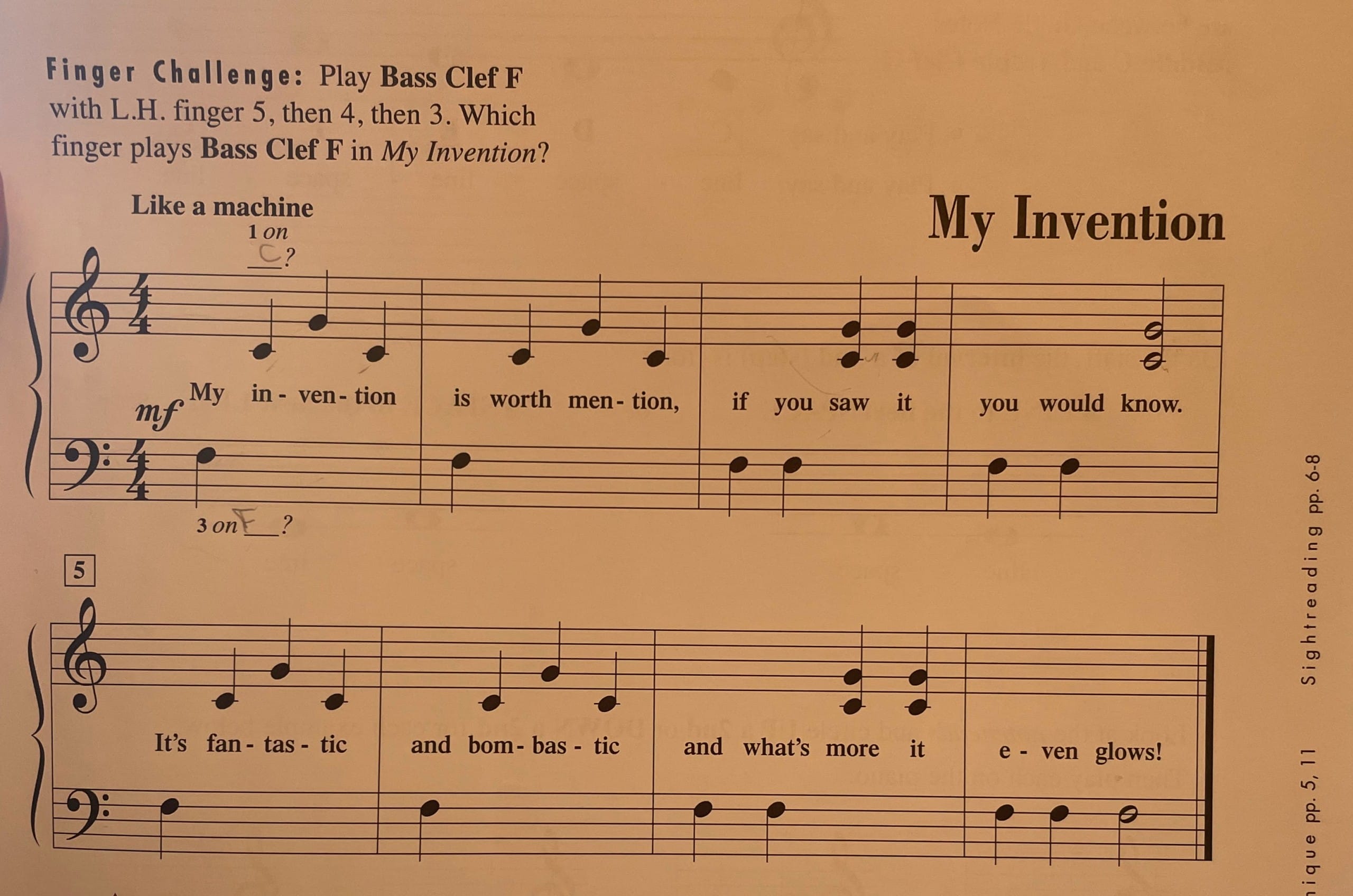
Use the corner of your thumb when playing. The thumb is like a really important beam holding up a deck (the rest of your hand) and it needs to be strong to keep your nice piano hand posture from collapsing.
Maria
Etude in D Major – HT m1-8. HS 8-16. You’re doing way better than you think! When putting the hands together, notice which notes are played together, and you can stop on each of them to check you’re doing it right. I put stars around each of the sections you should do spot practice on.
Arctic Voices – first 8 bars. LH begins in the bass clef. In the second line, every single collection of notes is a perfect 5th, which makes reading easier.
Melodic minor scales – Raised 6 and 7th going up, lower them when going back down. Going up the top half of the scale should be like a major scale, and then going back down, the top half will be like a plain minor scale.
Shakira
Technical exercises – using the papers from last week as well as this week at the keyboard (or at a desk using the correct fingering and saying the note names aloud), practice these to get comfortable with note reading.
Session 32 – written on the back of the technical exercises paper. Play along with the recording to learn the rhythm.
WindanSea – Notice which parts repeat and how some of the endings of phrases are different. The LH repeats the same profession for every line except the last line of this piece.
Noreet
Haunted Mouse – this piece uses your new skill of staccato. When playing staccato (light and detached notes) be sure your loose is light and flexible. It should feel like knocking on a door, or a chicken pecking the keys. Resist the urge to move your RH, and try to use the written fingering. Fingers 2 and 4 might be weaker than 1 and 3, but not if you practice using them!
C Major Scale RH and LH.
RH goes 123 (thumb under, to F) and then 12345.
LH goes 54321 (finger 3 over on A) 321.
Practice habits: it is better to do a little bit every day, than a lot on one day. Instead of playing each piece from beginning to end, choose small sections and work on playing them fluently. Repeat small sections until you can play them without hesitation or mistake. Then choose another small section to work on. Eventually you could then put those two sections together and work on doing the whole big section without pause.
Gerardo
Infinity Session – the bass line is a similar chord progression to the Swing. The RH uses a lot of dotted quarter notes, so be sure that your counting adds up to 3 beats per bar.
LH patterns – this paper gives you some inspiration on LH patterns to be used in improv/lead sheet playing. It also provides you with rhythms and note guidelines to improvise within in the RH.
Preferred Books for Erin Students
Click to buy them here, and they’ll come right to your house! What could be easier?
BOOK TITLE
COMING SOON
Faber Piano Adventures
The 2nd Edition Level 1 Lesson Book introduces all the notes of the grand staff, elementary chord playing, and the concept of tonic and dominant notes. Students play in varied positions, reinforcing reading skills and recognizing intervals through the 5th. Musicianship is built with the introduction of legato and staccato touches. This level continues the interval orientation to reading across the full range of the Grand Staff. The 5-finger approach is presented here in a fresh, musically appealing way.
Piano Safari