
ARCT • Teachers’ Diploma (RCM) in-progress
Trained Music Together Teacher
Erin Plank (they/he) is a passionate young piano teacher. For their professional development, Erin received the highest exam scores in all of Canada last year for “Teaching Elementary Piano” with the RCM.
Erin’s main goal is to turn students into lifelong music lovers, not just pianists. I seek to provide them with the tools to practice efficiently at home, sight read a song at their friend’s piano, learn the melody to a song off the radio by ear, and nurture a technical foundation that lasts a lifetime so it’s “just like riding a bike” to play the piano. And even better, they’ll want to.
Get to know Erin…Beyond the Bio!
Hobbies: Piano, weightlifting, playing with my cat, and hanging out with friends
Musical influences: Ben Folds, Brad Mehldau, Edvard Grieg
Favourite food: Fried chicken sandwich
Least favourite food: snap peas, because I ate too many as a kid one time and threw up and now I dislike the smell
Favourite music: Romantic era piano music, Beach Boys and similar era music, math rock
Favourite song: “How Dare You Want More” by Bleachers
Favourite movie: Sing Street
Favouirite movie music: main theme for “Eternal Sunshine of the Spotless Mind” or anything Star Wars
Favourite musical theatre/opera: Wozzeck
Best quote from your teacher: “Don’t show the audience you messed up, they won’t know! Keep going!”
Favourite quote: “That’s what life is, Happy Sad”
Favourite book: Recursion by Blake Crouch
Best thing about teaching at ABC: Getting to reach and connect with so many lovely people!
Latest Homework from Erin
Is Erin Your Teacher?
Sign up now to get your weekly assignments delivered, and never lose your homework sheet again!
Thursday May 25 Lessons – Erin P
Liam
Imperial March page 1 – You nailed the RH melody in lesson today, if you need to change any of the written fingering feel free, and then stick with it. The LH changing between G and Gb can get quite confusing notation wise because they chose to write in naturals unnecessarily, but trust your ear and you’ll find the right one to use when uncertain. Stay playing hands together for a day or two before putting it together.
Albert Alberti – in performance book. This piece is in C position and the Alberti bass is a new concept here. Alberti bass is *extremely* common in classical music. The pattern is bottom-top-middle-top within the triad. Use a light rotation movement in your wrist to play these, like you’re opening a twist door handle.
Chromatic scale use 1313 fingering on white-black keys. When two white keys beside each other do 2-1 in LH ascending and 1-2 in RH (so the fingers go nicely in order like 123 on EFGb for example)
If time, Stars and Stripes Forever in lesson book.
Marco
*New* Bear Dance – Ignore the grace notes! Learn the melody to the first 4 bars and then we’re going to loop these 4 bars HT so much and so perfectly that you feel like you’ve cracked the code to hands together playing. Yes it’s repetitive but pretend you’re hypnotizing someone or something :) Keep your LH relaxed and let gravity help you do the heavy lifting.
Going Undercover – playing this hands together will also greatly help Indiana Jones. This is the kind of music that could be used for a video game level because of how it loops and drones on, building tension and then releasing it. Keep your arms relaxed.
These two pieces are the focus for this week as they give you the foundation to play Indy. Of course feel free to continue exploring Indy and keeping the two hands parts fluent in your hands, but please prioritize steady HT practice on Bear and Undercover this week.
Daniel
*New* Crocodile Teeth – I’ve marked in any important notation things for you to notice. Count out everything and prioritize evenness and you’ll be great! A piece that’s chaotic like this only works because it’s actually not chaotic at all and everything is very accurate rhythmically with a consistent pulse. Staccato touch will be very important to creating this precise sound.
Stairway – fix syncopated rhythm measures 3 and 4. The RH comes just before the LH. Otherwise awesome!! Play along with this for fun, it even has a 2 bar count in.
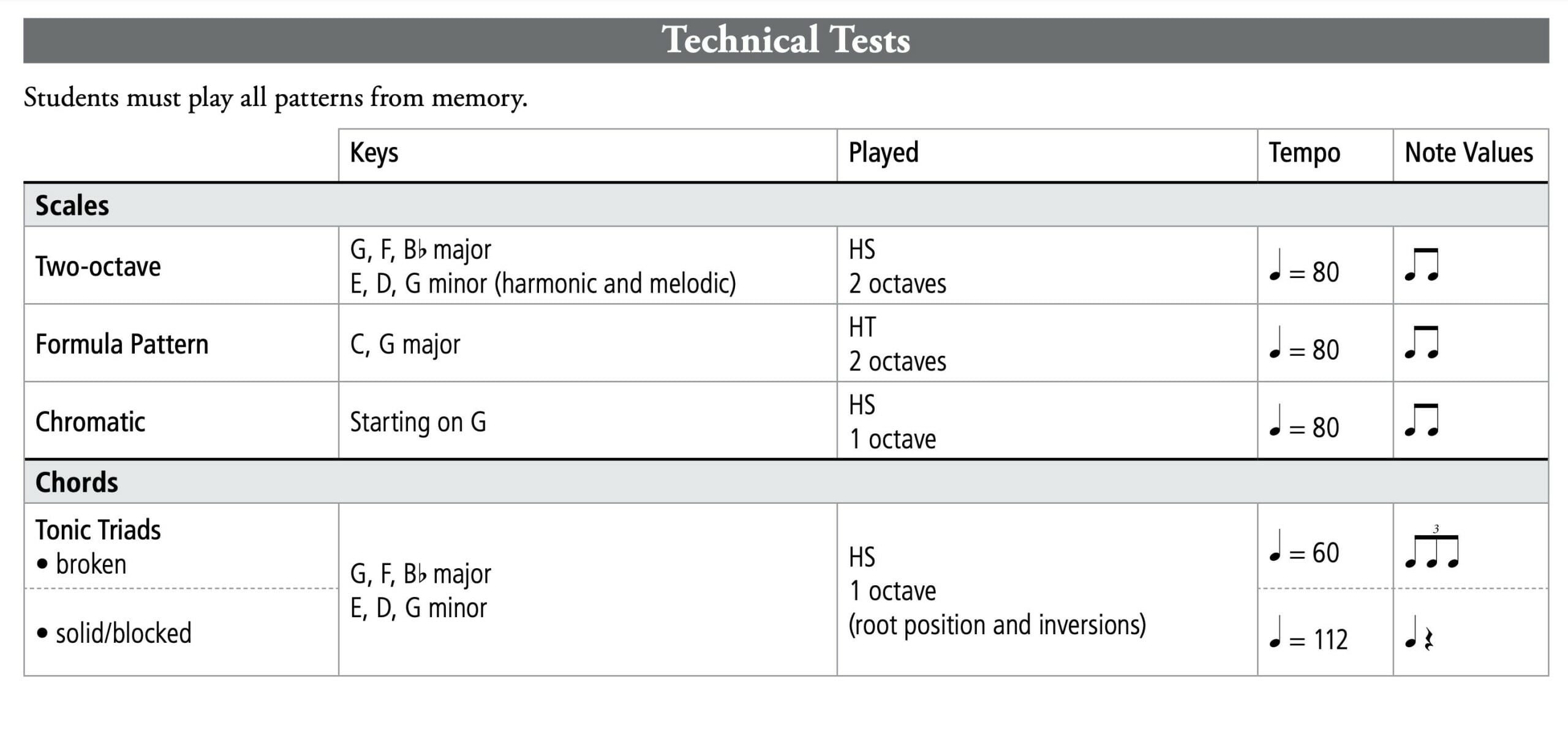
Below is all the technical requirements for level 2, all of which you already know except for melodic minor scales. I’ll teach those next lesson. For this week, practice your harmonic minor scales. The new one for you here will be G minor, so use Bb major’s key signature and then raise the 7th, so you get GABbCDEbF#G.
Sara
Repertoire all sounds great, fantastic details. Few notes, isolate the last 2 measures of In the Spirit (before it goes back to the beginning) practice the timing blocked so you don’t slow down and also practice lightening up on that final chord.
Sonatina, make sure you’re hearing the triplets inside your head for the final measure of the first page so the quarter notes are not too slow. I think it was accurate today, just make sure you don’t lose the pulse in your head.
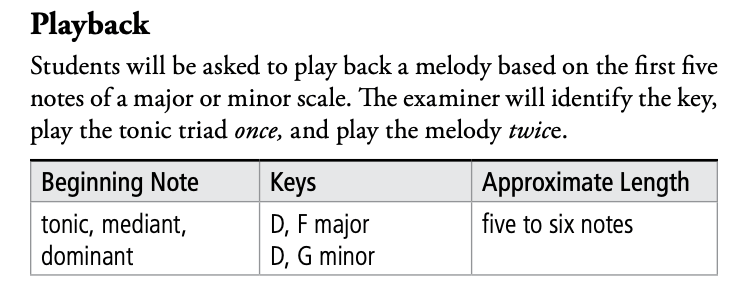
If you are able to get your Dad to do some melody playback with you that would be awesome. This image below shows the parameters. (Totally fine if not too!!) Tonic, mediant and dominant means you can start on any of the triad notes, 135.
Le Coucou – slow it down tempo wise and be very accurate about the articulation and phrasing. Notice some of the LH notes are meant to be legato (you’re doing this right) and some go staccato-then thicker. Be picky with this. Also in the RH you will notice the phrasing sometimes connects over the barline. If you need to, draw upwards arrows where the phrase line breaks to remind you to break the legato sound. This is a very impressive piece, and slowing it down and being super accurate will only benefit you more :)
Sina
If today was our final lesson together, I have prepared this summary of your current skills to give to whoever your next teacher is. If you are able to come for in person lessons on Thursday evenings or Saturday afternoons, I would love to continue working with you. You are great at taking feedback and lovely to work with Sina!!! Keep creating music <3
Marita
*New* The Swiss Cuckoo. This piece is in G major and the articulation is very important. Staccato when written and legato when needed to truly bring to life this playground song. It’s going to sound sing-songy and a little bit mocking in parts because it is traditional Italian children’s song. Watch the pickup beats.
Etude in C by Diabelli – take this for a spin one more week and see how fluent you can get it. Really lean into those down-up 2 note slurs and give a beautiful classical performance.
Saturday April 15 Lessons – Erin P
Happy spring weather everyone! Enjoy your weekend <3
Jadon
Canon x Memories – Great! Step 1 this week is to play the LH root notes while playing the Canon melody. Step 2 is to play the first 2 notes of the LH accompaniment part with the melody. Any more of the LH part you can do hands together is extra credit :)
Interstellar – sounding great! Keep plugging away at it, and I love the pivoting wrist in your LH. Exactly the right technique!
Marco
Great job on March of the Terrible Trolls. This week let’s work on keeping your fingers strong so that the C minor pattern stays even. Feel each finger make clear contact with the keys one at a time. Practice it all staccato to make it clean, then play it again as written and try and keep the even sound.
For Young Ludwig, work on connecting the first 4 bars with the last 4. Practice the RH Ab-Ab-Ab-G part onwards hands together.
A minor triad pattern. Play these broken and solid hands seperately. Fingers 135 are the norm, and 125 works great for certain inversions. Use what feels comfy, and keep it consistent. ACE, CEA, EAC, ACE.
B major scale. The only white keys are B and E, which makes our typical fingering very logical! RH is 123 12345 (thumb on white keys) and LH is 4321 4321.
Daniel
*New* Formula pattern. To begin getting used to this format, it’s totally fine to stop at each spot the direction changes, but the end goal is to eliminate any hesitation when changing directions (that’s the point of this exercise)
*New* Ditty of Yimeng Mountain. Have fun exploring this one! Here’s a lovely performance of this arrangement. Roll the chords from the bottom to the top with a nice wrist movement.
Allegretto – Great reading and attention to the articulation! As you learn the notes better, try to use consistent fingering to begin creating muscle memory. Notice the B section sequence I outlined. Sequences are so fun in Baroque music because you get to “terrace” the dynamics, this is where the music abruptly changes dynamic in steps (because harpsichords couldn’t do gradual dynamic changes). Notice how each of the sequences gets quieter.
Isabella
*New* D major scale. This uses the same fingering as your other scales, but it has two black keys: F# and C#. RH fingering is 123 12345, LH is 54321 321.
All of Copy Cat with dynamics. F for forte means to play loud, p for piano means to play quietly. This piece goes loud, soft, loud, soft. Be sure you are playing them like this :) Great reading today!
Julian
*New* C major triad pattern. Play these solid (all 3 notes at the same time) as well as broken (one note at a time) hands seperately. Fingers 135 are usually used, but 125 can be used when it’s more comfy, just keep it consistent.
*New* Aardvark Boogie. What an awesome piece! It’s in A position, and when the hands play together, they’re playing the exact same notes. Counting and a steady groove is most important in this piece. You can play the accented note (>) louder than the rest for a jazzy feel. Here is a recording if you need help with anything. Great reading today!
Preferred Books for Erin Students
Click to buy them here, and they’ll come right to your house! What could be easier?
BOOK TITLE
COMING SOON
Faber Piano Adventures
The 2nd Edition Level 1 Lesson Book introduces all the notes of the grand staff, elementary chord playing, and the concept of tonic and dominant notes. Students play in varied positions, reinforcing reading skills and recognizing intervals through the 5th. Musicianship is built with the introduction of legato and staccato touches. This level continues the interval orientation to reading across the full range of the Grand Staff. The 5-finger approach is presented here in a fresh, musically appealing way.
Piano Safari