
ARCT • Teachers’ Diploma (RCM) in-progress
Trained Music Together Teacher
Erin Plank (they/he) is a passionate young piano teacher. For their professional development, Erin received the highest exam scores in all of Canada last year for “Teaching Elementary Piano” with the RCM.
Erin’s main goal is to turn students into lifelong music lovers, not just pianists. I seek to provide them with the tools to practice efficiently at home, sight read a song at their friend’s piano, learn the melody to a song off the radio by ear, and nurture a technical foundation that lasts a lifetime so it’s “just like riding a bike” to play the piano. And even better, they’ll want to.
Get to know Erin…Beyond the Bio!
Hobbies: Piano, weightlifting, playing with my cat, and hanging out with friends
Musical influences: Ben Folds, Brad Mehldau, Edvard Grieg
Favourite food: Fried chicken sandwich
Least favourite food: snap peas, because I ate too many as a kid one time and threw up and now I dislike the smell
Favourite music: Romantic era piano music, Beach Boys and similar era music, math rock
Favourite song: “How Dare You Want More” by Bleachers
Favourite movie: Sing Street
Favouirite movie music: main theme for “Eternal Sunshine of the Spotless Mind” or anything Star Wars
Favourite musical theatre/opera: Wozzeck
Best quote from your teacher: “Don’t show the audience you messed up, they won’t know! Keep going!”
Favourite quote: “That’s what life is, Happy Sad”
Favourite book: Recursion by Blake Crouch
Best thing about teaching at ABC: Getting to reach and connect with so many lovely people!
Latest Homework from Erin
Is Erin Your Teacher?
Sign up now to get your weekly assignments delivered, and never lose your homework sheet again!
Thursday May 18 Lessons – Erin P
Have a great week everyone and a lovely long weekend!!
Liam
Chromatic Scale – this is not really a scale as it uses every single note in its path but it does sound satisfying when played octave to octave. Alternate fingers 1 (white keys) and 3 (black keys) with both hands. When you encounter 2 white keys beside each other, use 1 and then 2.
Can Can – have fun polishing it for another week. Propel yourself up to the octave in the RH with a staccato bounce.
Penguin Waltz – waltz’s have a very famous down-up-up LH rhythm, sometimes called strong-weak-weak. Show this in how your LH plays the notes, with a down up up wrist motion and a louder sound on the first note than the other two.
Sneak peak at June’s scale challenge: two legato notes followed by two staccato notes for your scales. Right not you have the tendency to only do one staccato note and then connect the 4th note to the next, so fix that up so the 4th note is also detached.
Marco
Indiana Jones – You’ve got this! It’s tricky until it’s not, power through. Count yourself in one whole bar and then begin your melody pickup on beat 4. Step 1: tap the LH on the piano or your lap while playing the RH. Step 2: playing only the root note of the LH while playing the RH. Step 3: playing the written LH along with the RH. I think once you make the connection that it’s the 3rd note of each little RH melody that lands at the same time as the LH quarter note, it will start clicking for you.
Never Gonna Give You Up – awesome!!!! Keep playing it over and over again making the gap where you find the next notes smaller and smaller each time.
Parental help: When he goes very slowly and controlled, he is able to play the first 2 bars quite well HT, but it is tricky and he needs to power through to make progress. If you are able to assist in keeping that LH quarter note tapping/root playing/chord playing (anything!) going, then he will be able to figure out how to make the melody slot in. Get him to tap quarter notes on his lap while singing the melody and he will notice he actually internally already knows how it’s supposed to click together, we just need to get it in the keys:)
Marita
Je Te Veux – Practice the RH melody by itself until you can hum it and know what the next note should be. If the lack of a LH root note every 2 measures is tripping you up, just play the accompaniment with that downbeat for now.
Etude in C by Diabelli – have fun polishing up this old friend. I made accent marks on the chords you can bring out louder because they’re surprising and fun.
Far Away – sounds beautiful! Keep playing it to get more comfy with it and add pedal too.
Sara
Get feeling better! Your technique sounded great and the success rate for ear skills was high as well :)
Practice tapping the pulse with one hand while tapping a rhythm with another. This will happen in the sightreading portion of your exam for only 4 bars of 3/4 or 4/4 music. The syllabus states “For a given rhythm, students will be asked to: • Tap a steady beat with their hand or foot for one measure. • Continue tapping while speaking, tapping, or clapping the given rhythm. A steady pulse and metric accentuation are expected.”
To practice this I would look at any of grade level 2 or 3 music and isolate one melody from it, and then tap the pulse and that rhythm.
Daniel
Ditty of Yimeng Mountain – nice progress. As you work on it, go slow enough that you don’t have to “retry” sections again, and allow your brain to learn the correct way to have the voices overlap. As this is an invention, the point is to fluently overlap voices without stopping.
Stairway – check out this recording of Stairway with a full band. The only thing to fix about this one is to ensure that in measures 3 and 4 that the syncopated RH F is played Before the bass note both times. Have fun getting dramatic with the dynamics as well.
Formula pattern – great fixing of the repeated notes when changing directions. Still some work to maintain proper fingering throughout, but that is an ever in progress task. Here is the formula shape.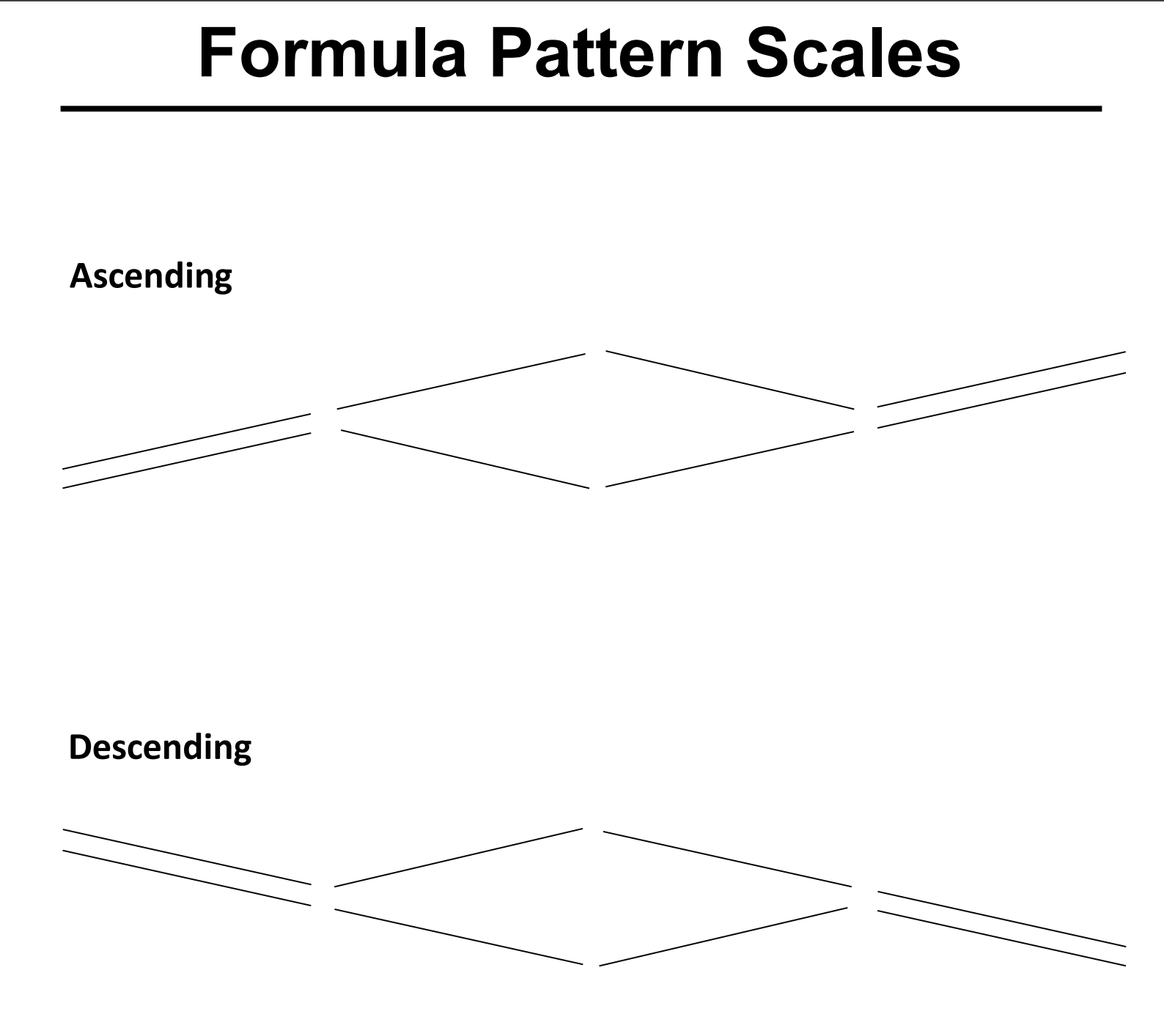
Sina
Half-Way There. You’ll have to look to the finger numbers at the beginning of each hand to know this piece’s position. RH is like C position, but finger 2 goes on C# and finger 3 is on D instead. LH plays only B, Bb and A in this piece.
Warmup with your C, D and G major scales.
Saturday April 8 Lessons – Erin P
Happy Easter everyone! Enjoy the weather and time with your family <3
Isabella
*New* Octavius Octopus – this is a left hand only piece. Practice bouncing from C to C using your thumb and pinky. For the scale coming up, use a nice strong rounded finger 3 to play it.
*New* First 4 bars of Copy Cat. This is a piece where the hands copy each other (lots of pieces do this, it’s how we get a catchy melody). You played the first 4 in class, if you can learn the next 4 bars at home I’ll give you a small prize next week! Both hands are in C position.
Jadon
Interstellar. Keep plugging away, I’ll hear this next week.
Canon x Memories. Hands seperate practice – LH do the descending bass line (can do this with the RH Canon melody also), as well as the arpeggio accompaniment pattern. Look to the paper I wrote up that shows the formula of the chord progression. Also practice the Canon melody with just the RH, and any Memories melodies you wish. Love the blocked chords technique you used in lesson, as well as the slow practice tempo chosen. Keep it up!
Marco
*New* March of the Terrible Trolls. Notice both hands are bass clef. Use the bounce off of the higher LH G to propel you to play the lower G with your pinky. For the Db-Eb part, be sure each note sounds louder than the last, because it is such a short duration to go from piano to forte. For the final RH chord, use fingers 125 but slide in further to the piano (past the line of black keys) so it is easier to reach all the notes. Your forearm should be in line with your hand. Have fun creating a musical story of what the trolls are up to.
Young Ludwig Exploring – Great job with the first 4 lines! This week let’s focus on the latter half where the melodies overlap. Go slow and steady.
Mission Impossible – I knew you could do it! Great work, keep practicing HT like you did last week. We can pretty much play the whole piece very soon :)
Daniel
*New* Allegretto in C. Notice the phrase markings in the RH, they are very important in Baroque music. Be sure to break the line at every one of them. The LH is also to be played detached in this style, ensure each note still gets its full value, just seperate it slightly from the next one. Have fun exploring however much of this one you can this week. Here is a performance for reference.
Crazy Comics – Awesome fingering fixes! I am also very proud of your dynamics! Keep it up, include as many details as possible as you play. At the ending with the Eb in the RH, use finger 4 as I wrote it in so you won’t have to cross under/over at all.
Triads – keep exploring different white key start triads with both hands. Broken and solid, but clean and steady.
Julian
Peter Pan’s Flight – with dynamics this week. Play the RH loud the first time, and then the second one quieter like an echo. Use the pedal to really enhance the mood you are creating, like a soundtrack for a movie with a melody and echo in a watery sound as Peter Pan flies around.
Composing Activity – Follow the worksheet to create a 2 bar C or G position melody (and articulation) that will be plugged into this song about a robot. Then play the song in its entirety, paying attention to the different legato and staccato parts. I’m excited to hear what you create!
Preferred Books for Erin Students
Click to buy them here, and they’ll come right to your house! What could be easier?
BOOK TITLE
COMING SOON
Faber Piano Adventures
The 2nd Edition Level 1 Lesson Book introduces all the notes of the grand staff, elementary chord playing, and the concept of tonic and dominant notes. Students play in varied positions, reinforcing reading skills and recognizing intervals through the 5th. Musicianship is built with the introduction of legato and staccato touches. This level continues the interval orientation to reading across the full range of the Grand Staff. The 5-finger approach is presented here in a fresh, musically appealing way.
Piano Safari