

ARCT • Teachers’ Diploma (RCM) in-progress
Trained Music Together Teacher
Erin Plank (they/he) is a passionate young piano teacher. For their professional development, Erin received the highest exam scores in all of Canada last year for “Teaching Elementary Piano” with the RCM.
Erin’s main goal is to turn students into lifelong music lovers, not just pianists. I seek to provide them with the tools to practice efficiently at home, sight read a song at their friend’s piano, learn the melody to a song off the radio by ear, and nurture a technical foundation that lasts a lifetime so it’s “just like riding a bike” to play the piano. And even better, they’ll want to.
Get to know Erin…Beyond the Bio!
Hobbies: Piano, weightlifting, playing with my cat, and hanging out with friends
Musical influences: Ben Folds, Brad Mehldau, Edvard Grieg
Favourite food: Fried chicken sandwich
Least favourite food: snap peas, because I ate too many as a kid one time and threw up and now I dislike the smell
Favourite music: Romantic era piano music, Beach Boys and similar era music, math rock
Favourite song: “How Dare You Want More” by Bleachers
Favourite movie: Sing Street
Favouirite movie music: main theme for “Eternal Sunshine of the Spotless Mind” or anything Star Wars
Favourite musical theatre/opera: Wozzeck
Best quote from your teacher: “Don’t show the audience you messed up, they won’t know! Keep going!”
Favourite quote: “That’s what life is, Happy Sad”
Favourite book: Recursion by Blake Crouch
Best thing about teaching at ABC: Getting to reach and connect with so many lovely people!
Latest Homework from Erin
Is Erin Your Teacher?
Sign up now to get your weekly assignments delivered, and never lose your homework sheet again!
Thursday March 9 Lessons – Erin P
Enjoy your March break everyone! You work really hard and it shows <3
Liam
*New* Minstrel Song. Be sure to play your Bbs when they occur. Again, balance to the RH melody.
Dark Eyes. Work on playing the LH quieter, like a beautiful violin accompaniment to your RH melody. Try shaping “to” the dotted quarter note, as in make it the loudest, and make a pyramid of sound around it.
Work on your D minor harmonic scales (Bb and C#), and D minor triads. Both hands.
Since it is March break, feel free to use the extra time to work on Duel of the Fates and I will assist you how I can. Remember your F#s.
Fiona
Great job on Grumpy Old Troll!
*New* Russian Sailor Dance. You were amazing reading this today! Continue to pay close attention to the staccato and legato contrast. Remember your rules for sharps, the sharp affects that note for the entire measure, and then the bar line resets it. Remember your bouncy wrist on the staccatos.
D Major scale. Two black notes, F# and C#. Same fingering as your other scales.
Marita
You know all your white key start scales! Woohoo! Keep warming up with these :)
Mist – awesome work! Keep working to eliminate the gaps between each position.
The Snake – you know the ending now! Just pay attention to the fingering changes and you’ve got it. Practice the ending to get the coordination between the hands since that’s the only part where both hands play at the exact same time.
Heavenly Blue – we learnt the latter half of this today! Now you can play the whole thing, I wouldn’t practice it all in one go though, break it into chunks for practicing.
Minuet in C – we didn’t play this today, but practice it all hands together over this March break.
Sara
Keep plugging away at memorizing your repertoire pieces (etudes don’t need to be memorized).
Arabesque – For the LH middle section, practice the 16th notes in random swung rhythms, and then finish off this section practicing it straight ahead as written. This will really help your evenness. Ensure these end with staccato notes (just like the RH does at the beginning).
Sunset at the Beach – There’s only two rhythmic things to fix on the second page, otherwise, awesome! Keep plugging away :)
Technique, start using your metronome as you practice, you can refer to the chart you have to see the minimum required tempos. If there are any specific keys that you struggle with, make note of them, and we can look at those next time.
Sina
*New* Folk Song Mix-Up. Pay close attention to the sharps (#s) and how they rule that note for the rest of the bar, and then the barline resets it. In the last two lines remember to move down one octave in the LH, a concept called 8va.
I have updated the Ready as I’ll Ever Be document in the Google drive to indicate finger numbers and position changes.
I have also uploaded images of C Major triads notes both on the staff and on the keyboard to help you practice your broken (one note at a time, bottom to top) triad patterns. You can use these as a warmup :) Do both hands, but seperate.
Saturday February 4 Lessons – Erin P
Happy February everyone! Happy to see you all :) Stay warm out there.
Isabella
*New Piece* Allegro. This piece is almost entirely skips, except for the phrase endings.
First 8 bars RH of Let It Go. Play with proper fingering, use your thumbs! This piece has F#s in its key signature (new concept), so whenever you see an F in the music, it will be an F sharp (the black note to the right of F). You’ve got this!
Jadon
Page 1 Becoming One with Neytiri. Work on beat to beat getting the coordination of both hands and when they line up. RH accented notes are most important, they must be loud enough that we know they are the melody and they mustn’t get lost in the sea of the other notes. This piece is beautiful and I’m excited to work on it with you!
Grace
Goldberg Variations. M9-12 is a descending sequence, so play it quieter each time. This is called “terraced dynamics” and is a baroque stylistic trait. Establish early on the staccato and legato feel of each hand’s lines and keep it consistent when the lines switch hands.
Cowherd’s Flute. Decide on phrase lengths in LH and mark them in. Once decided, break your phrases consistently in the same spots. There are 3 types of staccato (finger, wrist (for solid 3rds/6ths, that kind of thing) and arm (for big leaps or repeated octaves). This piece uses finger staccato. This feels like scratching a spot of the keys.
Marco
Page 1 Boat of Tai Lake. Good job keeping the melody connected across both hands. Use the written fingering for the LH in the bottom line of the first page.
Chorus of Never Gonna Give You Up in the RH. Continue working on the beginning: there are 4 LH notes in each bar, and the first one the RH plays at the same time = think Together. The next RH note comes halfway through the bar = think Between. Play this rhythm on your lap, Together L R L L.
E Major scale. Same fingering as your other scales (as written on the handout) and has 4 black keys. F#, G#, C#, D#.
Daniel
*New Piece* Detectives. Bouncy LH staccatos, and use the written RH fingering, it is very nice. Have fun with this one!
Ecossaise. Solidify LH fingering, your thumb never needs to leave Bb. Use the written fingering and practice the LH a lot until the fingering is brainless. Good job being picky with the RH articulations!
The Snake. Do the dramatic dynamic swells every time you play. Fix LH fingering in line 4, use 1-2 under. Practice this fingering correctly tons so your brain replaces any bad muscle memory.
Angelfish. Evenness! There are sometimes where the groups of 3 8th notes want to turn into triplets and we can’t have that – count 1+2+ consistently. Whenever you feel the rhythms start to slip and become uneven, break it down and play just 1 beat of notes over and over again like we did in class. This technique is called “beat to beat” practicing.
Shelton
*New Piece* Sailor’s Tall Tale. The new concept here is ties. This is when the curvy line connects two of the SAME note, and it combines the value of them both. These LH A whole notes are tied together, making one note you hold for 8 beats. Hold it down while your RH plays. Keep your hands in the starting position and use the written fingering.
D Major scale. Same fingering as your other scales, but with two black keys. F# and C#. Great work!
Julian
*New Piece* My Detective Agency. You read this so well today! It repeats a lot, usually the first time is loud and then the repeat is a softer echo. Be picky with what notes are staccato and which ones aren’t, that’s what makes it sound sneaky!
D Major scale. Same fingering as your other scales, but with two black keys. F# and C#. Great work!
Preferred Books for Erin Students
Click to buy them here, and they’ll come right to your house! What could be easier?
BOOK TITLE
COMING SOON
Faber Piano Adventures
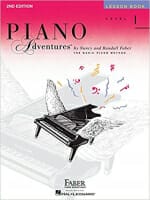
The 2nd Edition Level 1 Lesson Book introduces all the notes of the grand staff, elementary chord playing, and the concept of tonic and dominant notes. Students play in varied positions, reinforcing reading skills and recognizing intervals through the 5th. Musicianship is built with the introduction of legato and staccato touches. This level continues the interval orientation to reading across the full range of the Grand Staff. The 5-finger approach is presented here in a fresh, musically appealing way.
Piano Safari