M.Mus (U of T)
B.Mus (Oberlin)
Guitarist Gergely Szabo has an Advanced Diploma in Music Performance from Cambrian College where he majored in the classical guitar. Over his time there, he completed 2 years of comprehensive pedagogy courses. He also gained well grounded vocal skills, as well as basic knowledge on the piano. Outside of classical music, he exhibits a repertoire of skills and knowledge in playing the genres of rock, blues, and heavy metal music. He has experience in teaching the guitar and the ukulele to a range of people aged 6 to 54.
Gergely’s teaching methods include both the use of books and digital methods. The three main books he uses to teach guitar are as follows: “Guitar Method Book 1 by Will Schmid and Greg Koch,” “Four Star Sight Reading and Ear Tests RCM Level 1,” and “Classical Guitar Repertoire and Etudes RCM Level 1.” For teaching ukulele, he uses the book “Ukulele Songs for 1, 2, or 3 players by Elizabeth Ragsdale.” Aside from these, he frequently uses the Muse Score application as a play-along practicing tool.
Gergely’s passion for music and his dedication to growing the love of music in others are the biggest reasons why he teaches guitar and ukulele. His approach to teaching involves learning through play. The material he covers with his students is always delivered in a way that is highly interactive. Most of the assigned exercises he gives involve the elements of play that students can enjoy both in class and as homework.
Get to know Gergely…Beyond the Bio!
Coming soon!
Hobbies:
Musical influences:
Favourite food:
Least favourite food:
Favourite music:
Favourite album:
Favourite movie:
Favourite musical theatre/opera:
Best quote from your teacher:
Favourite quote:
Favourite book:
Latest Homework from Gergely
Is Gergely Your Teacher?
Sign up now to get your weekly assignments delivered, and never lose your homework sheet again!
Dalia — Sep 29th
Hi Dalia!
Nice meeting you yesterday! Here’s what to play this week.
Legend:
- The full dots are which frets to hold down
- The white dots are the open strings. No frets held down
- The X means you avoid playing that string
- SP = Strumming Pattern, D = Down, U = Up
- Rest = don’t play; be silent. Remember to use your hand to silence the strings
- RH = Right Hand
- LH = Left Hand
- LH fingers: 1 = index, 2 = middle, 3 = ring, 4 = pinky
Strumming Patterns
Play the following SP’s. Do each one over the following chords. One SP on only one chord at a time.
“Pineapple Rest Rest!” — D DU rest rest
“Watermelon Che-rry!” — DUDU D D
“Apples Peaches Plums and Pears!” — DU DU DU D
C

- That number 4 on the dot means to use finger 4 on your LH
- Put it on fret 3 of the A string
F

- Put finger 2 on fret 2 of the G string
- Put finger 1 on fret 1 of the E string
Dm

- Finger 2 on fret 2 of the C string
- Finger 1 on fret 1 of the E string
- This one is challenging because you have to avoid playing a string
- The challenge makes you a better ukulele player!
Thanks Dalia! See you next week!
Hudson — Sep 29th
Hi Hudson!
Nice meeting you yesterday! Here is what to do this week.
Memorize the string names
This link has all the string names. I’ll quiz you on which one’s which next week.
- “Eat A Darn Good Breakfast Everyday.” — This is the acronym that can help you memorize it
- “High E string” really means the one closer to the floor when holding the guitar. We speak upside-down in guitar because by higher, we mean higher pitched
Em (E minor) chord

This diagram represents the fretboard and the fingerings for this chord. LH (Left Hand) finger numbers:
- 1 = index
- 2 = middle
- 3 = ring
- 4 = pinky
The horizontal lines represent the frets.
^ This legend applies to the following chords I would also like you to play.
- SP (Strumming Pattern) to try on all the chords: D UD UDU
- D = Down, U = Up
E chord

C chord

- The X means that’s the string you don’t play
- This chord will be the most challenging due to the stretchy fingering and the string to avoid playing
Em pentatonic scale

The black dots on this diagram represent where to put your LH fingers down as you play this scale. The frets are vertical in this diagram — Sorry, I wasn’t able to access uniform direction diagrams this week.
- The grey dot is what most guitars have to label the frets 3, 5, 7, 9, and 12. They label these ones because these are very commonly used in scales on guitar
- The letters are the note names — You’ll start to memorize these as you progress on the guitar
- The E string that’s on the top of this diagram is the High E string — Again, it’s the one closest to the floor
Em pentatonic jam
Try playing any notes in any order from the scale above with this backing track. I know it will be quite challenging but the idea here is to start to acquaint yourself with the instrument more and more. https://www.youtube.com/watch?v=TSm2EhPZHFo
- Do not feel like you have to go as fast as this track. You can go twice as slow as it’s going. Or slower. You should get creative with what to play within the limits of what you have on your hands, here. That is, the notes you see in the scale above
- So: The only rule is to use the same notes as what you see in the scale above
Thanks Hudson. I’ll see you next week!
Preferred Books for Gergely’s Students
Click to buy them here, and they’ll come right to your house! What could be easier?
Hal Leonard Guitar Method
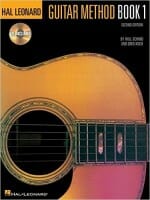
The second edition of this world-famous method by Will Schmid and Greg Koch is preferred by teachers because it makes them more effective while making their job easier. Students enjoy its easy-to-follow format that gives them a solid music education while letting them play songs right away. Book 1 provides beginning instruction including tuning, 1st position melody playing, C, G, G7, D7, and Em chords, rhythms through eighth notes, solos and ensembles and strumming.
Four Star Sight Reading and Ear Tests