

Guitarist Gergely Szabo has an Advanced Diploma in Music Performance from Cambrian College where he majored in the classical guitar. Over his time there, he completed 2 years of comprehensive pedagogy courses. He also gained well grounded vocal skills, as well as basic knowledge on the piano. Outside of classical music, he exhibits a repertoire of skills and knowledge in playing the genres of rock, blues, and heavy metal music. He has experience in teaching the guitar and the ukulele to a range of people aged 6 to 54.
Gergely’s teaching methods include both the use of books and digital methods. The three main books he uses to teach guitar are as follows: “Guitar Method Book 1 by Will Schmid and Greg Koch,” “Four Star Sight Reading and Ear Tests RCM Level 1,” and “Classical Guitar Repertoire and Etudes RCM Level 1.” For teaching ukulele, he uses the book “Ukulele Songs for 1, 2, or 3 players by Elizabeth Ragsdale.” Aside from these, he frequently uses the Muse Score application as a play-along practicing tool.
Gergely’s passion for music and his dedication to growing the love of music in others are the biggest reasons why he teaches guitar and ukulele. His approach to teaching involves learning through play. The material he covers with his students is always delivered in a way that is highly interactive. Most of the assigned exercises he gives involve the elements of play that students can enjoy both in class and as homework.
Get to know Gergely…Beyond the Bio!
Coming soon!
Hobbies:
Musical influences:
Favourite food:
Least favourite food:
Favourite music:
Favourite album:
Favourite movie:
Favourite musical theatre/opera:
Best quote from your teacher:
Favourite quote:
Favourite book:
Latest Homework from Gergely
Is Gergely Your Teacher?
Sign up now to get your weekly assignments delivered, and never lose your homework sheet again!
Homework for April 23-30
Great work today everybody! I enjoyed teaching you. Here is this week’s homework:
Georgia
Recommended mins to practice: 15-20 min per day
What to practice: Minuet/Trio
How to practice: Slow, hands separate until you’re very comfortable, then try hands together. Pay attention to the 3/4 timing. Continue to count out loud like you did in the lesson, it will help. You improved drastically from the beginning of the lesson to the end.
How parents can support practice: Listen and guide her with rhythm. Give positive encouragement.
Noreet
Recommended mins to practice: 15-20 min per day
What to practice: The Daydream, kitchki
How to practice:
The Daydream- use piano dynamics as written when playing the major version. Practice the minor version more so that you are prepared to play it without stumbling, since you don’t have music to look at for that part.
Kitchki- play the chromatic scale the same speed as you play the chords, even if that means you have to slow down the chromatic scale to accommodate the chords.
How parents can support practice: Listen and guide as needed.
Clara
Recommended mins to practice: 15-20 minutes per day
What to practice: Pink Panther, Ukrainian Folk Song
How to practice:
Pink Panther- play more with dynamics. Start quiet and then play loud at the climax.
Ukrainian song- review the two spots we discussed in line 2. Practice lines 3 and 4 hands separate, then once very comfortable try hands together.
How parents can support practice: Listen and guide as needed.
Andrew
Recommended minutes to practice: 15-30 minutes a day
What to practice: On My Own, breathing exercises
How to practice:
To warm up, inhale for 4 and exhale for 4, then inhale for 4, hold for 4, and exhale for 4, and finally inhale for 4, hold for 4, and exhale for 8. Place your hand on your diaphragm to feel it rising and falling.
On My Own (this can also be applied to any song or technique), practice opening your throat, lifting the soft palate, and relaxing facial muscles. This will help ease the tension when hitting high notes and overall healthier singing. With any song, it takes practice to get used to the amount of energy you need to get through the whole piece. Pace yourself; follow the emotional arc of the song and save singing at full volume for the moments you really need to.
Homework for April 22-29
Nova
Rec min to practice: 15-20 per day
What to practice: Ode to Joy for concert
How to practice:
Song structure:
Theme x2
Bridge
Theme x2
Bridge
Final Theme
Continue with the dynamic buildup. For the beginning, play the softest you can without losing sound quality. By the second theme, it should already be in the moderate loud range. Make the final theme a 10/10 on a scale from soft to loud, so that it’s epic. Practice the final chord.
Eighth notes in Bridge: Practice with funky rhythms both ways a few times and then do it normally. Round fingers will make for greater control.
How parents can support practice: Listen and guide as needed. Specifically give feedback on gradual buildup of dynamics (soft to loud) in Ode to Joy.
Maya
Rec min to practice: 10-15 min per day
What to practice: C-D-E
How to practice: Remember that notes with white heads have two beats. Count out loud while practicing, and use a metronome to make sure you are playing the correct rhythm.
How parents can support practice: Make sure she uses the metronome, and help her with rhythm, especially when it comes to fixing the half notes. Make sure she understands the difference between half notes and quarter notes.
See you next week:)
Efe – November 1st
Hi Efe and family! Wishing you a great weekend!
Below are the items I’d like Efe to work on this week.
Ode to Joy
- The circled areas on the sheet music only. I’d like these played more fluidly.
- 68bpm.
Blues
- I haven’t revealed the note names or the frets for this piece. The exercise is to locate the notes on the guitar. We did this in class and Efe did well on it. Doing this at home is a fair challenge for him.
Little Drummer Boy in D Major
— Listen to this. (This line should provide you with a link. If it doesn’t, then search up Little Drummer Boy by Pentatonix.) This is a modern version of the song. The key they perform it in is different from ours. Ours is in D Major. (I’ll talk about keys in more detail next time.) I just want you to get to know how the song is supposed to sound when sung with at least one voice.
— Play this song at both 70bpm and 115bpm.
- The video within this Google Drive link is of me demonstrating the strumming pattern and some transitions of the song at both tempos. https://drive.google.com/drive/u/0/folders/1cURXZdyFoL_6FZX5V4COTxCljwXKq8wO
- It may be helpful to practice alongside the video; in that you do what I’m doing in the video.
— The 2 pictures in the above Google Drive link have the strumming pattern and the sequence of the chords.
- I’ve shortened it; this way, you’ll be learning the main parts of it.
— The strumming pattern is the exact same all throughout. Every chord has the same strumming pattern. The only difference is the last bar, which is just an open D chord; I’ve highlighted this in green.
— The first strum is circled. It should be the loudest one for each bar; so, strum it the hardest :)
— The only tab I’ve written is the frets for each chord. We looked at each of these 3 chords in class today so holding them down properly should not feel new.
— Try this song both standing and sitting.
- In both ways of playing, remember to push the guitar head outward from your body. (Or as I usually say, forward.) Remember the triangle analogy from today. Point your guitar and your left hand out from roughly the centre of your body. Doing so will help you maintain proper posture in both of your wrists.
Good work this past week, Efe. Keep it up! See you in a week!
Efe – October 25th
Hi Efe and family! Wishing you guys a great week!
Ode to Joy was looking quite good today. I’m very happy with where we are for this piece.
Below are the following items of homework for Efe this week: an exercise and a piece aimed at the improvement of the techniques we’ve been working on lately. There’s also a game I’ve given Efe to play.
Outside picking on the circled areas of Ode to Joy.
- 20 minutes a day.
- 68bpm.
- Work on these most of all. They’re the hardest things to work on this week.
- Spend time working on these circled areas alone in one day, if that’s all you have time for.
- It’s important that we isolate these hard parts of a piece first. Without doing so, the following problem will take place: when playing an entire piece from beginning to end, the same mistakes are made over and over. Whether the mistakes are technical or in the sound of the music. Hence, we must work on the hard parts first so that they are sounding clean. Then after this, we can connect all the parts into a seamless piece of music.
Ode to Joy — the whole piece.
- 15 minutes a day.
- 68bpm.
- Like I said: only do this part once the hard parts are not so hard anymore.
Strumming game.
- 10 minutes a day.
Play any chord you know well with the strumming pattern in the following picture. Do each tempo I have given. Then play it at whatever tempo you want. It should feel fun. This is a game to play and to try out different tempos in. It’s also a great chance to experiment with how to strum chords. (Since your guitar is a steel-stringed acoustic, Efe, you can strike the strings fairly hard. Not too hard, of course, because you don’t want to damage your guitar.)
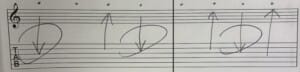
- 75bpm.
- 68bpm.
- A tempo of your choosing.
- I’ve changed the strumming pattern slightly.
— This is the amount of strumming that happens in 2 separate bars. That black line in the middle represents the separation of the bars. The dots at the top represent the 4 quarter notes that fit within each bar.
— I’ve circled the Downward arrows so as to emphasize that these are the strums that are supposed to sound louder. They should feel “stronger” than the upward arrows.
Lastly:
- Every 5 minutes during practice, check to see how the left hand is looking. Make sure it is as straight as possible while playing. Feel free to manipulate the guitar’s position relative to your body in order to achieve a straighter wrist.
- Use a metronome for all the parts that I’ve added a specific tempo.
- These times are just what I would ask to be done within a day ideally. I know it’s not always possible, so just do what you can everyday. For example, the 30 minutes on 3 or more days this past week was effective. Good work on that.
Keep up the good work, Efe. I’ll see you in a week!
Preferred Books for Gergely’s Students
Click to buy them here, and they’ll come right to your house! What could be easier?
Hal Leonard Guitar Method

The second edition of this world-famous method by Will Schmid and Greg Koch is preferred by teachers because it makes them more effective while making their job easier. Students enjoy its easy-to-follow format that gives them a solid music education while letting them play songs right away. Book 1 provides beginning instruction including tuning, 1st position melody playing, C, G, G7, D7, and Em chords, rhythms through eighth notes, solos and ensembles and strumming.
Four Star Sight Reading and Ear Tests