M.Mus (U of T)
B.Mus (Oberlin)
Guitarist Gergely Szabo has an Advanced Diploma in Music Performance from Cambrian College where he majored in the classical guitar. Over his time there, he completed 2 years of comprehensive pedagogy courses. He also gained well grounded vocal skills, as well as basic knowledge on the piano. Outside of classical music, he exhibits a repertoire of skills and knowledge in playing the genres of rock, blues, and heavy metal music. He has experience in teaching the guitar and the ukulele to a range of people aged 6 to 54.
Gergely’s teaching methods include both the use of books and digital methods. The three main books he uses to teach guitar are as follows: “Guitar Method Book 1 by Will Schmid and Greg Koch,” “Four Star Sight Reading and Ear Tests RCM Level 1,” and “Classical Guitar Repertoire and Etudes RCM Level 1.” For teaching ukulele, he uses the book “Ukulele Songs for 1, 2, or 3 players by Elizabeth Ragsdale.” Aside from these, he frequently uses the Muse Score application as a play-along practicing tool.
Gergely’s passion for music and his dedication to growing the love of music in others are the biggest reasons why he teaches guitar and ukulele. His approach to teaching involves learning through play. The material he covers with his students is always delivered in a way that is highly interactive. Most of the assigned exercises he gives involve the elements of play that students can enjoy both in class and as homework.
Get to know Gergely…Beyond the Bio!
Coming soon!
Hobbies:
Musical influences:
Favourite food:
Least favourite food:
Favourite music:
Favourite album:
Favourite movie:
Favourite musical theatre/opera:
Best quote from your teacher:
Favourite quote:
Favourite book:
Latest Homework from Gergely
Is Gergely Your Teacher?
Sign up now to get your weekly assignments delivered, and never lose your homework sheet again!
Saturday, Sept 19
Renaud
1. Equipment
Please purchase a pair of drumsticks and a practice pad.
Recommended stick brands include:
- Vic Firth
- ProMark
Look for sticks in either 5A or 7A size.
Recommended practice-pad brands include:
- Vic Firth
- Remo
- Evans RealFeel
If you decide to get a drum set, I recommend renting one from Long & McQuade for now rather than purchasing one immediately.
2. Basic Drum-Set Beat
Work on the basic beat notated on the handout.
Until a drum set is available, use pillows to represent the hi-hat and snare drum, and tap the bass-drum part with your foot.
If the full beat feels difficult, separate it into smaller instrument groups:
- Hi-hat and snare drum
- Snare drum and bass drum
- Bass drum and hi-hat
Practise each combination until it feels comfortable, then gradually put all three parts back together.
3. Practice-Pad Exercises
Work on the exercises found in the latter part of the handout. Play these on the practice pad and regularly check your technique against all the checkboxes provided.
The goal is not simply to finish each exercise. Listen and watch carefully to make sure you are meeting every technical goal before moving on.
Jonah
Congratulations to Jonah for a successful first go at an orchestral audition, and despite not making the group, Jonah should be proud of what he achieved. I would like to share some words from the instructor who audited:
“Jonah did fantastically at the audition. I hope that he received a note of positivity and appreciation from the management because I specifically asked them to reach out to him about that.
Jonah was extremely well prepared which gave an excellent first impression. He was a maybe for me, but unfortunately the level was too high after him and he got bumped out by 1 spot. I can’t take more than 5 and he was no. 6. I felt a little better when I saw that he was 13 because he would probably get a lot more out of the experience when he is a little older.
I really hope he keeps working and comes back to audition in the future. His overall energy level was a little down in terms of the repertoire. I didn’t feel a ton of musical connection, but he could’ve been nervous. Snare drum needed attention in terms of dynamics, but rhythm was solid. I think he really just needs to keep pushing. Lots of time left for him to develop and get in down the line!”
We will resume the mallet/drumming bi weekly module, and for this week on mallet, we started a ragtime from the “Xylophone Rags of George Hamilton Green” book.
https://drive.google.com/file/d/1LcvQkrNaUPDcf4i5Hdft4kkzqKFxQVYD/view?usp=drive_link
We will work on Triplets, P.50 on the pdf. Jonah please follow the sticking and use the blocking method to get used to the movements. Whenever there is a dyad (double stop), play out the top note, and we will talk more about the underlying melody next and how we should play it to the style of ragtime. Please work on the first two line, and note that the second line is the same as the first line in the first half of the phrase, so Jonah will only need to figure out the second half of that line.
Sam
Please use the following link for any of the class material in the future:
https://drive.google.com/drive/folders/1GdlS8_ljwuhMfCgquixFVbGJSHtKLZFG?usp=drive_link
I was absolutely blown away by Sam’s playing level, especially considering that he has only been playing the drums for three months! We will proceed with “Smells Like Teen Spirit” as our first project together.
Sam figured out the coordination very quickly. Our next goal is to understand how the pattern fits within the song’s timing and the underlying framework of the beat.
Although Sam may already be able to play along with parts of the song, understanding the counting and subdivision is essential. This will help him remain secure in the music and find his place again if he ever falls out of sync with the track.
Practise the first two bars with a metronome, beginning at a slow and comfortable tempo.
- Practise the first bar by itself.
- Practise the second bar by itself.
- Make sure the notes align with the correct subdivision.
- Once both bars feel comfortable with the metronome, connect them.
- Continue repeating the two-bar phrase until the pulse feels stable.
- Only then begin increasing the tempo gradually.
Accuracy and rhythmic understanding are more important than reaching the song’s full tempo right away.
If the first two bars are resolved quickly, begin working on the beat from the bridge section, found on line 4 of the handout.
Use the same process:
- Learn each bar separately.
- Practise slowly with a metronome.
- Check the counting and subdivision.
- Connect the bars only when each one feels secure.
- Gradually increase the tempo while maintaining a stable pulse.
Thursday, September 17
Lukas
- Stick Control
Great work on the assigned exercises! We are beginning to hear better evenness between your two hands.
Remember that the goal is not to play each exercise once and immediately move to the next. Repeat each exercise several times while checking that you are:
- Producing an even stream of single strokes
- Matching the sound and stick height of both hands
- Using a relaxed, consistent stroke
- Allowing the sticks to rebound naturally
- Staying rhythmically steady
Only move on when the exercise feels effortless and you can produce the same result consistently each time.
This week, continue the previously assigned exercises and add:
- Stick Control, page 6
- Stick Control, page 8 (containing the triplet exercises)
- https://drive.google.com/file/d/1mWcq9DUEUqKd_NBsZ5mer8exNMfGaLOz/view?usp=drive_link
For the triplet exercises, play the bass drum on every beat and use it as your rhythmic anchor.
- “Hotel California”
When playing a four-bar phrase, always keep track of which bar you are on. While playing the third bar, you should already be mentally preparing for what happens in the fourth bar.
Practice approach
- Practise with a metronome.
- Make sure you thoroughly understand each subdivision, especially in phrases containing thirty-second notes.
- Isolate and loop each bar containing a fill.
- Repeat the fill until you feel confident that you could play it accurately in any bar of the phrase.
- Reconnect the fill to the bars before and after it without losing the pulse.
At our next lesson, we will begin with a play-through with the music, continuing through the end of Chorus 2.
Finn
We have started learning “Imposter” by Arrester, Finn’s dad’s band!
The main pattern is similar to what Finn learned in “Otherside,” but this song introduces some new concepts:
- A drag/three-stroke ruff in the introduction
- A catchy fill involving an open-and-closed hi-hat pattern
- Introduction
Remember the counting carefully:
- Finn enters on beat 4.
- Play stick clicks on beats 1, 2, and 3.
Keep counting internally so the entrance and stick clicks remain securely in time.
- Bar 2
Review the pattern in bar 2 and practise it repeatedly without stopping.
The goal is to play it as one continuous phrase rather than as separate bars. Pay particular attention to connecting the buzzed snare smoothly into the beginning of the next bar.
There is an exercise notated at the bottom of the page specifically for practising this connection. Work on that exercise separately before returning to the full pattern.
- Optional Fill Practice
If Finn would like a head start on the fill:
- Begin by learning and vocalizing the rhythm.
- Ask Dad to help demonstrate or count the rhythm.
- Try playing the passage together.
- Add the open-and-closed hi-hat movements only after the basic rhythm feels comfortable.
Focus first on playing the rhythm accurately and keeping the pulse steady. The coordination can be added gradually.
Aleksander
Aleksander has a clean grasp of the intro section and my only comment is for him to follow the stockings in practise, so it becomes second nature for the phrase. We have moved on to verse 1, and I have asked Alex to try to keep the same spirit of the intro despite playing less in this section. Clean, accurate, smooth transitions. For this week please also try the pre chorus lick as well, which Alex has already demonstrated in class that he is fully capable of working out the coordination, and now is onto bringing it up to speed.
Zico
We picked up where we left off with “Drum Corps on Parade.” Since Zico has not had many opportunities to practise over the past few weeks, we spent this lesson working through the previous homework together.
Goal for Next Lesson
Let’s aim to play through to the end of line 5 by our next lesson.
- Five-Stroke Roll
To better understand the timing of the five-stroke roll, first practise the underlying rhythm as sixteenth notes.
When working on the passage:
- Replace the five-stroke roll with regular sixteenth notes.
- Play the entire phrase this way until its rhythm and shape are clear.
- Once you know how the phrase should sound, put the roll back in.
- Make sure the roll fits into the same rhythmic space without changing the timing.
This will help the roll feel like part of the phrase rather than a separate interruption.
- Triplets and Sextuplets
Be careful not to rush the triplets or sextuplets. Give each note its full amount of space and maintain an even pulse.
Try practising with the bass drum playing on every beat. This may feel challenging at first, but once it becomes comfortable, the bass drum will provide a reliable reference point and make it easier to hear whether the hands are rushing.
- PAS Rudiments
I have attached a PAS Rudiments Chart, which includes all the rudiments found in the piece.
For now, please focus on:
- No. 22: Flam Tap
- No. 23: Flamacue
Practise these slowly and aim for clear flams, even spacing, and consistent sticking before increasing the tempo.
Koel
Congratulations to Koel for making the school band! We will work on YYZ by Rush for next week. I gave Koel one tip to work on section B through isolating the snare and bass drum and practising RLRR and LRRL with those two limbs. Start slow and aim for 120 bpm. Again, the speed comes secondary, but clarity and fluidity is the goal here. Also practise all the repeats with metronome to make sure he has the right subdivision.
Preferred Books for Gergely’s Students
Click to buy them here, and they’ll come right to your house! What could be easier?
Hal Leonard Guitar Method
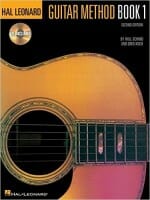
The second edition of this world-famous method by Will Schmid and Greg Koch is preferred by teachers because it makes them more effective while making their job easier. Students enjoy its easy-to-follow format that gives them a solid music education while letting them play songs right away. Book 1 provides beginning instruction including tuning, 1st position melody playing, C, G, G7, D7, and Em chords, rhythms through eighth notes, solos and ensembles and strumming.
Four Star Sight Reading and Ear Tests