Guitarist Gergely Szabo has an Advanced Diploma in Music Performance from Cambrian College where he majored in the classical guitar. Over his time there, he completed 2 years of comprehensive pedagogy courses. He also gained well grounded vocal skills, as well as basic knowledge on the piano. Outside of classical music, he exhibits a repertoire of skills and knowledge in playing the genres of rock, blues, and heavy metal music. He has experience in teaching the guitar and the ukulele to a range of people aged 6 to 54.
Gergely’s teaching methods include both the use of books and digital methods. The three main books he uses to teach guitar are as follows: “Guitar Method Book 1 by Will Schmid and Greg Koch,” “Four Star Sight Reading and Ear Tests RCM Level 1,” and “Classical Guitar Repertoire and Etudes RCM Level 1.” For teaching ukulele, he uses the book “Ukulele Songs for 1, 2, or 3 players by Elizabeth Ragsdale.” Aside from these, he frequently uses the Muse Score application as a play-along practicing tool.
Gergely’s passion for music and his dedication to growing the love of music in others are the biggest reasons why he teaches guitar and ukulele. His approach to teaching involves learning through play. The material he covers with his students is always delivered in a way that is highly interactive. Most of the assigned exercises he gives involve the elements of play that students can enjoy both in class and as homework.
Get to know Gergely…Beyond the Bio!
Coming soon!
Hobbies:
Musical influences:
Favourite food:
Least favourite food:
Favourite music:
Favourite album:
Favourite movie:
Favourite musical theatre/opera:
Best quote from your teacher:
Favourite quote:
Favourite book:
Latest Homework from Gergely
Is Gergely Your Teacher?
Sign up now to get your weekly assignments delivered, and never lose your homework sheet again!
Thursday, April 16th
Josh
We worked on a beat to play with his sister for the song Baby Bear. The rhythm that I would like Josh to pair it with, is the Carol of the Bells rhythm, with bass drum and hi-hat played on left and right foot. I have come up with a small fill for Josh to end it with, however he needs to workout how to cue his sister for the end of the song.
Aleksander
Aleksander has been making good progress playing Bring Me to Life. However I would just like him to isolate troubling bars more often in practise rather than playing through phrases. We will look to play through the whole song with music next week.
Finn
We worked on Otherside this week. We have now notated how many times each bars are being repeated and how one transition to the next. One thing that I am noticing is that Finn is moving his hands away after playing a buzz roll on the drum. Remind him to stay in place after doing a buzz, so that he can play those bars on repeat. We will look to go from verse into chorus next class. Also since he is looking to play Clocks for recital, I will like to give it a listen next class.
Mateo
Mateo has been making major progress on Labios Compartidos particularly on page 2. We played with the music today for this page, and I would like to remind Mateo to not try to start quarter note sections too fast, as that will give him a hard time when he has to play 16th note fills. Again, focus down bars that are giving you trouble and be clinical with how you approach practising. Give page 3 a read and we will look to complete the song soon.
Koel
We talked a lot about his band class experience and I shared with him a lot about the proper ways to play orchestral instruments. I have also notated sticking for his band class assignment for him to practise it with. When approaching mallet rolls, think of it as playing fast 32nd notes, but play odd numbers of repetition (3,5,7 etc.) We will go back to working on Fool in the Rain next week.
Efe — April 18th
Hi Efe!
I know this week will be super busy for you, so I’m making this practice plan super specific. So that you don’t waste time practicing anything you don’t need for now. Remember, our priority is for you to play at the recital. It’s only 2 weeks away, so that’s all we’re gonna be working on for now.
Boulevard of Broken Dreams
Google Drive Apr 18th. The newest video is in this Google Drive link. This is the only video you need for this week.
— For all the parts you would be playing alongside the video to practice, slow the video down to 0.5x speed. — Remember, 168BPM might not be what you’ll actually play it at on the day of. I just want you playing it comfortably.
- 84BPM is what I want you practicing this piece at, if you don’t have access to this video.
— At about 15 minutes in, the sound quality of this video is awful. It only gets worse from there. I didn’t have time to fix the issue. So I have run down what is covered when in the video. Seeing it with the information below should help you navigate the video and practice with it.
— The rundown:
- Specific exercises are detailed in the first 15 minutes. There are no major sound quality issues in this excerpt of the video. — Most of these involve playing pairs of bars individually; so two bars at a time, and with a bar of rest right after. Keep repeating this. Each exercise consists of repetitions of the given bars with a bar of rest right after. — Do this for all the pairs of bars that are highlighted in this video.
- 15:15 — The “another ending” part of Riff 2 described. All down-strummed. This part’s about remembering to count for yourself where you are in the music. — In this case: count 16 quarter notes of the B5 chord.
- 16:05 — The updated Riff 3. Powerchords, now. Instead of the single notes I was gonna get you to play. All down-strummed. — For where you see the powerchord with frets 2 & 4: As described, do fret 0 on the low E string and fret 2 on the A string. Fret 2 being held with finger 1.
- 16:45 — Powerchord with frets 3 & 5 instead of frets 5 & 7. The C5 chord on the A & D strings.
- 16:55 — More powerchords with the same idea; practice it two frets down from what the video shows.
- 17:10 — A fairly hard transition. It’s a pretty big jump with fingers 1 and 4.
- 17:35 — 17:10’s pair of bars to practice.
- 18:20 — The frets 3 & 3 unusual powerchord. (Frets 1 & 1 for this week.) Use finger 1 on the A string and finger 2 on the D string. Just these 2 strings. Remember: A challenge with the powerchords will be to hit only the 2 (or 3) strings that are in them.
- 19:55 — Riff 3 w different ending — All down-strummed.
- 20:15 — The very ending. — This is played twice as fast as its preceding powerchords. — Same practice plan: do that bar, do a bar of rest. Repeatedly.
- 21:48 — Me giving some closing remarks that you won’t be able to hear, haha.
— The PDF of this song is also in that G Drive. I recommend that you print it out and work with it, too.
— I am pushing you to do a little bit each day. These goals are made so that they’re all realistic for you to be able to achieve in a maximum of 2 weeks’ time.
You’ve got this, Efe. I’ve seen that you know what to do. Now you must push on to be better for next week! I’ll see you then!
Efe October 4th
Hi Efe and family! Here is the material to work on for this week.
Aim to do this practice routine once a day leading up to our next lesson. I’ve written out ideally how long Efe should practice these items in a day. If practicing in these time-lengths is not possible, then do as much as is possible in a day.
- Play everything here with a metronome. Tempos are listed for each item.
- Practice both standing and sitting. Maintain proper posture as we discussed in class. For classical positioning, have the guitar head high up. For casual positioning, have the guitar head far forward. Remember, we’re always aiming to make both wrists fairly straight.
- Please get the Guitar Method 1 book this week. The Amazon link is attached. The videos of the scales we covered today are accessible in the homework post from 2 weeks ago.
- Practice the following pieces from the Guitar Method 1 book:
Alternate pick the following pieces (picking Down-Up-Down-Up):
- Page 8 #11. 55BPM. One quarter note per beat. — 5 minutes.
- Page 9 #12, #13, and #14. 55BPM. One quarter note per beat. — Make sure to read the paragraph at piece 14. — 10 minutes altogether.
- I want Efe to start getting into the habit of alternate picking things. This will be done in countless other guitar playing he will come across.
Down pick the following piece (only pick down):
- Page 9 #15. 55BPM. One quarter note per beat. 5 minutes.
- C major scale. 45BPM. One quarter note per beat. — 10 minutes.
- A minor pentatonic scale. 45BPM. One quarter note per beat. — 10 minutes.
- Chords. Keep playing all the chords we have covered so far. Just play them freely, to a tempo no faster than 60BPM. — 5 minutes.
You can do this, Efe. It will only get easier with time. See you in a week!
Efe homework – Sep 27th
Hello Efe and family! Wishing you guys a great weekend!
Below is the rundown of material to work on from today’s lesson. Aim to do this practice routine once a day leading up to our next lesson.
- Practice everything with a metronome.
Tempos are listed for each item.
- Please get the Guitar Method 1 book this week. The Amazon link is attached. There is homework from it. Aside from this, the videos of the scales we covered today are accessible in the homework of last week.
- Play the guitar both standing and sitting. Try playing all the chords we’ve covered so far, both while seated and while standing. – 10 minutes.
Make sure you’re always wearing a guitar strap. This will ensure that your posture on the instrument is good regardless of whether you’re standing or sitting.
- C Major scale – 10 minutes. 45 BPM.
This is a classical scale. Its fingerings were found out by Andrés Segovia. He found that these were the most efficient possible fingerings for the major and minor scales on the classical guitar. Playing this scale and anything else from classical music calls on the most efficient and strict posture on the whole body of the guitarist. This means that the guitar head must be held so high that the instrument looks almost like a cello. As well, your thumb must be behind the guitar neck so that no one from in front of you can see it. So whether standing or sitting, make sure that the guitar is positioned in such a way that the wrists are straight. Remember, the adjusting the strap properly will help. Playing this scale in any other way will result in injury of the guitarist’s hands or body.
- A minor pentatonic scale – 10 minutes. 45 BPM.
This scale is used in the genres rock, pop, folk, country, heavy metal, and more. For these genres, it is not quite as strict how the guitar must be held. However, the rule I will enforce is that you play with the guitar head pushed forward, away from your body. Remember, twisting the wrist slightly will help you get the right position. Also: having the thumb on top of the guitar neck (as opposed to the classical hand position) is a good thing to help you maintain a suitable posture for this scale.
- Practice pieces 2 and 3 from page 6 of the Guitar Method 1 book. Then try playing as much as you want of anything from page 7. – 15 minutes. 60 BPM.
While they might be good beginner pieces, the challenge here will be to make sure you’re playing right on the beat of the metronome. I noticed that playing things exactly on the beat was more of a struggle today.
Thank you for your work this past week, Efe. Keep it up! You’ve got this! I’ll see you in a week!
Preferred Books for Gergely’s Students
Click to buy them here, and they’ll come right to your house! What could be easier?
Hal Leonard Guitar Method
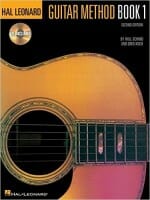
The second edition of this world-famous method by Will Schmid and Greg Koch is preferred by teachers because it makes them more effective while making their job easier. Students enjoy its easy-to-follow format that gives them a solid music education while letting them play songs right away. Book 1 provides beginning instruction including tuning, 1st position melody playing, C, G, G7, D7, and Em chords, rhythms through eighth notes, solos and ensembles and strumming.