M.Mus (U of T)
B.Mus (Oberlin)
Guitarist Gergely Szabo has an Advanced Diploma in Music Performance from Cambrian College where he majored in the classical guitar. Over his time there, he completed 2 years of comprehensive pedagogy courses. He also gained well grounded vocal skills, as well as basic knowledge on the piano. Outside of classical music, he exhibits a repertoire of skills and knowledge in playing the genres of rock, blues, and heavy metal music. He has experience in teaching the guitar and the ukulele to a range of people aged 6 to 54.
Gergely’s teaching methods include both the use of books and digital methods. The three main books he uses to teach guitar are as follows: “Guitar Method Book 1 by Will Schmid and Greg Koch,” “Four Star Sight Reading and Ear Tests RCM Level 1,” and “Classical Guitar Repertoire and Etudes RCM Level 1.” For teaching ukulele, he uses the book “Ukulele Songs for 1, 2, or 3 players by Elizabeth Ragsdale.” Aside from these, he frequently uses the Muse Score application as a play-along practicing tool.
Gergely’s passion for music and his dedication to growing the love of music in others are the biggest reasons why he teaches guitar and ukulele. His approach to teaching involves learning through play. The material he covers with his students is always delivered in a way that is highly interactive. Most of the assigned exercises he gives involve the elements of play that students can enjoy both in class and as homework.
Get to know Gergely…Beyond the Bio!
Coming soon!
Hobbies:
Musical influences:
Favourite food:
Least favourite food:
Favourite music:
Favourite album:
Favourite movie:
Favourite musical theatre/opera:
Best quote from your teacher:
Favourite quote:
Favourite book:
Latest Homework from Gergely
Is Gergely Your Teacher?
Sign up now to get your weekly assignments delivered, and never lose your homework sheet again!
Dalia — Oct 20th
Hi Dalia!
It was a great class today! Here is what to play this week.
Old Strumming Patterns
Play last week’s strumming patterns on all of last week’s chords.
- Do them all of the chords we’ve looked at so far. Including G7
New Strumming Patterns
- Free Apple Pie, Apple Pie is mine! — SP: D DUD DUD D D
- I am go- nna eat some lunch! — SP: D D D D | D D D — That line in the middle is a bar line. Count to 7 and you’ll be able to play this. — By go -nna, I mean “gonna.” Just space out the word into two separate beats
— Do them all of the chords we’ve looked at so far. Including G7
— The fun sentences have now been entered. Thank you for your patience!
Twinkle Twinkle Little Star
Play the whole first melody like we did in class.
- Pick only the E string
- Frets in the melody’s order: 0 0 7 7 9 9 7
- Be very tough on those strings. You’re a strong young girl so I know you can do it!
Thanks guys! I’ll see you next week!
Hudson — Oct 20th
Hi Hudson!
Here’s what to play this week.
Spanish Influence


- Play them in this order
- 4 strums per chord
Chords
- Keep playing the same chords as last week
- Get your fingers used to the chords
Single string games
— E string
- Frets: 5, 3, 0, 0 — repeated
- LH Fingers: 4, 1, 0, 0
— B string
- Frets: 5, 3, 0, 0 — repeated
- LH Fingers: 4, 1, 0, 0
— High E string “shred”
- Fret 0 of the high E string
- Pick through the E string up and down. You can go as fast as you like but in a controlled manner
- Remember: Have only your RH’s thumb and index finger on the pick
— Hot cross buns

- Frets: 0 on the high E string, 3 & 1 on the B string
- Note names: E, D, and C; corresponding to these^ frets
- Note order: E D C E D C CCCCDDDDE D C — I’ll soon post the guitar tablature to this page
- Have a metronome playing for this. 35BPM per quarter note. — All E & D notes here are quarter notes
— Try to figure out Mary Had A Little Lamb

- The first 3 note names are the same as for Hot Cross Buns
- Try figuring out the rest of it. 35BPM per eighth note for this one
- Disregard that pink lock — it’s my software’s way of showing that that’s the max number of bars to put in one line
- It’s not super important that you do this. But try it if you can
All of these games are made so that they strengthen your LH fingers. You gotta be nice and tough on those strings.
- When you get tired, rest and stretch
- If you don’t stretch during such a rest period, at least make sure to stretch after the practice session
Thanks a lot Hudson. See you in a week!
Dalia — Oct 13th
Hi Dalia!
Here is what to play this week.
Strumming Patterns
Do the SP’s on each chord. — The first 4 chords are in last week’s post. Here is the newest one: G9. — This is easier than a G chord. Strum all four strings. The orange numbers represent which fingers to hold down the frets with. The diagram is now horizontal; what you see as the lowest string there is G. Going up from there completes the acronym GCEA.

- “Strawberries and Apples!” — DUDUD D
- “Grapes! Grapes! Snozzberry grapes!” — D, D, D DUD
- “Peaches, Pears, Pumpkin Pie!” — DUD DUD
- Feel free to play the ones from last week too. But please make sure you are doing these^ ones
- You did really well on these in class!
Twinkle Twinkle Little Star
Just pick twice on each of the first 2 notes. SP: D D. Keep repeating this.
- Fret 0 on the E string
- Then fret 7 on the E string
- Picking is done with a smaller movement of your RH. Push down through the string with mostly your thumb
- Make sure to have the pointed part of the pick be the one plucking through the string
Additional notes
- The LH (Left Hand) nails need cutting to be able to hold down frets properly. Please do that as soon as possible. — Please cut the RH (Right Hand) nails, too
- Remember to stretch your hands after an ukulele playing session. Just like we did in class today
Thank a lot, guys! See you in a week!
Hudson — Oct 13th
Hi Hudson!
Here is what to focus on this week.
Chords
- The newest chord is A minor (Am)
- Do strumming patterns on each chord — Examples: 1. D UD UDU. Make the down-strums the stronger strums. 2. D D D D. 3. Strum down and up slowly. D U D U


Sliding games
- Hold down any fret. Pick it, and before the note dies, slide up and down the string
- Hold down fret 2 of the G string. Pick it, and slide up to fret 4. Upon letting fret 4 ring, pick the B string. — This should sound like country music
Scales
Look at last week’s post to see what scale is what.
- Play the Em pentatonic scale. Go all the way up then all the way down
- Blues scale games. — Get comfortable with adding that fret 1 and that fret 3. 1 — Play only the frets you can find on the A string in this scale and keep cycling them. 0 1 2, 0 1 2, 0 1 2… 2 — Play only the frets you can find on the G string in this scale and keep cycling them. 0 2 3, 0 2 3, 0 2 3…
Imaginative help
Playing the above things can get boring. So imagine what scene of a movie would be playing alongside each of the tasks I’ve given you this week.
Remember: Just 5 minutes a day on one of these things is good practice. It is indeed better than not practicing at all.
Thank you, Hudson. See you in a week!
Preferred Books for Gergely’s Students
Click to buy them here, and they’ll come right to your house! What could be easier?
Hal Leonard Guitar Method
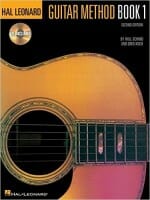
The second edition of this world-famous method by Will Schmid and Greg Koch is preferred by teachers because it makes them more effective while making their job easier. Students enjoy its easy-to-follow format that gives them a solid music education while letting them play songs right away. Book 1 provides beginning instruction including tuning, 1st position melody playing, C, G, G7, D7, and Em chords, rhythms through eighth notes, solos and ensembles and strumming.
Four Star Sight Reading and Ear Tests