Guitarist Gergely Szabo has an Advanced Diploma in Music Performance from Cambrian College where he majored in the classical guitar. Over his time there, he completed 2 years of comprehensive pedagogy courses. He also gained well grounded vocal skills, as well as basic knowledge on the piano. Outside of classical music, he exhibits a repertoire of skills and knowledge in playing the genres of rock, blues, and heavy metal music. He has experience in teaching the guitar and the ukulele to a range of people aged 6 to 54.
Gergely’s teaching methods include both the use of books and digital methods. The three main books he uses to teach guitar are as follows: “Guitar Method Book 1 by Will Schmid and Greg Koch,” “Four Star Sight Reading and Ear Tests RCM Level 1,” and “Classical Guitar Repertoire and Etudes RCM Level 1.” For teaching ukulele, he uses the book “Ukulele Songs for 1, 2, or 3 players by Elizabeth Ragsdale.” Aside from these, he frequently uses the Muse Score application as a play-along practicing tool.
Gergely’s passion for music and his dedication to growing the love of music in others are the biggest reasons why he teaches guitar and ukulele. His approach to teaching involves learning through play. The material he covers with his students is always delivered in a way that is highly interactive. Most of the assigned exercises he gives involve the elements of play that students can enjoy both in class and as homework.
Get to know Gergely…Beyond the Bio!
Coming soon!
Hobbies:
Musical influences:
Favourite food:
Least favourite food:
Favourite music:
Favourite album:
Favourite movie:
Favourite musical theatre/opera:
Best quote from your teacher:
Favourite quote:
Favourite book:
Latest Homework from Gergely
Is Gergely Your Teacher?
Sign up now to get your weekly assignments delivered, and never lose your homework sheet again!
Homework for Efe – Week of Sep 21st-26th
Goals
- Get your hands and arms used to positioning as we’ve been working on in class.
- Memorize the Left Hand fingerings of the Am pentatonic and C major scales.
- Get a feel for both standing and sitting while playing.
- Aim to practice for 45 minutes a day if you can. If that’s not possible then still do as much as you can in one day. Even if that’s only a little bit.
Warmup
- Play the C, Em, and G chords. Get the blood flowing in the fingers and arms of both hands. 10 minutes.
Chords
- The G and D piece. Play a G chord and let it ring for 3 beats, then transition to a D chord on beat 4. Then play a D chord and let it ring for 3 beats, then transition back to a G chord. Be mindful of letting the chords ring for all 3 beats; don’t rush to the transitions. It should never feel too fast.
- I’ve attached a picture of the fingerings of the G and D chords.

- Saying “Hey!” On beat 3 could help.
- 40 BPM.
- This piece is supposed to train the Left Hand to adjust its positioning accordingly with each chord. Pay close attention to the position of your Left Arm.
- 20 minutes.
Memory
- Memorize the Left Hand fingerings of the Am pentatonic and C major scales. Before you even attempt to practice them.
- 5 minutes.
Scales
- Am pentatonic. Try playing it with using only fingers 1 and 4. Then try playing it with the fingerings you’ll have memorized from above.
- C major.
- Both at 42 BPM.
- 10 minutes.
Additional notes
- Do half your practice sitting and the other half standing.
- Do this stretch at the end of each longer guitar session. It’s demonstrated and explained in the following link. (If you only did about 10 minutes of practice in one day then don’t worry about it. Do this stretch if you did any more than that.) https://www.youtube.com/watch?v=9tC6sVlnpqY
- Stretch your fingers and hands in any way you want after a longer guitar session. As long as you do some, it counts.
- I have your notebook and pencil, Efe :) just don’t forget to take it home next time. I’ll have it for you next lesson.
- Please buy the book in this link. We’ll be working on some pieces from it in class. This is the only book I’d like you to get for this week. https://www.amazon.ca/GUITAR-METHOD-BOOK-SONGBOOK-CD/dp/0793533929/ref=as_li_ss_tl?ie=UTF8&qid=1480282241&sr=8-14&keywords=hal+leonard+guitar+method+cd+book+1&linkCode=ll1&tag=abacofmu-20&linkId=c46d9f40616531bb8a5d685c39b486e0
Assignments from Thursday September 18th
Hello Everyone!
Thank you for all your hard work this past week! We’re making some great progress!
Georgia
Today we looked at page 26 of the Alfred’s piano method book. We reviewed note values and time signatures and discussed how many beats can fit in each bar as dictated by the time signature given for the specific song. We also learned what D.C al Fine and Fine mean in music. These are Italian terms that will help guide Georgia through the “map” of the song. D.C al fine (Da Capo al fine) is used to indicate that the pianist should return to the beginning of the song and play until the bar marked “fine”, this is the “end” of the song. When practicing the song on page 26, please remind Georgia of these markings! Georgia has also been given a new worksheet to fill out this week. The worksheet reviews notes written in the bass clef. Using the mnemonic phrases “Green Bugs Don’t Fly Away” and “All Cows Eat Grass” Georgia should fill in the letter name for each note in her worksheet. We will correct this next week in class. Please also remind Georgia to practice “The Clown”. She can use her new mnemonic sayings to read the notes in the left hand. Remember, please do not write the letters in the book to help challenge Georgia’s sight-reading skills!
Noreet:
Today we reviewed the Elf’s Silver Hammer and talked more about how to tell a story with music based on certain musical choices like which octave to play in and how soft or loud to play a song. We also reviewed the left hand of Ode to Joy and sight-read the left hand. Noreet’s focus this week should be the left hand as it varied between to patterns of notes. When she has played the whole song start to finish with the left hand, encourage challenge her by isolating one phrase in the left hand and asking her to play it for you! Please help Noreet by reminding her that the left hand starts with descending notes before jumping back up. Noreet can start to play the first 3 lines of Ode to Joy hands together! Review the left and right hands separately before practicing these lines hands together. When practicing hands together, encourage Noreet to play slowly so that she can take note of when her left and right hand move in contrary motion (opposite directions) and when they play in parallel motion (same direction).
Benji:
We used Benji’s new Piano Adventures Lesson book in class today! Thank you for picking this up! In the book, we reviewed Little River. When practicing this song at home this week, try using a metronome! You can find this for free via google. The metronome taps the beat of the song to help reinforce a steady tempo (speed). Set the metronome to 85BPM (beats per minute) and encourage Benji to play the notes in time with the metronome. Each quarter note should be the same length as 1 click of the metronome, while each half note is worth 2 clicks. Use the metronome to ensure each quarter note is played for an equal amount of time (1 beat, no more no less). Please help Benji practice Little River by reminding him that the entire first phrase should be played with his right hand as dictated by the treble clef (the tall curly symbol) written at the start of the line, and the entire second phrase is played in his left hand as dictated by the bass clef (the backwards C symbol) written at the start of the second phrase. We will review this next week.
Eva:
Today we learned the first phrase of “Classic Dance”. When practicing Classic Dance, remind Eva that her hands should be in C-Position with the thumb of her right hand, and the 5th finger of her left hand both on a C (they should be one octave apart C-C). Her other 4 fingers should line up with the 4 notes above C (D,E,F,G) with the thumb of her left hand, and 5th finger of her right hand both on a G. When practicing, encourage Eva to not move her fingers from their designated note! She can play the opening two chords in her left and right hands with her 1st, 3rd, and 5th fingers, then step down the scale at the end of the phrase with her 4th finger, 3rd finger, 2nd finger, and 1st finger (thumb). We will review these fingerings next week in class. Please note, the first and last lines of this song are identical! Encourage by reminding her that she already know two thirds of the song! Have Eva read both lines this week. We can learn the middle line in class together.
Clara:
Today we played The Giraffe! We recorded both The Giraffe and Ladybug today so that Clara could hear her performance for herself. Continue to encourage this listening activity at home so that Clara can decide what she likes about playing a song and where she might want to improve. When reviewing Ladybug, Clara pointed out that her favourie part of the song is the phrase with the F# in it. She likes that this part sounds a little odd compared to the rest of the song. We then learned why it sounds odd by reviewing some scales and key signatures. Clara has a worksheet with the scales C-B Major, she knows these scales up to A, E Major and B Major are new. On the back of this sheet is a Circle of 5ths. We learned that the circle works like a clock to tell us how many sharps or flats a specific key signature has. Clara knows that if you move one space to the right, you add one sharp to the key signature. Using the circle, please have Clara fill in the missing sharps in the E Major and B Major scale of the worksheet. Finally, we started the Haunted Mouse! This is review for Clara as this song appears in the Piano Adventures Level 1 book. Encourage her to practice this song hands together at home and let her record herself when she feels ready.
Christian:
I’ve uploaded a copy of the Scientist for you! You can find that here. For this week, practice forming the chords hands separately. Once you can confidently identify and play the notes used in each chord, you can then practice switching from chord to chord with both hands together – play each chord only once. Pay attention to which inversion of the chord you play and where your fingers have to move to from chord to chord. When you fee confident in building the chords and the chord progression, you can refer back to the sheet music and practice alternating hands – remember, you always start the new chord with your right hand!
Thank you everyone!
Have a great week!
Preferred Books for Gergely’s Students
Click to buy them here, and they’ll come right to your house! What could be easier?
Hal Leonard Guitar Method
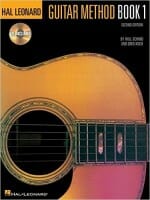
The second edition of this world-famous method by Will Schmid and Greg Koch is preferred by teachers because it makes them more effective while making their job easier. Students enjoy its easy-to-follow format that gives them a solid music education while letting them play songs right away. Book 1 provides beginning instruction including tuning, 1st position melody playing, C, G, G7, D7, and Em chords, rhythms through eighth notes, solos and ensembles and strumming.