M.Mus (U of T)
B.Mus (Oberlin)
Guitarist Gergely Szabo has an Advanced Diploma in Music Performance from Cambrian College where he majored in the classical guitar. Over his time there, he completed 2 years of comprehensive pedagogy courses. He also gained well grounded vocal skills, as well as basic knowledge on the piano. Outside of classical music, he exhibits a repertoire of skills and knowledge in playing the genres of rock, blues, and heavy metal music. He has experience in teaching the guitar and the ukulele to a range of people aged 6 to 54.
Gergely’s teaching methods include both the use of books and digital methods. The three main books he uses to teach guitar are as follows: “Guitar Method Book 1 by Will Schmid and Greg Koch,” “Four Star Sight Reading and Ear Tests RCM Level 1,” and “Classical Guitar Repertoire and Etudes RCM Level 1.” For teaching ukulele, he uses the book “Ukulele Songs for 1, 2, or 3 players by Elizabeth Ragsdale.” Aside from these, he frequently uses the Muse Score application as a play-along practicing tool.
Gergely’s passion for music and his dedication to growing the love of music in others are the biggest reasons why he teaches guitar and ukulele. His approach to teaching involves learning through play. The material he covers with his students is always delivered in a way that is highly interactive. Most of the assigned exercises he gives involve the elements of play that students can enjoy both in class and as homework.
Get to know Gergely…Beyond the Bio!
Coming soon!
Hobbies:
Musical influences:
Favourite food:
Least favourite food:
Favourite music:
Favourite album:
Favourite movie:
Favourite musical theatre/opera:
Best quote from your teacher:
Favourite quote:
Favourite book:
Latest Homework from Gergely
Is Gergely Your Teacher?
Sign up now to get your weekly assignments delivered, and never lose your homework sheet again!
Assignments for the week of May 13-20
Josh Shuster
Keep working on “Livin on a Prayer,” focusing on the ride cymbal groove for the chorus, as well as the fill right before the guitar solo.
How to practice it most effectively: Practice the chorus (Ride cymbal) groove with and without the music! Maybe practice the song from YouTube at 0.75 playback speed.
Myles Jubé
Practice “Dreaming” on drum set – the full song now! And for next week try to play through what we’ve done for “Dreaming” on xylophone so far. Next week we’ll also try some new stuff!
How to practice it most effectively: have fun with it!
Finnian Romero
Keep working on “Livin on a Prayer,” focusing on the groove for the chorus, and the fills.
How to practice it most effectively: Practice the chorus (Ride cymbal) groove with and without the music! Maybe practice the song from YouTube at 0.75 playback speed.
Francisco Garcia
Use the link in your Drive to practice the groove in the first 4 bars of “locked out of heaven.” Try to figure out the kick groove and get the groove as fast as you’re able to. No pressure to make it as fast as the song yet, I just want to see if you can play / loop the groove correctly at whatever speed you can make it.
How to practice it most effectively: see if you can play on YouTube with the playback speed reduced.
Jared Portus
Keep doing what we were doing before – grooving along to songs, playing with the swing of the hi-hat or ride cymbal, and the loose-ness of the snare and kick hits in relation to your right hand. Come up with fills as well!
Practice the “throw / grab” motion when playing 16th note grooves on the hi-hats / ride (song to practice this to – Chelsea Reject “Kidulthood”)
Songs we played along to:
MF DOOM – “Figaro”
J Dilla – “Time: The Donut of the Heart”, “Don’t Cry” (has tempo changes that make it maybe not the best song to play along to)
Jacob Collier – “Time Alone With You (feat. Daniel Caesar)”
D’Angelo – “Devil’s Pie”
JID – “Money”
Albums to listen to if you have some time!
J Dilla – DONUTS
MF Doom / Madlib – Madvillainy
D’Angelo – Voodoo
A Tribe Called Quest – The Low End Theory
Koel Rayner
Keep practicing the groove for “Squabble Up,” make sure you’re playing the hi-hats correctly. Try to find where in the song the variations come in on the kick drum. We’ll try a new song this week.
I know you have exams coming up so absolutely no pressure if you don’t have time to practice this week.
Saturday, May 10
Jack
Great job concentrating and keeping time this class! We created a cool drum pattern to play with Thriller today and we will look to get familiar with the pattern next class!
Nova
We have now fully learnt Cupid and our goal is to record a video next week with myself on accompaniment! If stuck on a tricky rhythm, count out loud and get comfortable with the syncopation!
Aleksander
Great progress on Living on a Prayer! We played through until pre chorus. Practise it under tempo and when you feel more comfortable with the transition, go a little faster and eventually try play it at original speed with the recording.
You also grasp the triplet rhythm nicely, but make sure you play it in time! Give chorus a read, and we will aim to play through that next lesson!
Jonah
The Simpson
The tune is very very tricky and Jonah you did a great job nailing the notes! You also showed great understanding on how to practise tricky licks through repetition and practising step by step BUT you need to have the dedication to do it at home as well! In order to do your best on your performance coming up, try to familiar yourself with many of those licks as possible, and always remember to count!
Jared
Bring Me To Life
Bar 24 and 25 have been your nemesis of late! BUT you are closer than you think! The third and fourth beat of bar 24 and first two beats of bar 25 are super similar, which is the reason why you have been confusing them. Subdivide! Practise the RIGHT pattern, repeat! We will aim to go on next week, and play till bar 45.
Mario
Warm Up with triplet and 16th notes exercise, go for evenness and relaxation!!!
Great great progress on My Friend as we played through first page. We are now at 65 bpm right now and original speed is at 84. When possible practise with metronome at home and crank up the speed when you feel comfortable! We will read through till Guitar Solo next week!
Preferred Books for Gergely’s Students
Click to buy them here, and they’ll come right to your house! What could be easier?
Hal Leonard Guitar Method
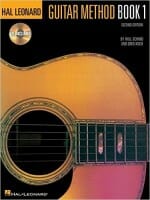
The second edition of this world-famous method by Will Schmid and Greg Koch is preferred by teachers because it makes them more effective while making their job easier. Students enjoy its easy-to-follow format that gives them a solid music education while letting them play songs right away. Book 1 provides beginning instruction including tuning, 1st position melody playing, C, G, G7, D7, and Em chords, rhythms through eighth notes, solos and ensembles and strumming.
Four Star Sight Reading and Ear Tests