
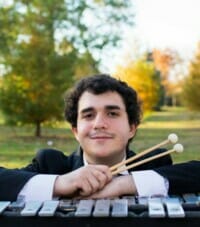
B.Mus (Oberlin)
M.Mus (U of T)
Louis “Pino” Pino is from Dix Hills, NY and is a recent graduate of Oberlin Conservatory, having studied percussion with Michael Rosen and computer music with Aurie Hsu and Joo Won Park, and is currently pursuing a master’s degree in percussion performance at the University of Toronto with Aiyun Huang. Pino began his musical career playing drum set and hand drums with several local ensembles, and moved on to study at the Juilliard Pre-College, where he received the Commencement Award upon graduation. When arriving at Oberlin, Pino had the opportunity to collaborate with many students at the conservatory and has come to premiere over 50 new chamber and solo works written by himself and his peers.
In addition to performing, Pino teaches a small studio of students and is an active composer of electroacoustic music. He often writes music for instruments and interactive electronics, and collaborates in creating interdisciplinary works with dancers and film artists. Outside of music, Pino likes to spend time cooking, hammocking outdoors, and competing in food challenges.
Get to know Pino…Beyond the Bio!
Hobbies: Cooking, Hammocking
Musical influences: Chet Baker, Bela Bartok, Olivier Messiaen, The Strokes
Favourite food: Sushi
Least favourite food: Peanut butter
Favourite music: Hip-Hop, Contemporary Classical
Favourite song: Alvin Row – Animal Collective
Favourite movie: Taxi Driver
Favouirite movie music: Taxi Driver OST
Favourite musical theatre/opera: Saint François d’Assise – Messiaen
Best quote from your teacher: “Play pretty.”
Favourite quote: “ Fear is the path to the dark side. Fear leads to anger. Anger leads to hate. Hate leads to suffering.” Master Yoda
Favourite book: The Stand – Stephen King
Best thing about teaching at ABC: Watching young minds grow a bit more every week.
Latest Homework from Pino
Is Pino Your Teacher?
Sign up now to get your weekly assignments delivered, and never lose your homework sheet again!
April 3 – April 8
ALL TEXT IN BLUE IS “CLICKABLE” AND LINKS TO RESOURCES.
Ella
- Practice the hit-tap technique. Here is a video explaining it. I made it for another student who is learning to play fast, which the technique is also good for, but you’re learning it so that you get that LOUD-soft hi-hat sound.
- Play along to the song! Have fun! If you don’t have a copy of the recording, here is the YouTube version.
Eric
- Print this sheet to work on. Practise the exercises with a metronome. Start with the metronome at 50 bpm (beats per minute). Once you feel comfortable with that tempo, raise it to 60 bpm. Then 70. Then 80. You can go faster if you’d like, but 80 is fine for now. The clicks of the metronome represent quarter notes, so they should occur at the same time as your bass drum and hi-hat notes. Use a “layered entry”: start by just playing the foot pattern along to the metronome, then start counting 16th notes, and finally come in with your hands (you can stop counting if you’d like).
- Practise the beat from Immigrant Song along to a metronome at 50 bpm. Then increase the tempo to 60. Then to 70. You can go faster if you’d like, but 70 is fine for now. Use a layered entry: start by just playing the hi-hat part, then add the snare drum, and finally come in with the bass drum.
- Free play: Have fun! Play whatever you want!
Sylvie
- “Getting those limbs independent” worksheet
- Polish up number 1 and practise number 2. We’ll leave numbers 3 and 4 for another time.
- Remember to do a “layered entry”: start by just listening to the metronome, then count 16th notes out loud, and finally come in with the pattern (you can stop counting if you’d like).
- Drum fills
- Polish up the first fill and practise the second one, too. We’ll leave the others for later. Use a metronome at 40 bpm.
- Do a layered entry: start with the bass drum playing quarter notes, then count 16th notes, and finally come in with the fill.
- Free play: Have fun! Play whatever you want!
March 27 – April 4
ALL TEXT IN BLUE IS “CLICKABLE” AND LINKS TO RESOURCES.
Ella
Practise the Another One Bites the Dust beat with the drum fill we worked on at the end of every bar. Practise with a metronome at 50 bpm (beats per minute). Once you can do that comfortably, try it at 60 bpm. Then try it at 70 bpm, which is this week’s tempo goal. Each metronome click equals a quarter note.
Eric
- Print this sheet to work on. Only do numbers 1-4. Practise them with a metronome. Start with the metronome at 50 bpm (beats per minute). Once you feel comfortable with that tempo, raise it to 60 bpm. Then 70. Then 80. You can go faster if you’d like, but 80 is fine for now. The clicks of the metronome represent quarter notes, so they should occur at the same time as your bass drum and hi-hat notes.
- Practise the beat from Immigrant Song along to a metronome at 50 bpm. Then increase the tempo to 60. Then to 70. You can go faster if you’d like, but 70 is fine for now.
Sylvie
- Here is a clearer copy of the limb independence exercises we worked on. The exercises may not be exactly what you have written, but they will still be helpful. Practise them with a metronome at 40 bpm (beats per minute). Each metronome click equals one quarter note.
- Practise the accent patterns Pino gave you where the right-hand accents are played on the floor tom and the left-hand accents are played on the high tom. The only difference is that this time, I want you to play quarter notes on the bass drum, too. You do not need to alternate between the accent patterns and the drum beats written above them, like you did last week. Play along to a metronome at 40 bpm.
Preferred Books for Pino’s Students
Click to buy them here, and they’ll come right to your house! What could be easier?
STICK CONTROL
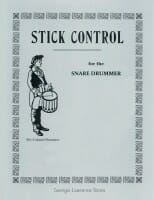
George Lawrence Stone’s Stick Control is the bible of drumming. In 1993, Modern Drummer magazine named the book one of the top 25 books of all-time. In the words of the author, it is the ideal book for improving: control, speed, flexibility, touch, rhythm, lightness, delicacy, power, endurance, preciseness of execution and muscular coordination, with extra attention given to the development of the weak hand.
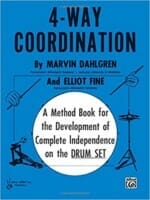
4-Way Coordination
Rockin' Bass Drum, Bk 1
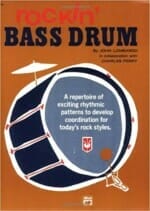
Written in two volumes, these books include 2- and 4- bar rock and jazz-rock beats designed for the modern drummer. Both books are designed to develop the drummer’s skill in coordinating their hands and feet. The books also offer the drummer a repertoire of exciting rhythmic patterns.