
Guitarist Gergely Szabo has an Advanced Diploma in Music Performance from Cambrian College where he majored in the classical guitar. Over his time there, he completed 2 years of comprehensive pedagogy courses. He also gained well grounded vocal skills, as well as basic knowledge on the piano. Outside of classical music, he exhibits a repertoire of skills and knowledge in playing the genres of rock, blues, and heavy metal music. He has experience in teaching the guitar and the ukulele to a range of people aged 6 to 54.
Gergely’s teaching methods include both the use of books and digital methods. The three main books he uses to teach guitar are as follows: “Guitar Method Book 1 by Will Schmid and Greg Koch,” “Four Star Sight Reading and Ear Tests RCM Level 1,” and “Classical Guitar Repertoire and Etudes RCM Level 1.” For teaching ukulele, he uses the book “Ukulele Songs for 1, 2, or 3 players by Elizabeth Ragsdale.” Aside from these, he frequently uses the Muse Score application as a play-along practicing tool.
Gergely’s passion for music and his dedication to growing the love of music in others are the biggest reasons why he teaches guitar and ukulele. His approach to teaching involves learning through play. The material he covers with his students is always delivered in a way that is highly interactive. Most of the assigned exercises he gives involve the elements of play that students can enjoy both in class and as homework.
Get to know Gergely…Beyond the Bio!
Coming soon!
Hobbies:
Musical influences:
Favourite food:
Least favourite food:
Favourite music:
Favourite album:
Favourite movie:
Favourite musical theatre/opera:
Best quote from your teacher:
Favourite quote:
Favourite book:
Latest Homework from Gergely
Is Gergely Your Teacher?
Sign up now to get your weekly assignments delivered, and never lose your homework sheet again!
Efe — May 2nd
Hi Efe!
Proceed to check out the bands I described in last week’s Homework Post.
— An artist I’m adding: Megadeth.
- The same way: be warned about the content in their music. It’s controversial and dark.
Acoustic Open
Here’s the link to its Unlisted YouTube video. Link.
— Work on the first 16 bars.
- Practice it at 0.75x speed.
- Remember: finger 3 is never used in these bars. There are a lot of stretchy Left Hand positions and fingerings here. Be mindful of posture and push the guitar forward from your left side. — Anytime there’s a question relating to posture and the comfort & strength of your Left Hand, it’s usually helpful to push the guitar forward from your left side.
- Alternate picked. Pay close attention to this. Down-Up Down-Up Down-Up. (It can help to know that Down is usually played a bit louder than Up.) Where there are rests, just down-pick.
— The goals:
- LH (Left Hand) technique, in those stretchy positions.
- Getting used to alternate picking.
- Learning to locate the where what notes are played on the fretboard from the musical notation.
See you in a week!
Saturday, April 25th
Jack
Jack has been making good progress with Seven Nation Army but just at times lacking focus. I am ready to move him onto a new song as he has been able to play with the music and displayed the ability to change from pattern to pattern.
Nova
Going forward Nova’s assignment will always be in three part: a reading exercise, a rudiment page from stick control or other method books and section of the song we are working on. The rudiments assigned this week focuses on triplet and is geared towards learning our new song Sparkles by REDWIMP. Practise the triplet exercise pulsing every beat on the bass drum, so they know they are playing the triplet accurately. For the reading exercise, I would like Nova to work on two lines each week. We did the first two line this week. I told Nova they have the choice of either practising it at home, or we will do it as sight reading during lesson. Either way I would like them to read more. As for the new song, I have showed the first phrase. I will like them to try to read the song until bar 52 this week.
Adam
Since Adam has no drum set to practise on these past few weeks, I have resorted to giving him more rudiments exercise to work on. On the Stick Control book, he did a good job on the 16th notes exercise, and I would like him to try the page next to it which will introduce him to double strokes and roll in general. On top of that, I have assigned him several two bar drum patterns from the Drumset Musician book. This will get him well prepared to approach Under the Bridge when we are back to working on the song.
Jonah
We played through Superstition this week with the music, and Jonah did a superb job despite all the crazy transitions and how complicated the rhythms are. I have assigned Super Bad by James Brown to him this week. Please print it out and I would like him to first only work on the main pattern which is the first bar. That bar gets repeated a lot until the bridge section.
Efe Homework Dec 6th
Hi Efe!
Wishing you and your family a great two weeks! On Saturday December 13th I won’t be teaching, so you have two weeks to work on the following material.
General notes
- Warm up before practice sessions. It doesn’t matter what strings or frets you play. Just start picking the strings on the guitar at a fairly brisk speed so that the blood starts flowing in the right hand. Then do some simple but physically straining fingerings on the frets while strumming the guitar so that the blood starts flowing in the left hand. — 5 minutes altogether is enough for one session.
- Make sure to give your hands rest during all practice sessions. Then at the very end, do some stretching on your hands and arms.
String Crossing melody
- 65BPM fastest. Practicing without a metronome is fine. But you must also learn to be able to play with a metronome much more comfortably. It should feel like a helpful tool to get you on the correct, steady speed of the melody or piece at hand. It can help to tap your foot on the ground as you play, or nod your head to its beats.
- Be mindful of the picking pattern. It is always down-up-down-up.
- It might look like a simple melody. And it is. But the reason this should be a challenge is because of all the things you have to pay attention to while playing it. Right Hand: picking directions. Left Hand: use only fingers 4, 1, and 2.
- Do 2 repetitions of this whole melody in a row and then rest for at least 2 bars. — Those huge colon looking things and the double lines at the start and end of this melody mean repeat what’s between them.
- See my picture of the added guitar tablature for this melody in this Google Drive: https://drive.google.com/drive/u/0/folders/1cURXZdyFoL_6FZX5V4COTxCljwXKq8wO
- That Blues piece from the Guitar Method 1 book is going to be left out for these 2 weeks. This melody is covering things that the Blues piece was aimed at getting you to improve on.
D & G chords’ transitioning exercise
Well done on getting the D major chord fingering right today.
- Stick to this correct D major chord fingering.
- One bar per chord. 4 beats per bar. Transition to the next chord at the next bar. Don’t feel rushed to get to the next chord. Music should almost never feel too fast to play. Only transition on beat 3. — This being said: Just do this exercise slowly. 55BPM at the very fastest.
More chords
Play the E major chord, as you normally would. (The picture is in the above Google Drive. The fingering is indicated with the numbers there.) Then play the B major chord the way we covered it in class. Repeat these 2 chords over and over. Just like the G & D chords’ exercise.
- No strict timing for this. I just want you to learn how it physically feels to play these chords, and how these two in particular complement each other. — We were discussing musical keys today. If you were to play something in the key of E (in this case, major), then these two chords are beautiful together. B should feel like you want to play it loudly, and E can be the quieter chord. (Although: it can feel extra energizing to play E major at least as loudly as you did B major, haha.)
- I know you’ve played the E minor chord in a previous song. Here is where we cover the E major chord.
B major chord
- This B major chord is played up the guitar neck, with the thumb.
- Fingerings from the E string up to the G string: 5, 3, 4, 2. — by “finger 5,” I just mean the thumb.
- Frets from the E string up to the G string: 7, 9, 9, 8.
- Really feel like you’re clamping down on the low E string from behind in order to get a proper sound out of it. — I know this was tough to do. I’d like to see how much you improve on this over these two weeks. It should only be somewhat sore after doing it properly. If it hurts a lot, definitely take a rest. But when done enough times, and properly, this should end up feeling like a comfortable way of playing this chord. It is physically straining, but still comfortable. Remember: strong, straight, comfortable. Keep trying it.
Little Drummer Boy
- Keep trying this with its respective videos. (They’re in the same Google Drive folder.)
- Don’t worry about being fast. Go as slow as you need in order to play it accurately.
- Do it both sitting and standing.
Today was a good lesson. There is plenty of work for you to do here, haha. But I know you can do it. Remember: if it wasn’t hard then you wouldn’t be improving as a guitarist. I look forward to seeing your progress in 2 weeks, Efe. Good luck in school and I’ll see you on December 20th!
Efe November 29th
Hi Efe! Here’s a list of today’s homework in detail.
E Major string crossing
- 65BPM fastest. Strictly. — Do this alongside my video.
- Practice it as we did in class. 8 reps, 2 bars of rest. Then do that again. Until 5 whole minutes have passed.
- Pay close attention to one hand at a time. Take time to correct what mistakes might be done on one of the hands. Then do the same with the other hand. The mistakes I saw today: the picking pattern was not being followed; ingrain the habit of picking this down-up-down-up. The left hand fingerings were not being followed; it is always supposed to be 4, 1, 2, 0. Never use finger 3.
Goals:
- String crossing. I want to ensure that this is not such an issue later on. Many guitarists have this as a weakness even in their later years. It’s best to iron it out now.
- Picking patterns. Learning and sticking to the (picking) directions in a tab.
- Physical prep of the whole body when playing these techniques. Playing with worse posture will inevitably make your music sound worse or your body feel worse.
D & G chords’ transitioning
- Keep trying with this.
- Get the chords’ fingerings right. The main issue was with the D chord today.
Goals:
- Get used to the different postures of the wrist we’ve been talking about.
- Get accustomed to the wrist posture that is farthest out from the body. Remember: the guitar body should hang a little lower than your right knee. This will allow space for your left hand wrist to work properly.
Posture
- Play any chord or single note with proper posture.
- Remember: Straight, Strong, Comfortable. These things will ensure that your body is in good posture. This is important because I don’t want you to build bad habits or get any injuries.
- Standing
- Sitting
Goals:
- This is a very basic exercise told in order for you build the habit of having proper and reliable in all of your body. From your legs up to your head. — Keep ensuring that you’re following all the directions that result in maintaining good posture. See my pictures in this Google Drive: https://drive.google.com/drive/u/0/folders/1cURXZdyFoL_6FZX5V4COTxCljwXKq8wO
Little Drummer Boy
- Its faster tempo — Do this both with the video of the melody and without it.
- Its slower tempo — Do this with both the video of me strumming and without it.
Goals:
- Learning to fluidly play alongside a melody.
- Get the feeling of strumming a song.
- Get the feeling of this song’s strumming pattern.
I know that these exercises can be frustrating. But you can do it, Efe. Remember: This process is not an overnight change. Keep on going strong!
See you in a week!
Preferred Books for Gergely’s Students
Click to buy them here, and they’ll come right to your house! What could be easier?
Hal Leonard Guitar Method
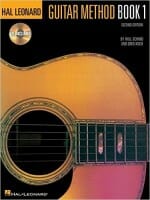
The second edition of this world-famous method by Will Schmid and Greg Koch is preferred by teachers because it makes them more effective while making their job easier. Students enjoy its easy-to-follow format that gives them a solid music education while letting them play songs right away. Book 1 provides beginning instruction including tuning, 1st position melody playing, C, G, G7, D7, and Em chords, rhythms through eighth notes, solos and ensembles and strumming.
Four Star Sight Reading and Ear Tests