M.Mus (U of T)
B.Mus (Oberlin)
Guitarist Gergely Szabo has an Advanced Diploma in Music Performance from Cambrian College where he majored in the classical guitar. Over his time there, he completed 2 years of comprehensive pedagogy courses. He also gained well grounded vocal skills, as well as basic knowledge on the piano. Outside of classical music, he exhibits a repertoire of skills and knowledge in playing the genres of rock, blues, and heavy metal music. He has experience in teaching the guitar and the ukulele to a range of people aged 6 to 54.
Gergely’s teaching methods include both the use of books and digital methods. The three main books he uses to teach guitar are as follows: “Guitar Method Book 1 by Will Schmid and Greg Koch,” “Four Star Sight Reading and Ear Tests RCM Level 1,” and “Classical Guitar Repertoire and Etudes RCM Level 1.” For teaching ukulele, he uses the book “Ukulele Songs for 1, 2, or 3 players by Elizabeth Ragsdale.” Aside from these, he frequently uses the Muse Score application as a play-along practicing tool.
Gergely’s passion for music and his dedication to growing the love of music in others are the biggest reasons why he teaches guitar and ukulele. His approach to teaching involves learning through play. The material he covers with his students is always delivered in a way that is highly interactive. Most of the assigned exercises he gives involve the elements of play that students can enjoy both in class and as homework.
Get to know Gergely…Beyond the Bio!
Coming soon!
Hobbies:
Musical influences:
Favourite food:
Least favourite food:
Favourite music:
Favourite album:
Favourite movie:
Favourite musical theatre/opera:
Best quote from your teacher:
Favourite quote:
Favourite book:
Latest Homework from Gergely
Is Gergely Your Teacher?
Sign up now to get your weekly assignments delivered, and never lose your homework sheet again!
Saturday, Nov 30th
Jack
Benny Greb Rhythmic Alphabet
–Today we spelled words from our new favourite song! Using the example I sent home with you today, and the rhythmic alphabet page, try writing out and playing some new words!
–Play the resulting words along with “In Too Deep”
Tragically Hip: 50 Mission Cap
–Learning the beat (Bass-Snare-Bass-Snare) and playing along with the song while I play piano
Xylophone
–Learning the musical alphabet (ABCDEFG)
–Visually identifying C on the keyboard
–Spelling “Dad” and “Egg” on the keyboard
Nova
DRUMS again next week:
Tommy Igoe’s Groove Essentials: Groove 1 SLOW
–Today, we learned to play along with the score and track (both can be found in the google drive)
–The skill we’re working on this week is counting repeats. For each time you play through the beat, count “1……2…..” That way, you know where you are in the song. The reward is that we get to play a fill at the end of every 8 bars!
–Today, we played a simple fill that went snare-snare-tom (“4e+”). Once you’ve mastered that one, can you come up with your own?
–We also began learning the different variations notated on the sheet. See if you can master those before next lesson
–Finally, remember that when you’re playing along with the track, the count-in goes “1 2 3 4 1 2 3+4+”
Aleksander
Warmups (30 sec each) goal tempo 160bpm:
–Single strokes (R L R L…)
–Double Strokes (R R L L….)
–Paradiddles (RLRR LRLL…)
–RLLR LRRL
–Next week FLAMS
Drumset Musician p14 ex. 7-8 (2min ea.)
ACDC: Back in Black–DONE! Great work.
NEW SONG! Lenny Kravitz: Are You Gonna Go My Way
–This week, learn everything up until the verse (0:32)
–Use your ear, as we have been doing, but you can also read the chart posted in your google drive folder
Koel
Warmups (1min each):
–Triplet Ex. 125bpm
–Ride pattern exercise with sixteenth exercise on the cymbal (goal tempo 90)
Tommy Igoe’s Groove Essentials: Groove 1 SLOW (track one) you can find this in the google drive
–This week, practice playing along with the backing track using the basic beat, variation A, and variation B
–As you play, read along with the chart, being sure to count the number of times you play the beat. Each “verse” will be 16 measures long, so you’ll play the groove 16 times each repeat.
–For this week, (A) play through the verses (groove 16x), then (B) create three different drum fills, and play them in measure 16 before you repeat for the next verse. Start simple!
–Remember, the backing track will could you in “1 2 3 4 1 2 3+4+”
Please give me the details about your Duke of Ed program. Smart goal? Deadlines? Hours?
Tracie
Warm-ups:
–Rhythm ex. Good! Keep focused on listening and adjusting to stay with the metronome
Stone Temple Pilots: Plush
–Great work on the main beat
–Today, we learned one of the prominent fills from the song. The drummer plays snares on “4 +a” in various places. For the verse, it’s at the end of every third bar. Afterwards, it happens ever second bar
Jonah
Xylophone Warmup exercise (Eb maj) see video in google drive:
1) Scale, one octave, ascending and descending
2) arpeggio
3) Scale in broken thirds, one octave, ascending and descending
Hannaford Frozen Theme music
–Practice Eb Major Scale (Eb-F-G-Ab-Bb-C-D-Eb) and arpeggios
–Opening section uses LRRLRRLR sticking
–Practice the notes on your keyboard at home, using your index fingers like mallets
Jared
Warmups:
–Stick Control ex 14-23 (70bpm)
—-Play each exercise 4 times
Bruno Mars: Locked Out of Heaven
–Good, but you haven’t mastered the parts I circled in blue. Drill those this week, and we’ll begin a new song next time
BONUS Exercise for next week: Igoe’s Groove Essentials – Groove 1 slow (track 1)
1) learn each of the three beats at the top of the page.
2) play them along with the chart
Mario
Warmups (1min/ea)
–8 on a hand
–Single Stroke Roll (R L R L…)
–Double Stroke Roll (R R L L…)
–Imagine the playing surface is a hot burner on the stove…get the stick down and up fast or you might get burned! Really quick contact–jump off the drum
Drumset Musician p27 (in google drive) – 8th-note Fills, ex. 1-3
–Work on these in steps: (a) practice the fill on its own (b) “plug it in” to the passage written near the top of the page, playing three bars of time followed by one bar of fill (c) add a crash and bass drum after each fill
White Stripes: Seven Nation Army COMPLETE
–Keep the pace up: you’re doing everything really well, you just need to trust yourself
Mateo
Warmups (30 sec each):
–8 on a Hand
–Single Stroke Roll (RLRL…)
–Double Stroke Roll (RRLL…)
**Think more skin on the stick (but not squeezing)
**Let the stick bounce off the drum
Drumset Musician: Review ex. 3 a) on p 11 so that we can use it in a new worksheet!
–don’t crush your strokes!
–No pointer fingers on top of the stick!
–Count out loud
–Go slow if it’s tricky
–Play confidently. Make it a statement, not a question :)
White Stripes: Seven Nation Army
–Keep polishing this off. When you pretended to be the teacher today, you told me how to do it perfectly! Make sure you follow your own instructions
First drum fill! Chad Kroger
–5x “chad” (snare and floor tom) and three times “Kroger” (snares)
–Follow it with a crash
–Play the basic beat three times, and then play this fill. It will sound great1
Assignments for the week of November 28, 2024
Hello All! Your lesson notes are as follows:
Eva
What we learned/reviewed in lesson:
- Worked through composition/spelling exercises — played CAB, BAG, and our seven letter work, CABBAGE on the piano!
- Began looking through 10 second song
Recommended minutes to practice:
- 10-15 minutes, 4 to 5 days a week
What to practice:
- Finger number patterns (most recent version)
- 10 Second Song and Diving in the G clef; see if you can have these prepared for next week
- Play through more of the spelling/composition exercises
How to practice efficiently:
- Focus primarily on note name recognition at the keyboard and hand position/fingerings (avoiding collapsed wrists, and making sure all fingers are on the keyboard and not curled into fists
- Note recognition: practice having Eva name notes on the keyboard and make sure to recall anchor points (C and F; D) while doing so. Avoid counting from the bottom of the keyboard to figure out every note, jump to different areas of the keyboard for variety
How can caregivers support practice:
- Posture/alignment: Eva sitting at the piano and hand position at the keys. Look for the Faber Primer pages from September 5th for a diagram of how to sit and play.
- Balloon with paint imagery to prevent collapsing wrists. Even though wrists are elevated, make sure that Eva isn’t creating tension in her arms/shoulders, keep an eye for elbow “wings” and rising shoulders. We want to avoid tension while we play
Chris
What we learned/reviewed in lesson:
- Bartok sight reading
- Reviewed acronyms for notes on the clefs
- Minuet w/ duet, started Russian Sailor Dance
Recommended time to practice:
- 20-30 minutes 4 or 5 days of the week
What to practice:
- Bartok sight reading, new exercises are attached
- Russian Sailor Dance, Midnight Ride
- Additional pieces are also attached
- 5 note scales with chords in C position and G position. Try in A position to explore a different tonality — we’ve been working only with Major (happy sounding) keys so far. Playing a 5 note scale beginning on A with no sharps or flats will be our first exploration of a Minor (sad sounding) key.
How to practice efficiently:
- Exploring the extremes of concepts to find the middle ground: explore the range of legato to staccato articulation by moving through the spectrum
- If we’re noticing a lot of resistance with our non-dominant hand while playing, try leading some of your practice starting with your left hand (ex: if you’re sitting down to do scales, start with a left hand scale. Or if you’re learning a new piece, start by reading just the left hand).
- If you have limited time, try focusing on broad ideas while practicing. (Ex: if there’s not to work on every single detail, try practicing a piece with some simplified ideas; if you can’t work on articulation, dynamics, hand shape, and notes during the time you have, choose one of those areas to work with. Then at the next practice session, focus on that previous area and combine it with another.
Preferred Books for Gergely’s Students
Click to buy them here, and they’ll come right to your house! What could be easier?
Hal Leonard Guitar Method
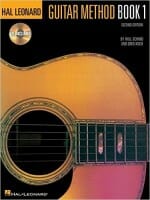
The second edition of this world-famous method by Will Schmid and Greg Koch is preferred by teachers because it makes them more effective while making their job easier. Students enjoy its easy-to-follow format that gives them a solid music education while letting them play songs right away. Book 1 provides beginning instruction including tuning, 1st position melody playing, C, G, G7, D7, and Em chords, rhythms through eighth notes, solos and ensembles and strumming.
Four Star Sight Reading and Ear Tests