M.Mus (U of T)
B.Mus (Oberlin)
Guitarist Gergely Szabo has an Advanced Diploma in Music Performance from Cambrian College where he majored in the classical guitar. Over his time there, he completed 2 years of comprehensive pedagogy courses. He also gained well grounded vocal skills, as well as basic knowledge on the piano. Outside of classical music, he exhibits a repertoire of skills and knowledge in playing the genres of rock, blues, and heavy metal music. He has experience in teaching the guitar and the ukulele to a range of people aged 6 to 54.
Gergely’s teaching methods include both the use of books and digital methods. The three main books he uses to teach guitar are as follows: “Guitar Method Book 1 by Will Schmid and Greg Koch,” “Four Star Sight Reading and Ear Tests RCM Level 1,” and “Classical Guitar Repertoire and Etudes RCM Level 1.” For teaching ukulele, he uses the book “Ukulele Songs for 1, 2, or 3 players by Elizabeth Ragsdale.” Aside from these, he frequently uses the Muse Score application as a play-along practicing tool.
Gergely’s passion for music and his dedication to growing the love of music in others are the biggest reasons why he teaches guitar and ukulele. His approach to teaching involves learning through play. The material he covers with his students is always delivered in a way that is highly interactive. Most of the assigned exercises he gives involve the elements of play that students can enjoy both in class and as homework.
Get to know Gergely…Beyond the Bio!
Coming soon!
Hobbies:
Musical influences:
Favourite food:
Least favourite food:
Favourite music:
Favourite album:
Favourite movie:
Favourite musical theatre/opera:
Best quote from your teacher:
Favourite quote:
Favourite book:
Latest Homework from Gergely
Is Gergely Your Teacher?
Sign up now to get your weekly assignments delivered, and never lose your homework sheet again!
Homework for November 26-December 3
Henry
Recommended minutes to practice: 5-10 per day
What to practice:
Itsy Bitsy Spider- first line with counts that I wrote on your music sheet
Teaching Little Fingers to Play- review page 5 Stepping and Skipping
Theory book- complete page 45
How to practice most effectively:
Itsy Bitsy- Follow the counting according to how the note is written in relation to the numbers above. Remember that if a note has two counts it is longer than a note that has one count, and shorter than a note that has three counts. You can try playing while counting out loud or reciting “short” for short notes and “long” for long notes.
Stepping and Skipping- Pay attention to the notes on the sheet. Follow the counting as written. Remember that a note with a line and a black head is 1 beat, a note with a line and a white head is 2 beats, and a white note with no line is 4 beats.
How parents can support practice: Guide him in following the lines with the counts, using the rhythm of the song and/or counting using the values of 1 beat, 2 beat, and 4 beat notes.
Tuesday, November 26th
Josh
Post Malone: I Had Some Help
–Good work on this!
–To help get that main beat coordinated at performance speed, isolate the “2 + 3” portion of it, making sure to line up the bass drums with the hihats. When isolated, you do a great job of this at high speeds. Can you bring the same coordination to the main beat overall?
–The pre-chorus fill (flam-bass…) is great! Make sure to play it four times, not three
Play-along Tracks:
–In your personal folder, find tracks to play along with
–The “rock” track can be used to work on VD #9, the same beat as in “I Had Some Help”
–Play your soca beat along to the soca track
Myles
Drumset Musician p81 ex. 9-12
–Polish these off this week
Weezer: My Name is Jonas
–Drill the intro and main groove on p.1
–See worksheet for explanation of new bass pattern: master each exercise and then we’ll put it in context next week
–For next week, we’ll warm up with some of these fills (V1 out fill)
==Xylophone==
Warmups (***G Major):
–Scale, one octave, ascending and descending, saying the note names as you play them (G-A-B-C-D-E-F#-G’)
–Arpeggio (G-B-D-G’-D-B-G)
–Broken thirds (G-B A-C B-D…)
Cirone Book: “Step Six” ex. 5-8
–Flashcards for note identification
–Next time we’ll do eartraining
Finn
Warmups (30sec each, counting aloud):
–Single Strokes
–Double Strokes
–8 on a hand
White Stripes: Seven Nation Army
–Great work! Make sure to play the regular beat during the chorus EXCEPT for that one moment when you play the triplet
Joan Jett: I Love Rock and Roll
–begins with “watermelon watermelon” on the snare
–Play the main beat (1+2 3+4)
Fruit Salad game
–Four fruits: pear, apple, blueberry, watermelon
–Each fruit has a rhythm. Experiment mixing up to four fruits together to create your own rhythms!
Visual Drummer: Drum Beats ex. 1-3
–Let’s try to polish these off for next week
–Aim for four repetitions of each. Keep the rhythm steady.
Francisco
Warmups:
–Stick Control*** (in google drive), first page ex. 1-8 (4x each, 100bpm goal tempo)
Stevie Wonder: Superstition
–Everything up until the end of page three
–See google drive for simplified fill from the second last bar of that page
–Think about how you’d like to proceed
Noah
We’ll come back to our regularly scheduled programming next week. For this week, work on the shuffle-train two-beat we learned today
Shuffle-train Worksheet
–Learn the accent patterns from these five exercises
–Pay close attention to the volume of the accented vs non-accented notes. Make them as different from one another as possible
–Also, be sure that the coordination between limbs is precise. This will make these really groove
–For backing tracks, try “That Was Your Mother” and “All Around the World” from Paul Simon’s album Graceland. These aren’t a perfect fit, but work well as a slower-tempo example for this beat. Give it a try!
Preferred Books for Gergely’s Students
Click to buy them here, and they’ll come right to your house! What could be easier?
Hal Leonard Guitar Method
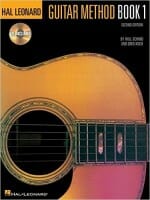
The second edition of this world-famous method by Will Schmid and Greg Koch is preferred by teachers because it makes them more effective while making their job easier. Students enjoy its easy-to-follow format that gives them a solid music education while letting them play songs right away. Book 1 provides beginning instruction including tuning, 1st position melody playing, C, G, G7, D7, and Em chords, rhythms through eighth notes, solos and ensembles and strumming.
Four Star Sight Reading and Ear Tests