M.Mus (U of T)
B.Mus (Oberlin)
Guitarist Gergely Szabo has an Advanced Diploma in Music Performance from Cambrian College where he majored in the classical guitar. Over his time there, he completed 2 years of comprehensive pedagogy courses. He also gained well grounded vocal skills, as well as basic knowledge on the piano. Outside of classical music, he exhibits a repertoire of skills and knowledge in playing the genres of rock, blues, and heavy metal music. He has experience in teaching the guitar and the ukulele to a range of people aged 6 to 54.
Gergely’s teaching methods include both the use of books and digital methods. The three main books he uses to teach guitar are as follows: “Guitar Method Book 1 by Will Schmid and Greg Koch,” “Four Star Sight Reading and Ear Tests RCM Level 1,” and “Classical Guitar Repertoire and Etudes RCM Level 1.” For teaching ukulele, he uses the book “Ukulele Songs for 1, 2, or 3 players by Elizabeth Ragsdale.” Aside from these, he frequently uses the Muse Score application as a play-along practicing tool.
Gergely’s passion for music and his dedication to growing the love of music in others are the biggest reasons why he teaches guitar and ukulele. His approach to teaching involves learning through play. The material he covers with his students is always delivered in a way that is highly interactive. Most of the assigned exercises he gives involve the elements of play that students can enjoy both in class and as homework.
Get to know Gergely…Beyond the Bio!
Coming soon!
Hobbies:
Musical influences:
Favourite food:
Least favourite food:
Favourite music:
Favourite album:
Favourite movie:
Favourite musical theatre/opera:
Best quote from your teacher:
Favourite quote:
Favourite book:
Latest Homework from Gergely
Is Gergely Your Teacher?
Sign up now to get your weekly assignments delivered, and never lose your homework sheet again!
Tuesday, Nov 5th
Aleksander
Warmups (30 sec each) ***at metronome=120:
–Single strokes (R L R L…)
–Double Strokes (R R L L….)
–Paradiddles (RLRR LRLL…)
–Basic Beat level 3.5
—-Make sure that when two instruments play together they land precisely at the same time
Drumset Musician p12 ex. 8-15 a)
ACDC: Back in Black–everything up until 2:49
–Bridge section
Josh
20241105
See new visual drums page in Google Drive
ACDC: Back in Black
–We need to review the guitar solo (ca. 2-2:30)
–Use Visual Drumming ex. 24 (in personal folder) to help you prepare for the Bridge!
Myles
Drumset Musician p81 ex. 9-12**
NEW SONG Weezer: My Name is Jonas
–Drill the intro and main groove on p.1
–Today, we muddled our way through the WHOLE SONG. It’s not super complicated, but we’ll continue to work on the details each week
Xylophone:
–Review of C Major scale
–***Simple Steps to Keyboard Percussion “Step Six” p. 12-13 (in google drive). Use “Step 5” exercises to help you find the notes
Finn
Warmups (30sec each):
–Single Strokes
–Double Strokes
–8 on a hand
–This week, practice putting a count (“1+2+3+4+) overtop of the Singles and Doubles.
NEW SONG*** White Stripes: seven Nation Army
–Going through this song’s “procedure”: sit out for bass–>bass drum on the beats–>add snares on 2 and 4–>crashes on one w/ bass drum–>BBlvl1 on crash–>back to crashes on one
–Next week, we’ll learn the variation in the basic beat during the chorus
Robbie
Warmups:
–Gminor and Bb Major arpeggios (G-Bb-D-G; Bb-D-F-Bb)
Canticum:
–Second melody is slower. Make sure to READ the notes, and not just try to rely on your memory
Halloween:
–Good work. Not too slow! Make sure to READ the variations in the snare drum part
Third Planet:
–“I don’t have a pen” rhythm at the end: be consistent
Francisco
Warmups (30sec/ea.):
–8 on a hand (80bpm***)
–Singles (sixteenths at 145bpm**)
–doubles (16ths at 100**)
–Paradiddles (16ths at 100**)
Stevie Wonder: Superstition–up until the middle of page 2 (big fill)
–Drills: R-L-K triplet rolls
—-Floor tom, Snare, kick, repeated
—-hi-tom, med-tom, snare, as written in the fill
–See video in google drive for fill demonstration
Noah
Warmups (1min each per practice session):
–Triplet Exercise (1mm RH, 2mm LH) @ 95bpm
–Sixteenth-note Exercise 75bpm
–Rhythm Exercise (60bpm)
***Next week we’re doing paradiddles
NEW SONG*** Paul Simon: Late in the Evening
–Watch legendary drummer, Steve Gadd, explain this legendary groove here
–This week, get the hands and feet really solid (see handout). Next week, we’ll orchestrate it on the drums like in the chart
Saturday, November 2nd
Jack
Benny Greb Rhythmic Alphabet
–Learn each letter in the “binary” part of the alphabet (counting 1-2-3-4)
–try building small words!
Tragically Hip: 50 Mission Cap
–Learning the beat (Bass-Snare-Bass-Snare) and playing along with the song while I play piano
Xylophone
–Learning the musical alphabet (ABCDEFG)
–Visually identifying C on the keyboard
–Spelling “Dad” and “Egg” on the keyboard
Nova
Warmups:
–C Major Scale and Arpeggio (C-E-G-c-G-E-C)
Cirone Book: “Step 6” (pdf in Nova’s personal gdrive folder)
–Finish of the last three exercises, singing the note names aloud as you play
–Ear training
–Visual training on the keyboard
DRUMS next week:
Warmups:
–Stick Control first 13 exercises (trying for 50bpm goal tempo)
Remi Wolf: Photo ID
–Finishing this song off
–Work on adding the Chorus fill (on handout) into the second chorus
Jonah
Four-mallet Xylophone chords
–Learn the shape of the C Major Triad (C-E-G-C)
–Using that shape, play along to Bill Withers’ “Lean On Me”. It plays the same triads on different roots (C…C.D.E.F…F.E.D.C…C.D.E.E..D..) etc
Jared
Warmups:
–Stick Control ex 1-13 goal tempo: 80bpm***
—-Play each exercise ***4 times***
Bruno Mar: Locked Out of Heaven
–Chart is now in your personal folder
–Playing through the whole song, the only bit we don’t know is the half-time drum groove near the end. Try working this out on your own, we’ll polish it off next week
–Drill all the small transitions (eg. end of chorus back into verse)
Tracie
Warmups:
–Triplet exercise (85bpm)
–Rhythm Ex. 60bpm–>counting! (quarters-eighths-quarters-triplets-quarters-sixteenths and reverse)
White Stripes: Seven Nation Army
–Learning by rote
–Great work! Sing along, and get the chorus variation in time with the guitar
Mario
Warmups (1min/ea; slow, med, fast speeds)
–8 on a hand
–Single Stroke Roll (R L R L…)
–Double Stroke Roll (R R L L…)
White Stripes: Seven Nation Army (up to ca. 1:000
–LISTENING is the key skill to playing in time with the recording
–Use listening to help you adjust when accidentally playing too fast/slow
***Drumset Musician p11, ex. 1-3 (find a PDF in the google drive “Frequently Used Resources” folder)
–Learn exercise 3 on your own, counting aloud, four repeats each
Preferred Books for Gergely’s Students
Click to buy them here, and they’ll come right to your house! What could be easier?
Hal Leonard Guitar Method
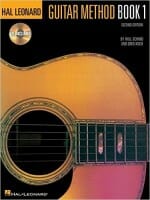
The second edition of this world-famous method by Will Schmid and Greg Koch is preferred by teachers because it makes them more effective while making their job easier. Students enjoy its easy-to-follow format that gives them a solid music education while letting them play songs right away. Book 1 provides beginning instruction including tuning, 1st position melody playing, C, G, G7, D7, and Em chords, rhythms through eighth notes, solos and ensembles and strumming.
Four Star Sight Reading and Ear Tests