M.Mus (U of T)
B.Mus (Oberlin)
Guitarist Gergely Szabo has an Advanced Diploma in Music Performance from Cambrian College where he majored in the classical guitar. Over his time there, he completed 2 years of comprehensive pedagogy courses. He also gained well grounded vocal skills, as well as basic knowledge on the piano. Outside of classical music, he exhibits a repertoire of skills and knowledge in playing the genres of rock, blues, and heavy metal music. He has experience in teaching the guitar and the ukulele to a range of people aged 6 to 54.
Gergely’s teaching methods include both the use of books and digital methods. The three main books he uses to teach guitar are as follows: “Guitar Method Book 1 by Will Schmid and Greg Koch,” “Four Star Sight Reading and Ear Tests RCM Level 1,” and “Classical Guitar Repertoire and Etudes RCM Level 1.” For teaching ukulele, he uses the book “Ukulele Songs for 1, 2, or 3 players by Elizabeth Ragsdale.” Aside from these, he frequently uses the Muse Score application as a play-along practicing tool.
Gergely’s passion for music and his dedication to growing the love of music in others are the biggest reasons why he teaches guitar and ukulele. His approach to teaching involves learning through play. The material he covers with his students is always delivered in a way that is highly interactive. Most of the assigned exercises he gives involve the elements of play that students can enjoy both in class and as homework.
Get to know Gergely…Beyond the Bio!
Coming soon!
Hobbies:
Musical influences:
Favourite food:
Least favourite food:
Favourite music:
Favourite album:
Favourite movie:
Favourite musical theatre/opera:
Best quote from your teacher:
Favourite quote:
Favourite book:
Latest Homework from Gergely
Is Gergely Your Teacher?
Sign up now to get your weekly assignments delivered, and never lose your homework sheet again!
Saturday, October 12th
Click here for the google drive. Please bookmark!
Jack
Puss in Boots drills (30sec each):
1) Playing the beat with your LH
2) playing along with the sticking L-R-L-rest, repeatedly
3) playing along alternating between “L-R-L” and “R-L-R”
Xylophone
–Learning the musical alphabet (ABCDEFG)
–Visually identifying C on the keyboard
Playing cowbell on different counts: all the beats, all the ands, improvising
Next week, let’s revisit the Benny Greb rhythmic alphabet
Aleksander
Warmups (30 sec each) at three speeds (slow/med/fast):
–Single strokes (R L R L…)
–Double Strokes (R R L L….)
–Paradiddles (RLRR LRLL…)
–Basic Beat level 3.5
—-same as level 2, but bass drum plays on all four beats and RH plays on ride cymbal
First song!!! ACDC: Back in Black–everything up until 1:50 (stop at guitar solo)
–Great work!
–Add in crashes on “Back in black” at the end of the chorus
Learning Drumset Notation: Drumset Musician book
–Practice exercises 1-7 on p11 of the Drumset musician book (find PDF below)
–top line is hihat,middle space is snare drum, bottom space is bass drum
==Please Bookmark the following link, we’ll use it throughout lessons==
https://drive.google.com/drive/folders/1RuBf7-jO6pZUsKMZJTwePeIQxdfKCEnV?usp=drive_link
Print the Back in Black charts from Alexander’s folder (Student-specific), and “Drumset Musician (11-13)” from the Frequently Used folder.
Tracie
Warmups:
–Triplet exercise (85bpm)
–Rhythm Ex. 60bpm–>counting!
Deftones: Minerva
–Awesome job!
–This week’s goal is to play the new fill in the fourth measure of our four-bar pattern
–Break this into intermediary goals: four bar pattern on its own; fill on its own; drilling the “seams”; altogether
Jonah
First Lesson of the Year!!
Goals for this year:
–Xylophone songs
–Drum set songs
–Stick Control
Warmups (1min/ea)
–Triplet Exercise (Goal tempo=115)
–Sixteenth-note exercise (goal tempo=100)
New Song! Bruno Mars: Locked Out of Heaven
–Find the sheet in Jonah’s personal folder in the google drive (please print)
–We learned the entire first page today. Drill it!
Mario’s first lesson! Woohoo
Required Materials:
1) Sticks (check)
2) Binder
3) Metronome (or app)
4) Sign up for the lesson notes emails
Recommended materials:
1) Hearing protection
2) Practice pad
3) Method books (I’ll recommend when and what to get)
Warmups (1min/ea; slow, med, fast speeds)
–8 on a hand
–Single Stroke Roll (R L R L…)
–Double Stroke Roll (R R L L…)
First Drum Beat! Basic Beat Level 1
Step 1) Count “1 2 3 4”
Step 2) Play the Hihat with your right hand (RH) on all counts
Step 3) Add in the bass drum with your right foot (RF) on “1” and “3”
Step 4) Add in the snare drum with your LH on “2” and “4”
–The goal is to get through this with all instruments four times uninterrupted
This week your challenges are to play RELAXED, without unwanted bounces of the stick. Also, focus on making sure the notes line up precisely.
Assignments for the week of October 10 2024
Hello Everyone! Your notes are as follows:
Chris
What we learned/reviewed in lesson:
- Finger patterns
- Relating the posture and hand positioning to our playing
- Playing with our bigger muscle groups (reminding ourselves: we walk with our legs, not our toes. Similarly, we play piano with our arms, not our fingers)
- To remind yourself of what your hand position should feel like, rest hands on knees with the fingers relaxed
- Played through exploring seconds and exploring thirds
- Reviewed: contrary and parallel motion, treble and bass clef
- New info
- Dynamics ranging from pp-p-mp-mf-f-ff, pianissimo to fortissimo
- Reading on the staff, treble G + bass F + middle C
- Acronyms for notes on the staff (Treble: FACE, Every Good Bat Deserves Fruit; Bass: All Cows Eat Grass, Good Bats Deserve Fruit Always)
- Whole steps and half steps; remembering the difference between these will help us once we start learning scales
Recommended time to practice:
- 20-30 minutes 4 or 5 days of the week
What to practice:
- Pg 15, 17-19
How to practice efficiently:
- Isolating right and left hand lines and trying different ways approach what you are reading (clapping, saying/singing finger numbers, saying/singing note names)
- Work on both reading the music and recalling notes on the keyboard. Developing a fluent understanding of the keyboard layout (note names) will allow reading to become more efficient / manageable.
Greta
What we learned/reviewed in lesson:
- 2 octave scales for G major and D minor. Being mindful of the fingering
- Solid triads (2 octaves)
- Minor scales: incorporating harmonic (raising the 7th up a half step) and melodic (raising 6th and 7th up a half step going up the scale ascending and going back to the natural minor descending)
- How to pedal for sustained pieces
Recommended time to practice:
- 20-30 minutes a day, 4 days a week
What to practice:
- G major, D minor: 2 octave scales and 2 octave solid triads
- First page of Amber Moon, hands together
How to practice efficiently:
- Isolating each hand, work through phrases with a steady pulse. Check in with yourself to see if the beat is steady, if dynamics are being incorporated, if your sound is consistent.
- In addition to playing at the keyboard, listen to a recording of your piece. A recording can help establish the melody/harmony in your ear — but be mindful not to directly imitate the recording, use it as a tool that can help you with phrasing ideas, tempo, and rhythm.
- Amber Moon Recording
Have a good week!
Preferred Books for Gergely’s Students
Click to buy them here, and they’ll come right to your house! What could be easier?
Hal Leonard Guitar Method
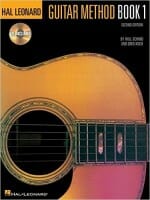
The second edition of this world-famous method by Will Schmid and Greg Koch is preferred by teachers because it makes them more effective while making their job easier. Students enjoy its easy-to-follow format that gives them a solid music education while letting them play songs right away. Book 1 provides beginning instruction including tuning, 1st position melody playing, C, G, G7, D7, and Em chords, rhythms through eighth notes, solos and ensembles and strumming.
Four Star Sight Reading and Ear Tests