M.Mus (U of T)
B.Mus (Oberlin)
Guitarist Gergely Szabo has an Advanced Diploma in Music Performance from Cambrian College where he majored in the classical guitar. Over his time there, he completed 2 years of comprehensive pedagogy courses. He also gained well grounded vocal skills, as well as basic knowledge on the piano. Outside of classical music, he exhibits a repertoire of skills and knowledge in playing the genres of rock, blues, and heavy metal music. He has experience in teaching the guitar and the ukulele to a range of people aged 6 to 54.
Gergely’s teaching methods include both the use of books and digital methods. The three main books he uses to teach guitar are as follows: “Guitar Method Book 1 by Will Schmid and Greg Koch,” “Four Star Sight Reading and Ear Tests RCM Level 1,” and “Classical Guitar Repertoire and Etudes RCM Level 1.” For teaching ukulele, he uses the book “Ukulele Songs for 1, 2, or 3 players by Elizabeth Ragsdale.” Aside from these, he frequently uses the Muse Score application as a play-along practicing tool.
Gergely’s passion for music and his dedication to growing the love of music in others are the biggest reasons why he teaches guitar and ukulele. His approach to teaching involves learning through play. The material he covers with his students is always delivered in a way that is highly interactive. Most of the assigned exercises he gives involve the elements of play that students can enjoy both in class and as homework.
Get to know Gergely…Beyond the Bio!
Coming soon!
Hobbies:
Musical influences:
Favourite food:
Least favourite food:
Favourite music:
Favourite album:
Favourite movie:
Favourite musical theatre/opera:
Best quote from your teacher:
Favourite quote:
Favourite book:
Latest Homework from Gergely
Is Gergely Your Teacher?
Sign up now to get your weekly assignments delivered, and never lose your homework sheet again!
Homework for October 15-22
Hi Henry and Noreet! Great work today! Here is your homework for next week:
Henry
Duration of practice: 5-10 minutes a day
What to practice: Mary Had a Little Lamb, piano theory workbook pages 16, 18
How to practice: Two different speeds. Have a slow version of Mary Had a Little Lamb, and then a faster one
How parents can support practice: Prompt him to start with the slower speed and once he gets more comfortable, increase the speed gradually
Noreet
Duration of practice: 5-10 minutes a day
What to practice:
Piano: Look at two new pieces, “Awesome Creatures”, “A Minuet for Mr. Bach’s Children”, and decide which one you want to learn
Singing: Pina Colada
How to practice:
Piano: Try first two lines of each piece, hands separate
Singing:
- Practice with different levels of volume, for example, find a spot in the song where it is appropriate to sing loudly, quietly, or step by step get louder or quieter
- Exaggerate the consonants
How parents can support practice: Listen to her sing and give feedback on whether you can understand the words clearly
Tuesday, October 15th
Josh
Visual Drums p14 1-6
–Great!
–This week, work on #5-6. Aim for four uninterrupted repetitions of each, making sure the bass drums land on the correct counts
ACDC: Back in Black
–Great! Keep tidying up everything up until the end of the guitar solo (ca. 2:30)
–Moving onto the Bridge (ca. 2:50), you’ll need to learn a new beat! This one isn’t too hard, but it’s quite different from what we’ve worked on so far. Use Visual Drumming ex. 24 (in personal folder) to help you prepare! Work on it the same way as the other Vis. Drum. exercises above
Myles
Warmups:
–Flam Accents (lR-L-R rL-R-L)**
–8 on a Hand, goal tempo= 130bpm using a metronome
Drumset Musician p81 ex. 1-4 (please print)**
–Try each of these fills with a LH lead and RH lead
QOTSA: Keep Your Eyes Peeled (up to 2:00)
–Awesome!
–Use the two-beat fills in the latest section as a break for your LH
Finn
Warmups (30sec each):
–Single Strokes
–Double Strokes
–8 on a hand
–Try playing these at three different speeds (slow, med, fast)
Basic Beat LEVEL 3
Survivor: Eye of the Tiger
–Way to go
–Keep drilling the fill in Verse 1, making sure it starts exactly on beat 3
–Once that’s comfortable, follow along with the song…how long does this same drum beat go?
Nova
Warmups:
–Stick Control first 13 exercises
Remi Wolf: Photo ID
–Finishing this song off
–Work on adding the Chorus fill (on handout) into the second chorus
XYLOPHONE NEXT WEEK :)
–C Major Scale and Arpeggio (C-E-G-c-G-E-C)
–Piano Adventures p 46-47 (counting in 3)
Cirone Book: “Step 6” (pdf in Nova’s personal gdrive folder)
–Review note reading using the Step 6 melodic exercises
–If you need help or a reminder about which notes are which, look back at lesson 5 (Amw PDF)
–Be careful to follow the correct stickings and rhythms!
Francisco
Warmups (30sec/ea., find goal speed):
–8 on a hand (140bpm)
–Singles (sixteenths at 140bpm)
–doubles (16ths at 90)
–Paradiddles (16ths at 90)
Bon Jovi: Livin On a Prayer: everything up until Guitar Solo section
–Way to go!
–Let’s finish this off. Today we learned the last things you need to know to do this:
—-1) the toms fill at the end of the guitar solo
—-2) the funky beat with extra crashes
–Work on getting through everything this week with the recording. Focus on staying steady and we can polish details next time.
Preferred Books for Gergely’s Students
Click to buy them here, and they’ll come right to your house! What could be easier?
Hal Leonard Guitar Method
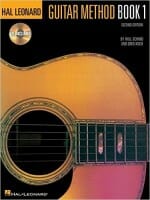
The second edition of this world-famous method by Will Schmid and Greg Koch is preferred by teachers because it makes them more effective while making their job easier. Students enjoy its easy-to-follow format that gives them a solid music education while letting them play songs right away. Book 1 provides beginning instruction including tuning, 1st position melody playing, C, G, G7, D7, and Em chords, rhythms through eighth notes, solos and ensembles and strumming.
Four Star Sight Reading and Ear Tests