M.Mus (U of T)
B.Mus (Oberlin)
Guitarist Gergely Szabo has an Advanced Diploma in Music Performance from Cambrian College where he majored in the classical guitar. Over his time there, he completed 2 years of comprehensive pedagogy courses. He also gained well grounded vocal skills, as well as basic knowledge on the piano. Outside of classical music, he exhibits a repertoire of skills and knowledge in playing the genres of rock, blues, and heavy metal music. He has experience in teaching the guitar and the ukulele to a range of people aged 6 to 54.
Gergely’s teaching methods include both the use of books and digital methods. The three main books he uses to teach guitar are as follows: “Guitar Method Book 1 by Will Schmid and Greg Koch,” “Four Star Sight Reading and Ear Tests RCM Level 1,” and “Classical Guitar Repertoire and Etudes RCM Level 1.” For teaching ukulele, he uses the book “Ukulele Songs for 1, 2, or 3 players by Elizabeth Ragsdale.” Aside from these, he frequently uses the Muse Score application as a play-along practicing tool.
Gergely’s passion for music and his dedication to growing the love of music in others are the biggest reasons why he teaches guitar and ukulele. His approach to teaching involves learning through play. The material he covers with his students is always delivered in a way that is highly interactive. Most of the assigned exercises he gives involve the elements of play that students can enjoy both in class and as homework.
Get to know Gergely…Beyond the Bio!
Coming soon!
Hobbies:
Musical influences:
Favourite food:
Least favourite food:
Favourite music:
Favourite album:
Favourite movie:
Favourite musical theatre/opera:
Best quote from your teacher:
Favourite quote:
Favourite book:
Latest Homework from Gergely
Is Gergely Your Teacher?
Sign up now to get your weekly assignments delivered, and never lose your homework sheet again!
Assignments for the week of September 18th, 2024
Sara
Technique – Scales, Triads, Arpeggios
-Continue with E Major, focusing on staying relaxed all exercises (checking in with the entire hand, the wrist, and the forearm)
-Especially with solid triads – thinking in a similar way to RH octaves in “The Entertainer” – not letting wrist get too high, or letting the hand “set” into position.
The Entertainer: Getting things overall more physically comfortable and automatic. Break into small chunks and work HS as we did in lesson.
-For RH, breaking octaves/chords apart into their pieces and playing through as an exercise (only finger 1/finger 5, repeating each chord before moving onto the next)
-For LH, focusing on jumps between hand positions: making sure you are able to jump back and forth quickly and comfortably (practicing repeating chords similar to RH, make the jumps more difficult by jumping an extra octave)
Pierrot & Pierrette: Breaking apart into small chunks (approximately 4 measure groups) and isolating any problem notes/tricky spots. Making sure that we can confidently and loudly play to the end of each small chunk.
-For LH, focusing on STRONG weak weak rhythm – emphasizing a STRONG beat 1 in each measure.
-For RH, not allowing for any shy playing! Ignore the “p” dynamic for now, playing confidently and strongly in the RH to get settled. When practicing HT, making sure that our RH is louder than LH (remember! RH is our melody in this case, LH is creating atmosphere and supporting)
Bartok: Continuing on with #9-10; focusing on reading ahead and looking at the entire shape of a musical phrase, not just looking a note ahead. Try to imagine how it will sound based on the shape before you play.
-Reviewing #1-8 throughout the week for your own purposes, focusing on reading the entire shape as we tried in lesson (don’t be afraid to draw out the shape into your score to help visually to “connect the dots”)
Clara
Lesson book pages 25-31, practicing speaking note names and finger numbers out loud.
Practicing 5 finger scales hands separately, ascending and descending in a C 5 finger position. Speaking finger numbers and note names out loud while playing detached, staccato (like popcorn), and legato (smooth and connected).
C-1, D2, E3, F4, G5
Assignments for the week of September 19, 2024
Hello everyone! Here are your notes for this week:
Eva
What we learned/reviewed in lesson:
- Reviewing finger numbers on our Left and Right hand
- Learned our first note name on the piano! D in the dog house (between the 2 black keys on the keyboard)
- Quarter notes and Half notes; quarter notes can count for 1 beat, half notes count for two
- Started two new pieces: The Walking Song and The I Like song
Recommended minutes to practice:10-15 minutes, 4 to 5 days a week
What to practice:
- Review Left and Right hand number patterns; practice recalling which finger is which number (thumbs are always number 1!). Patterns can be practiced on any flat surface (and eventually brought to keyboard
- Begin learning new pieces (Walking Song and I Like Song)
How to practice efficiently:
- Try reading out the numbers, matching it with fingers, and eventually on the (black) keys of the keyboard
- Instead of just playing the keyboard, try singing along with your notes (singing the numbers, singing along with melody with word or vowel of choice)
- Try to see how fluidly you can play the piece! Can you play it start to finish with a steady beat?
How can caregivers support practice:
- Practice recalling finger numbers on Left and Right hand, can double check with the image we drew at our first lesson
- When Eva practices, check hands to make sure they aren’t curled up/tense. Shake out tension and reset to the soft “c” position
- If feet don’t reach the ground when sitting at the keyboard, can put a short stool or a stack of books under feet so she can feel more supported when playing (having the feet dangling might feel uncomfortable after a while).
Greta
What we learned/reviewed in lesson:
- Great work on Video Games lead sheet!
- Learned about dominant 7ths for potential use in lead sheets
- Find your base key, think about key signature (how many sharps or flats?) and then locate the 5th note of the scale (ex: C major, no sharps or flats, 5th note is G)
- Build a major triad off that 5th note (G = GBD) and add the last note (F) on the end
- Practiced finding dominant 7th of other keys (D major, A major)
- Reviewed notes in lines and on spaces for treble clef, order of sharps and flats (FCGDAEB), and minor keys+relative major
- Sight reading parallel and contrary etudes
What to practice:
- Start Amber Moon and/or Bouree in D minor; can work on the rest of Video Games lead sheet too
- Technique: G major scale (hands together, 2 octaves) and triads; D minor scale (hands together, 2 octaves; don’t worry about harmonic or melodic scale this week)
How to practice efficiently:
- Always check in with what’s written in the piece (fingerings, dynamics, tempo)
- Look for patterns and where they come back
- Spend a few minutes whenever you practice to review some of the acronyms involved with reading/technique (FACE, Every Good Bat Deserves Fruit; All Cows Eat Grass, Good Bats Deserve Fruit Always); the more confident we are with knowing where the notes are, the more confident we can become at reading sheet music
Happy practicing! Have a good week, everyone
Preferred Books for Gergely’s Students
Click to buy them here, and they’ll come right to your house! What could be easier?
Hal Leonard Guitar Method
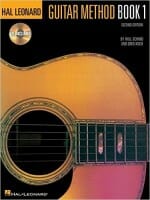
The second edition of this world-famous method by Will Schmid and Greg Koch is preferred by teachers because it makes them more effective while making their job easier. Students enjoy its easy-to-follow format that gives them a solid music education while letting them play songs right away. Book 1 provides beginning instruction including tuning, 1st position melody playing, C, G, G7, D7, and Em chords, rhythms through eighth notes, solos and ensembles and strumming.
Four Star Sight Reading and Ear Tests