M.Mus (U of T)
B.Mus (Oberlin)
Guitarist Gergely Szabo has an Advanced Diploma in Music Performance from Cambrian College where he majored in the classical guitar. Over his time there, he completed 2 years of comprehensive pedagogy courses. He also gained well grounded vocal skills, as well as basic knowledge on the piano. Outside of classical music, he exhibits a repertoire of skills and knowledge in playing the genres of rock, blues, and heavy metal music. He has experience in teaching the guitar and the ukulele to a range of people aged 6 to 54.
Gergely’s teaching methods include both the use of books and digital methods. The three main books he uses to teach guitar are as follows: “Guitar Method Book 1 by Will Schmid and Greg Koch,” “Four Star Sight Reading and Ear Tests RCM Level 1,” and “Classical Guitar Repertoire and Etudes RCM Level 1.” For teaching ukulele, he uses the book “Ukulele Songs for 1, 2, or 3 players by Elizabeth Ragsdale.” Aside from these, he frequently uses the Muse Score application as a play-along practicing tool.
Gergely’s passion for music and his dedication to growing the love of music in others are the biggest reasons why he teaches guitar and ukulele. His approach to teaching involves learning through play. The material he covers with his students is always delivered in a way that is highly interactive. Most of the assigned exercises he gives involve the elements of play that students can enjoy both in class and as homework.
Get to know Gergely…Beyond the Bio!
Coming soon!
Hobbies:
Musical influences:
Favourite food:
Least favourite food:
Favourite music:
Favourite album:
Favourite movie:
Favourite musical theatre/opera:
Best quote from your teacher:
Favourite quote:
Favourite book:
Latest Homework from Gergely
Is Gergely Your Teacher?
Sign up now to get your weekly assignments delivered, and never lose your homework sheet again!
Assignments for the Week of May 25-31
Hi everyone,
Here are your assignments for this week:
Will
Recommended minutes to practice: 20-30 minutes per day
What to practice: Focus this week on practicing “Comp Example 2.”
How to practice it most effectively: Pick out some of the comp examples that incorporate the middle note of the triplet and practice playing them with the right hand and foot patterns. Take it slow and focus on how the rhythm sounds in connection with the ride cymbal. Be aware of when the ride and snare should play together and when they should play separately. Once these rhythms start to feel comfortable, then try playing them together with one of the tracks below.
100 bpm: https://www.youtube.com/watch?v=4VmZwkqi0HU
120 bpm: https://www.youtube.com/watch?v=LpTYcnG5WYE
140 bpm: https://www.youtube.com/watch?v=mr2rLTQtRPo
Jude
Recommended minutes to practice: 10-15 minutes per day
What to practice: Practice all the new beats that we have worked on over the last two weeks and try playing them together with drums fills.
How to practice it most effectively: With the beats, look carefully at the notation in your book to make sure that you have the correct rhythm on the bass drum and snare drum. Watch out for the places where the hi-hat plays without the bass or the snare. Also, look at the drum fill examples that I wrote below the beats. Try playing these fills (or other fills like them) together with some of the new beats once you are comfortable with them.
Noah
Recommended minutes to practice: 15-20 minutes per day
What to practice: Review Section 2 of Watermelon Man and practice playing it all the way through with the new fill at the end.
How to practice it most effectively: The trickiest thing about this section is making sure that all of the bass drum and snare drum notes are played in the right spots. The best way to address this is by practicing slowly and counting. If you count “1 e & a 2 e & a 3 e & a 4 e & a” as you are playing, it will be easier to identify mistakes in the rhythm and to fix them. Once you can get through the whole section at a slow speed, then try playing it faster and counting only in your head. As you get used to how the rhythm sounds, then you won’t need to rely as much on counting.
Koel
Recommended minutes to practice: 15-20 minutes per day
What to practice: Practice playing all the way through “Sweet Child O’ Mine” with the recording and come next week with some suggestions for a new song you’d like to learn.
How to practice it most effectively: Your playing sounds really great on “Sweet Child O’ Mine!” Just be careful not to rush and always listen carefully for what’s happening in the recording. As you get more and more familiar with the song, you will be able to hear more easily how your part should line up with the rest of the song. Keep listening each time you practice and try to identify certain sound or rhythms that will help you to stay in time.
Caroline
Recommended minutes to practice: 15-20 minutes per day
What to practice: Practice playing through “Boulevard of Broken Dreams” with the recording and focus on the new section that we worked on this week.
How to practice it most effectively: The guitar solo section of the song has a lot of changes in the drums between the cymbals, snare drum, bass drum, and toms. Practice it slowly until you’re comfortable with all the changes. Then practice playing it together with the recording. Listen carefully as you play through to make sure that what you’re playing matches up with what you are hearing. Next week we will finish off this song and pick a new one to do before the end of the school year.
Thursday May 25 Lessons – Erin P
Liam
Imperial March page 1 – You nailed the RH melody in lesson today, if you need to change any of the written fingering feel free, and then stick with it. The LH changing between G and Gb can get quite confusing notation wise because they chose to write in naturals unnecessarily, but trust your ear and you’ll find the right one to use when uncertain. Stay playing hands together for a day or two before putting it together.
Albert Alberti – in performance book. This piece is in C position and the Alberti bass is a new concept here. Alberti bass is *extremely* common in classical music. The pattern is bottom-top-middle-top within the triad. Use a light rotation movement in your wrist to play these, like you’re opening a twist door handle.
Chromatic scale use 1313 fingering on white-black keys. When two white keys beside each other do 2-1 in LH ascending and 1-2 in RH (so the fingers go nicely in order like 123 on EFGb for example)
If time, Stars and Stripes Forever in lesson book.
Marco
*New* Bear Dance – Ignore the grace notes! Learn the melody to the first 4 bars and then we’re going to loop these 4 bars HT so much and so perfectly that you feel like you’ve cracked the code to hands together playing. Yes it’s repetitive but pretend you’re hypnotizing someone or something :) Keep your LH relaxed and let gravity help you do the heavy lifting.
Going Undercover – playing this hands together will also greatly help Indiana Jones. This is the kind of music that could be used for a video game level because of how it loops and drones on, building tension and then releasing it. Keep your arms relaxed.
These two pieces are the focus for this week as they give you the foundation to play Indy. Of course feel free to continue exploring Indy and keeping the two hands parts fluent in your hands, but please prioritize steady HT practice on Bear and Undercover this week.
Daniel
*New* Crocodile Teeth – I’ve marked in any important notation things for you to notice. Count out everything and prioritize evenness and you’ll be great! A piece that’s chaotic like this only works because it’s actually not chaotic at all and everything is very accurate rhythmically with a consistent pulse. Staccato touch will be very important to creating this precise sound.
Stairway – fix syncopated rhythm measures 3 and 4. The RH comes just before the LH. Otherwise awesome!! Play along with this for fun, it even has a 2 bar count in.
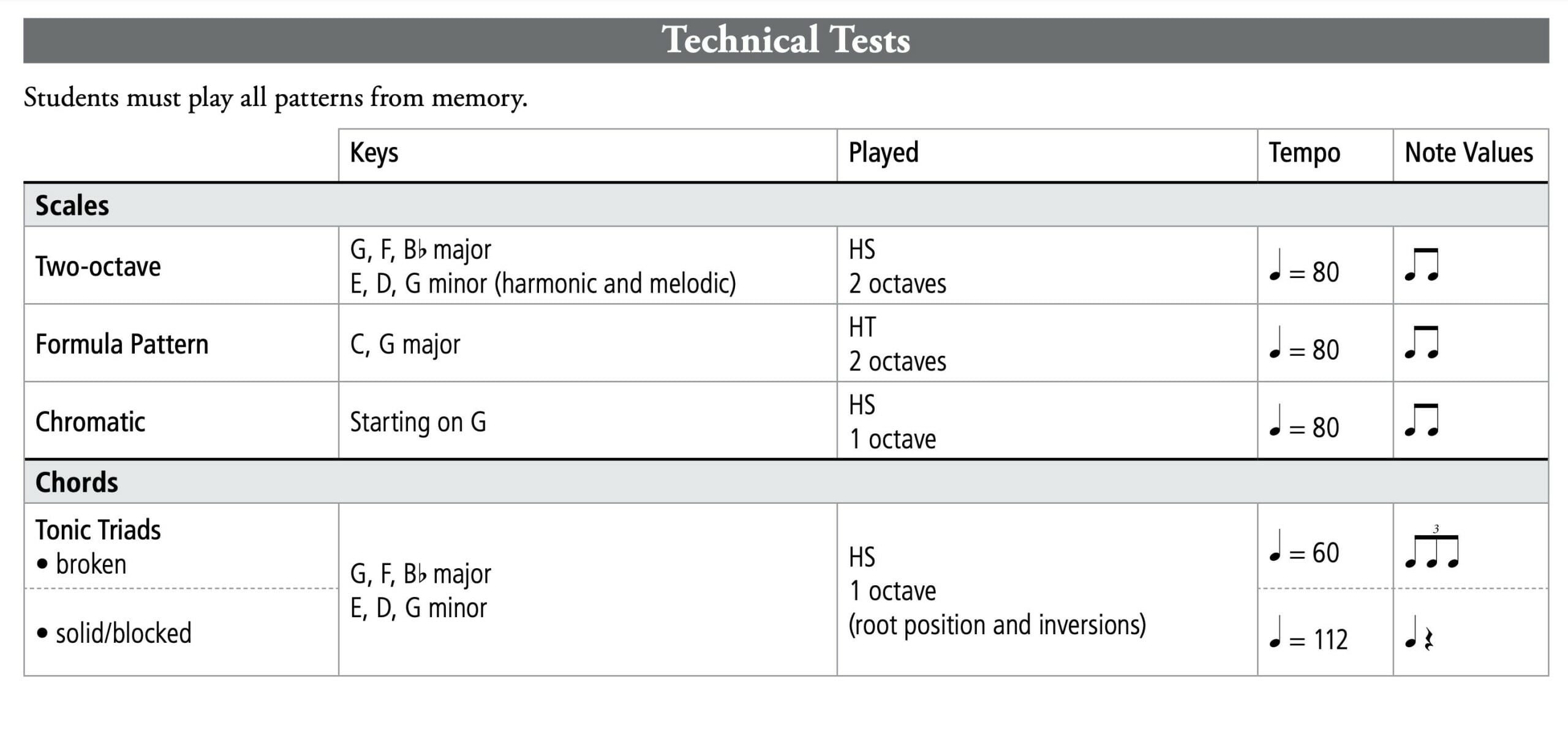
Below is all the technical requirements for level 2, all of which you already know except for melodic minor scales. I’ll teach those next lesson. For this week, practice your harmonic minor scales. The new one for you here will be G minor, so use Bb major’s key signature and then raise the 7th, so you get GABbCDEbF#G.
Sara
Repertoire all sounds great, fantastic details. Few notes, isolate the last 2 measures of In the Spirit (before it goes back to the beginning) practice the timing blocked so you don’t slow down and also practice lightening up on that final chord.
Sonatina, make sure you’re hearing the triplets inside your head for the final measure of the first page so the quarter notes are not too slow. I think it was accurate today, just make sure you don’t lose the pulse in your head.
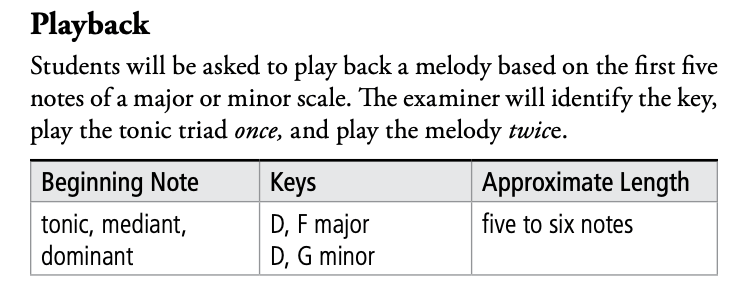
If you are able to get your Dad to do some melody playback with you that would be awesome. This image below shows the parameters. (Totally fine if not too!!) Tonic, mediant and dominant means you can start on any of the triad notes, 135.
Le Coucou – slow it down tempo wise and be very accurate about the articulation and phrasing. Notice some of the LH notes are meant to be legato (you’re doing this right) and some go staccato-then thicker. Be picky with this. Also in the RH you will notice the phrasing sometimes connects over the barline. If you need to, draw upwards arrows where the phrase line breaks to remind you to break the legato sound. This is a very impressive piece, and slowing it down and being super accurate will only benefit you more :)
Sina
If today was our final lesson together, I have prepared this summary of your current skills to give to whoever your next teacher is. If you are able to come for in person lessons on Thursday evenings or Saturday afternoons, I would love to continue working with you. You are great at taking feedback and lovely to work with Sina!!! Keep creating music <3
Marita
*New* The Swiss Cuckoo. This piece is in G major and the articulation is very important. Staccato when written and legato when needed to truly bring to life this playground song. It’s going to sound sing-songy and a little bit mocking in parts because it is traditional Italian children’s song. Watch the pickup beats.
Etude in C by Diabelli – take this for a spin one more week and see how fluent you can get it. Really lean into those down-up 2 note slurs and give a beautiful classical performance.
Preferred Books for Gergely’s Students
Click to buy them here, and they’ll come right to your house! What could be easier?
Hal Leonard Guitar Method
The second edition of this world-famous method by Will Schmid and Greg Koch is preferred by teachers because it makes them more effective while making their job easier. Students enjoy its easy-to-follow format that gives them a solid music education while letting them play songs right away. Book 1 provides beginning instruction including tuning, 1st position melody playing, C, G, G7, D7, and Em chords, rhythms through eighth notes, solos and ensembles and strumming.
Four Star Sight Reading and Ear Tests