
Guitarist Gergely Szabo has an Advanced Diploma in Music Performance from Cambrian College where he majored in the classical guitar. Over his time there, he completed 2 years of comprehensive pedagogy courses. He also gained well grounded vocal skills, as well as basic knowledge on the piano. Outside of classical music, he exhibits a repertoire of skills and knowledge in playing the genres of rock, blues, and heavy metal music. He has experience in teaching the guitar and the ukulele to a range of people aged 6 to 54.
Gergely’s teaching methods include both the use of books and digital methods. The three main books he uses to teach guitar are as follows: “Guitar Method Book 1 by Will Schmid and Greg Koch,” “Four Star Sight Reading and Ear Tests RCM Level 1,” and “Classical Guitar Repertoire and Etudes RCM Level 1.” For teaching ukulele, he uses the book “Ukulele Songs for 1, 2, or 3 players by Elizabeth Ragsdale.” Aside from these, he frequently uses the Muse Score application as a play-along practicing tool.
Gergely’s passion for music and his dedication to growing the love of music in others are the biggest reasons why he teaches guitar and ukulele. His approach to teaching involves learning through play. The material he covers with his students is always delivered in a way that is highly interactive. Most of the assigned exercises he gives involve the elements of play that students can enjoy both in class and as homework.
Get to know Gergely…Beyond the Bio!
Coming soon!
Hobbies:
Musical influences:
Favourite food:
Least favourite food:
Favourite music:
Favourite album:
Favourite movie:
Favourite musical theatre/opera:
Best quote from your teacher:
Favourite quote:
Favourite book:
Latest Homework from Gergely
Is Gergely Your Teacher?
Sign up now to get your weekly assignments delivered, and never lose your homework sheet again!
Saturday, 31 May
Jack
We looked into the drum fill of Back in Black today, and though it is slightly complicated to grasp, Jack was able to do it at a slower speed. We will try to speed it up next time and play it in context!
Aleksander
Great job with Living on a Prayer! We have attempted to play with the song today and the same old spots are tripping us. Always remember phrases are mostly in eight bar cycle so if you are lost, just look to pick back up in the next cycle! In the track, listen for the bass pattern and during practise look into how you lock into that pattern. We will try to play through again and perhaps make a recording next week!
Tracie
We had a super duper fun impromptu lesson on All By Myself by Celine Dion! We learnt about the concept of playing the space(rest) and also explored some fun fills! Look forward to seeing you again after the break and when you have a chance this break, pull up songs that you like and see if you can just play along with it and invent fun fills!
Jonah
We worked on some Snare Drum playing together. Treat snare drum like a lyrical instrument! If there are phrases of 16th notes, phrase to the end of it, meaning get in the habit of crescendoing to the end. Please work on the assigned etude with the number 4 on the too of the page. Also work on the worship song and we will try to tackle it together in person next week!
Mario
For My Friends today, we went further into Chorus and the Guitar solo section. I mentioned this during lesson, this piece have a lot of tricky spots and I am very much inspired by your resilience in lesson, and one quick tip that I can give you is though it might seem like every section has a different 16 notes lick, its actually always the same rhythm (1 na), except every time its assigned to different instruments, sometimes cymbal sometimes kick. When in doubt, listen to the recording I made and re familiarise yourself with the 1 na rhythm played on hihat and snare (see fourth bar of chorus on first page) THEN relate that to the lick that you have trouble with. If the rhythm sounds similar, you are more or less on the right track :)
Assignments from May 31st
Hello Everyone!
Vida:
Continue to practice Under the Sea, working towards playing the first two pages hands together! Use the metronome if this helps Vida. Start at 60BPM then slowly increase the tempo. The ideal tempo for Under the Sea is 120BPM. Review any tricky or challenging spots hands separately when necessary. Review Green Frog Hop, Home on the Range, and Mr. McGill’s Boop Sha Bop specifically to highlight the difference in staccato phrases and legato phrases. Mr. McGill’s Boop Sha Bop asks Vida to do both. Continue to read Lochness Monster hands separately. We will review this in class next week. Finally, Vida can review the F# Major, D# minor, B, and C# chords as these will be used in Ed Sheeran’s “I don’t care”. When Vida feels comfortable building and playing these chords, add in the rhythm pattern from the song. We can add some of the melody next week.
Berke:
Today we read a new song! I’ve uploaded the sheet music for “Burlesque in G Major” to the google drive. Review this hands separately, when you feel confident playing both the right and left hands separately, you can try playing this hands together. Do the same for the minor section of Mozart’s Minuet in F Major. Focus specifically on the minor section. Only when you can confidently play the minor section hands separately should you go back and add the major section we have already learned. At that point, play the song from the beginning hands together and continue playing into the minor section with the right hand only so that you can hear how the song changes. Practice the Major section and minor section hands together separately. We can try to play the whole thing together in class next week. For Moonlight sonata, focus on building the chords in bars 7, 8, and 9 while holding down the upper note. Play these chords very slowly to build and practice this technique in your fingers. You can find Burlesque in G Major here.
Great work today! I look forward to hearing how both of you progress in June!
Happy Practicing!
Preferred Books for Gergely’s Students
Click to buy them here, and they’ll come right to your house! What could be easier?
Hal Leonard Guitar Method
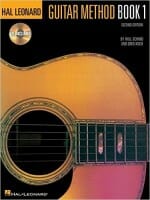
The second edition of this world-famous method by Will Schmid and Greg Koch is preferred by teachers because it makes them more effective while making their job easier. Students enjoy its easy-to-follow format that gives them a solid music education while letting them play songs right away. Book 1 provides beginning instruction including tuning, 1st position melody playing, C, G, G7, D7, and Em chords, rhythms through eighth notes, solos and ensembles and strumming.
Four Star Sight Reading and Ear Tests