
Guitarist Gergely Szabo has an Advanced Diploma in Music Performance from Cambrian College where he majored in the classical guitar. Over his time there, he completed 2 years of comprehensive pedagogy courses. He also gained well grounded vocal skills, as well as basic knowledge on the piano. Outside of classical music, he exhibits a repertoire of skills and knowledge in playing the genres of rock, blues, and heavy metal music. He has experience in teaching the guitar and the ukulele to a range of people aged 6 to 54.
Gergely’s teaching methods include both the use of books and digital methods. The three main books he uses to teach guitar are as follows: “Guitar Method Book 1 by Will Schmid and Greg Koch,” “Four Star Sight Reading and Ear Tests RCM Level 1,” and “Classical Guitar Repertoire and Etudes RCM Level 1.” For teaching ukulele, he uses the book “Ukulele Songs for 1, 2, or 3 players by Elizabeth Ragsdale.” Aside from these, he frequently uses the Muse Score application as a play-along practicing tool.
Gergely’s passion for music and his dedication to growing the love of music in others are the biggest reasons why he teaches guitar and ukulele. His approach to teaching involves learning through play. The material he covers with his students is always delivered in a way that is highly interactive. Most of the assigned exercises he gives involve the elements of play that students can enjoy both in class and as homework.
Get to know Gergely…Beyond the Bio!
Coming soon!
Hobbies:
Musical influences:
Favourite food:
Least favourite food:
Favourite music:
Favourite album:
Favourite movie:
Favourite musical theatre/opera:
Best quote from your teacher:
Favourite quote:
Favourite book:
Latest Homework from Gergely
Is Gergely Your Teacher?
Sign up now to get your weekly assignments delivered, and never lose your homework sheet again!
Fall & Summer 2025 Registration Open!
Hello Everybody!
School Year 2025
We are now beginning our Fall 2025 re-registration, and our summer registration. For the autumn, you will receive an email invitation to register through the system. This time will be held and will be set to expire on Friday.
The autumn times will be set to the recommended length from your spring report (which may be longer than currently). You can change this, if you like. Your invitation will link directly to the booking confirmation. You will need to pay for September to hold your spot. If this is an issue, please contact the office before registering.
Summer 2025
For the summer you can go directly to the online registration (https://abcmusic.opus1.io/w/lessons). Summer is more flexible than the school year, if you are going to be away. Just go to your schedule after registration and cancel weeks you expect to be away. The system should only require payment for the first lesson to hold the time, rather than have you pay for the full month which you may not take advantage of.
During the summer we only teach Tuesdays, Wednesdays, and Thursdays. This assures that everyone can have 4 day weekends at a minimum.
Lessons are typically in the same time range as the school year (after 3pm, and evenings).
Office unattended June 18-28 – Use Opus to Communicate with Teachers
Please note that the office will be unattended from June 19th through 29th.
During this time, log into Opus to use the ‘Comments’ area to communicate directly with your teacher.
This is a feature that is in testing for us, and allows you to communicate directly with your teacher during non-lesson times. At the moment, teachers are asked to reply during reasonable business hours only. It is not and is not meant to function as text/instant messaging. If you use this feature, we welcome your feedback to tell us your experience with it. Thank you!
Post-Pandemic note to follow
While we are keen to put pandemic life behind us, we are still seeing effects, and would like to bring you up to date on those. Please watch for a separate note on that soon.
Assignments from May 10th
Hello!
I have a few reminders and updates for you all. First, Berke has informed me that he does not have access to his chrome book this week! So if you could kindly remember to share this email with him that will be super helpful for Berke’s practice this week. Second, while I know the in person recital was cancelled, we are still going ahead with the digital concert! Berke and I record Minuet in F today to be added to the concert! Thank you Berke for your hard work on this piece, I am very much looking forward to seeing everyone’s performances!
Berke:
For this week please review Moonlight Sonata and practice the first 8 bars of Clair de Lune. Practice the fingerings as follows for the 3 alternating eighth note “motifs”. Eighth note group 1: 3/5 – 1/4 – 3/5 – 1/4. Eighth note group 2: 2/4 – 1/5 – 2/4. Eighth note group 3: 1/3 – 2/4 – 1/3. Please practice these bars slowly. This requires meticulous fine motor skills in the hand and fingers so pay attention to how this feel in your hand when you play these 3 bars. Use the metronome to help you stay in time, but start at 45BPM, switching chords with each tick of the metronome. Once your hands feel comfortable with this technique, you can slowly speed up to your desired tempo. Please review the upper notes only of the melody in bars 5 and 6 and continue to sight-read the second chunk of that melody in bars 7 and 8 on your own. Practice the eighth note groups and melody separately, put the two sections together only when both feel comfortable in your hands. Review what we have learned in Moonlight Sonata (bars 1-9). Review the chords in bars focusing specifically on bars 7-9 as this is newer material. Play these bars hands separate until you can confidently build and play the chords in the left hand. Review bars 5 and 6 slowly, playing close attention to which notes are played together and when. We will review and learn more Moonlight Sonata next week.
Excellent work today! I look forward to hearing more next week.
Preferred Books for Gergely’s Students
Click to buy them here, and they’ll come right to your house! What could be easier?
Hal Leonard Guitar Method
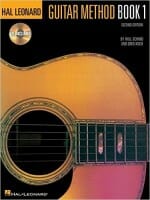
The second edition of this world-famous method by Will Schmid and Greg Koch is preferred by teachers because it makes them more effective while making their job easier. Students enjoy its easy-to-follow format that gives them a solid music education while letting them play songs right away. Book 1 provides beginning instruction including tuning, 1st position melody playing, C, G, G7, D7, and Em chords, rhythms through eighth notes, solos and ensembles and strumming.
Four Star Sight Reading and Ear Tests