M.Mus (U of T)
B.Mus (Oberlin)
Guitarist Gergely Szabo has an Advanced Diploma in Music Performance from Cambrian College where he majored in the classical guitar. Over his time there, he completed 2 years of comprehensive pedagogy courses. He also gained well grounded vocal skills, as well as basic knowledge on the piano. Outside of classical music, he exhibits a repertoire of skills and knowledge in playing the genres of rock, blues, and heavy metal music. He has experience in teaching the guitar and the ukulele to a range of people aged 6 to 54.
Gergely’s teaching methods include both the use of books and digital methods. The three main books he uses to teach guitar are as follows: “Guitar Method Book 1 by Will Schmid and Greg Koch,” “Four Star Sight Reading and Ear Tests RCM Level 1,” and “Classical Guitar Repertoire and Etudes RCM Level 1.” For teaching ukulele, he uses the book “Ukulele Songs for 1, 2, or 3 players by Elizabeth Ragsdale.” Aside from these, he frequently uses the Muse Score application as a play-along practicing tool.
Gergely’s passion for music and his dedication to growing the love of music in others are the biggest reasons why he teaches guitar and ukulele. His approach to teaching involves learning through play. The material he covers with his students is always delivered in a way that is highly interactive. Most of the assigned exercises he gives involve the elements of play that students can enjoy both in class and as homework.
Get to know Gergely…Beyond the Bio!
Coming soon!
Hobbies:
Musical influences:
Favourite food:
Least favourite food:
Favourite music:
Favourite album:
Favourite movie:
Favourite musical theatre/opera:
Best quote from your teacher:
Favourite quote:
Favourite book:
Latest Homework from Gergely
Is Gergely Your Teacher?
Sign up now to get your weekly assignments delivered, and never lose your homework sheet again!
Assignments from March 22nd
Hello!
I hope you all had a good March Break!
Berke:
For this week, please have Berke warm up with Mozart’s minuet in F so that he can continue to practice playing hands together. Remind him that there is an octave jump in the left hand in measure 3. Please ask Berke to play the full 8 bars as smoothly and as accurately as possible without stopping. Challenge him to resist going back in the music to correct any mistakes; play each bar once and move on to the next bar – even if its not perfect. Play the piece this way 3-5 times then put it away. Today we started learning Beethoven’s Moonlight Sonata! This piece is in C# minor and has 4 sharps F#, C#, G#, and D#. When practicing, Berke must remember that these notes are always to be played sharp, unless otherwise indicated in the sheet music. There is also a B# in this piece. We talked about it today in class, but if Berke forgets, please help remind him that B# and C are the same note. We also learned that in musical notation, should an accidental (a sharp, a flat, or a natural) appear with a specific note in a bar, this accidental is implied every time that same note appears within the same bar, regardless of whether the accidental is rewritten or not. There is an example of this in measure 4 of the sonata. Berke is to practice the chords in the right hand as well as the octave figures in the left hand for the first 8 bars of the piece. When he feels confident playing the notes of the chords accurately, he can play the 8 bars hands together. The sheet music for “Moonlight Sonata” can be found here.
Happy Practicing!
Assignments from March 20th
Hello Everyone!
I hope you all enjoyed your March Break!
Noreet:
Today we sight-read Mr. Haydn’s Theme and reviewed the meaning of transposition and modulation; when the song starts in one key and ends in a different one. Noreet can continue to practice the right and left hands of Mr. Haydn’s theme separately until she feels confident to try playing hands together. Noreet is able to find the first note of the song, if she forgets, please remind her that the ledger line in the middle of the staff is always middle C. Noreet can also feel free to go back through her book and review previous songs we have studied together. This is in anticipation of an upcoming student recital – I will have more information about this in April.
Vida:
Vida can continue to practice “Green Frog Hop” and “Theme and Variation”. Play with tempo this week; “Green Frog” can be played quickly while “Theme and Variation” should be played at a moderate tempo. “Green Frog Hop” is to be played no faster than 185BPM, this is fast enough for Vida’s liking but not too fast that we miss out on the melody. “Theme and Variation” is to be played at 120BPM on the metronome. Have her play along with the metronome at least once to internalize each tempo. Pay close attention to the running eight note figure in the Variation, please help Vida to ensure all eight notes are played evenly, that none of them “stick”, and that the phrase is played smoothly throughout. Record this one when Vida is ready so that she can hear the melody of the song – if the melody is unclear have her play it slower. Finally, help Vida practice her sight-reading with “Under the Sea”.
Eva:
I’m sorry we missed you today. Eva can continue to practice different rhythm patterns on the piano. She can also write her own rhythm pattern if she would like. Please help her to write these out if she wishes and ensure she uses the correct names for each note. See the flashcards in Eva’s google drive folder to help this process.
Christian:
For this week, warm up with the “French Minuet”. Play this entirely with one hand (even the one bar indicated for the left hand). You can alternate playing this with the right and left hand. Play it as quickly as you are comfortable with, being mindful of your fingerings so your fingers do not get tangled up when ascending or descending. Continue to practice the chord progression for “How Long Will I Love You”. Use the bottom note of each chord to map out where your fingers land for each chord – this will help with faster transitions between chords. When confident playing the pattern of the chord progression, try adding in the roll. Review the first two phrases of the right hand, watching out for where the melody is in stepwise motion or leaping intervals. You can also read more of the piece to challenge your sight-reading.
Happy practicing everyone!
Preferred Books for Gergely’s Students
Click to buy them here, and they’ll come right to your house! What could be easier?
Hal Leonard Guitar Method
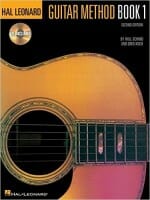
The second edition of this world-famous method by Will Schmid and Greg Koch is preferred by teachers because it makes them more effective while making their job easier. Students enjoy its easy-to-follow format that gives them a solid music education while letting them play songs right away. Book 1 provides beginning instruction including tuning, 1st position melody playing, C, G, G7, D7, and Em chords, rhythms through eighth notes, solos and ensembles and strumming.
Four Star Sight Reading and Ear Tests