Guitarist Gergely Szabo has an Advanced Diploma in Music Performance from Cambrian College where he majored in the classical guitar. Over his time there, he completed 2 years of comprehensive pedagogy courses. He also gained well grounded vocal skills, as well as basic knowledge on the piano. Outside of classical music, he exhibits a repertoire of skills and knowledge in playing the genres of rock, blues, and heavy metal music. He has experience in teaching the guitar and the ukulele to a range of people aged 6 to 54.
Gergely’s teaching methods include both the use of books and digital methods. The three main books he uses to teach guitar are as follows: “Guitar Method Book 1 by Will Schmid and Greg Koch,” “Four Star Sight Reading and Ear Tests RCM Level 1,” and “Classical Guitar Repertoire and Etudes RCM Level 1.” For teaching ukulele, he uses the book “Ukulele Songs for 1, 2, or 3 players by Elizabeth Ragsdale.” Aside from these, he frequently uses the Muse Score application as a play-along practicing tool.
Gergely’s passion for music and his dedication to growing the love of music in others are the biggest reasons why he teaches guitar and ukulele. His approach to teaching involves learning through play. The material he covers with his students is always delivered in a way that is highly interactive. Most of the assigned exercises he gives involve the elements of play that students can enjoy both in class and as homework.
Get to know Gergely…Beyond the Bio!
Coming soon!
Hobbies:
Musical influences:
Favourite food:
Least favourite food:
Favourite music:
Favourite album:
Favourite movie:
Favourite musical theatre/opera:
Best quote from your teacher:
Favourite quote:
Favourite book:
Latest Homework from Gergely
Is Gergely Your Teacher?
Sign up now to get your weekly assignments delivered, and never lose your homework sheet again!
Saturday, November 9th
Jack
Benny Greb Rhythmic Alphabet
–Learn each letter in the “binary” part of the alphabet (counting 1-2-3-4)
–try building small words!
Using these words, play along to Sum 41: In too Deep
Tragically Hip: 50 Mission Cap
–Learning the beat (Bass-Snare-Bass-Snare) and playing along with the song while I play piano
Xylophone
–Learning the musical alphabet (ABCDEFG)
–Visually identifying C on the keyboard
–Spelling “Dad” and “Egg” on the keyboard
Aleksander
Warmups (30 sec each) goal tempo 160bpm:
–Single strokes (R L R L…)
–Double Strokes (R R L L….)
–Paradiddles (RLRR LRLL…)
Drumset Musician p12 ex. 8-15 a)
ACDC: Back in Black–everything up until 2:49
–Bridge section: use the worksheet to practice this beat
–Once comfortable, listen to this recording and try playing along to this section
Jared
Warmups:
–Stick Control ex 14-23** (70bpm)
—-Play each exercise 4 times
Bruno Mars: Locked Out of Heaven
–Use the Half-Time Groove Primer worksheet (handout) to help build up to the new beat on the last page. Sorry I left ex. 5-1/2 out. It’s at the bottom
–Drill all the small transitions (eg. end of chorus back into verse)
Jonah
Warmups (1min/ea)
–Triplet Exercise (Goal tempo=115)
–Sixteenth-note exercise (goal tempo=100)
New Song! Bruno Mars: Locked Out of Heaven
–Good work. Remember to read along!
–Tom-tom groove in the chorus: make sure to nail the transition back to the verse
–Use the handout to practice the halftime groove from the end of the song
Mario
Warmups (1min/ea; slow, med, fast speeds)
–8 on a hand
–Single Stroke Roll (R L R L…)
–Double Stroke Roll (R R L L…)
White Stripes: Seven Nation Army COMPLETE
–Follow the “roadmap” of the song. You know it all now, so it’s just a question of playing the correct parts at the correct times in the song
–LISTENING is the key skill to playing in time with the recording
–Use listening to help you adjust when accidentally playing too fast/slow
Drumset Musician p11, ex. 1-4*
–Good work
–Also practice 1 b) to help with the White Stripes song
Mateo–WOOHOO great first lesson!
Required materials: notebook/binder/duotang, sticks, metronome
Recommended materials: hearing protection (ear plugs or otherwise), practice pad, method books (I’ll let you know when/what to buy)
Also, please visit this link and bookmark it. Mateo will use resources posted in the “Frequently Used Resources Folder” as well as his personal folder (Hull, Chris>Student-Specific Resources>Mateo Zalamea) throughout his drum lessons.
Holding the sticks (“The Grip”):
–With the backs of your hands facing the sky, hold the stick between your thumb and index finger. It should be kind of like how you’d grip a key to open your front door
–Let the rest of your fingers wrap comfortably around the stick
–When playing, use the flexion and extension (or up and down motion) of your wrist to make a stroke, kind of like bouncing a basketball
–Allow the stick to bounce freely from the drum
–Remember: flying V, key grip, basketball
Warmups (30 sec each):
–8 on a Hand
–Single Stroke Roll (RLRL…)
–Double Stroke Roll (RRLL…)
FIRST DRUM BEAT (Basic Beat exercise, Level 1)
Step 1) Count “1 2 3 4”
Step 2) With your Right Hand (RH), play the hihat cymbals on all counts
Step 3) With your Right Foot (RF), play the bass drum on “1” and “3”
Step 4) With your LH, play the Snare Drum on “2” and “4”
–if it gets tricky, slow things down! Give your brain more time to think
–Be careful not to crush the strokes: sticks should bounce freely from the drum
You can find sheet music for these beats in the Frequently Used Resources folder. They are from Drumset Musician, p11 (ex. 1 a and b). Please download and print. :)
Assignments for the week of November 7, 2024
Hello everyone!
I hope you all enjoyed your Halloween. Your lesson notes are as follows:
Eva
What we learned/reviewed in lesson:
- Dynamics review (piano, mezzo piano, mezzo forte, forte)
- Counting exercises: we were able to figure out the math to have 4 beats in each measure
- Played through Echo Song and Old Macdonald
- Introducing the pedals! They can really change the sounds of the piano
Recommended minutes to practice:
- 10-15 minutes, 4 to 5 days a week
What to practice:
- We’ve done a lot of practice on the black keys but now we will also begin playing on the white keys! As of now, we should be familiar with C, D, and F. The pieces you can work on this week will be on the white keys
- Balloons (page 25), Merrily We Roll Along (page 26), Men From Mars (page 29)
- Extra pieces if there’s interest: The Escalator (page 27), CDEFG March (page 28)
- Continue playing through the new Finger Number Patterns for review/practice
How to practice efficiently:
- When we eat a pizza, we eat it one slice at a time (bite by bite), not the whole pizza at once! When learning a new piece, we can break it down into finger numbers, notes, rhythms, and sometimes words. Instead of trying to “digest” the whole piece at once, isolate one of these things to practice:
- Can you say all the finger numbers of the piece?
- Can you name all the notes you’re playing?
- Can you clap the rhythm on its own?
How can caregivers support practice:
- Remind Eva of the pizza analogy and how we can approach learning a piece from many different angles (bite by bite, starting with the cheese, starting with the crust, eating all the toppings before eating the dough). When jumping into a new piece, try isolating some of the “ingredients” — can we say all the finger numbers? Can we name the notes? Can you clap the rhythm? Can we clap/sing the different dynamics?
Chris
What we learned/reviewed in lesson:
- Bartok sight reading
- Noting shape of notes (which direction the notes are moving in, is the musical line going up? Or down?)
- Motion of the hands (parallel or contrary)
- Noticing if the lines are moving by steps or leaps
- Chant of the monks
- This piece tied in well with our sight reading. It mainly featured parallel motion moving by steps, integrating the 5 note scale (C D E F G)
- Introducing sharps and flats (aka, the black keys on the keyboard)
- See attached image breaking down how to read/understand their relation to white keys
- Try sitting on books/pillows at home to get to the right seated position at the keyboard
- Introducing C and G “positions” (Left Hand finger 5 and Right Hand finger 1 placed on these notes to start)
- Begin playing through 5 note scales beginning in either of these positions. End with playing the first and fifth note together, playing the third (the note finger 3 is on), and end with playing the 3 notes chord (1 3 5)
- Can work on this exercise one hand at a time before playing hands together.
Recommended time to practice:
- 20-30 minutes 4 or 5 days of the week
What to practice:
- Planetarium, Roman Trumpets (focus on dynamic contrast in this piece. Aim to be able to play it start to finish so we can try the duet)
- If there’s time/interest to look through a couple more pieces: Minuet, Russian Sailor Dance
- Scales and chords (c position, g position)
- Can practice hands separate, then together
- In addition to our “main course” practice (playing pieces at the keyboard), take some time to check in with foundational elements (alignment, wrist support, tucking in elbows, whether tension is being felt in the body while playing)
How to practice efficiently:
- Address the height of your keyboard at home in case it’s contributing to discomfort while playing
- To counteract the fingers floating away while playing, keep the imagery of fingertips being covered in peanut butter/caramel — we want to keep them close to the keyboard
- Incorporating listening into practice:
- When listening to recordings of our pieces, our goal is not to make that performance our blueprint (do not aim to directly imitate what you hear). Listening can be a really great tool for developing your ear — listen to get ideas/wider understanding about phrasing, dynamics, and articulation.
- Roman Trumpets: https://youtu.be/jbdjP7zadA0?si=j09m_p8V4h6sKw7S
- Planetarium: https://youtu.be/a1Z9MXVObDs?si=NWdOarjB7lyM4p1k
Greta
What we learned/reviewed in lesson:
- Bartok sight reading; recognizing parallel vs. contrary motion, notes moving by steps or leaps, counting
- I have resent the PDFs for Amber Moon, please print or save a copy to your device so you can easily access it again
- Discussing the importance of metronomes: they can be a bit tricky to use at first but they are ultimately a tool that exists to help elements of your playing. In this case, it is consistent rhythm/pulse
- How to use a metronome:
- the beat that you hear will be a quarter note. The number equals how many times the metronome play a beat (you might hear the phrase “beat per minute” or BPM
- Set the metronome to a pulse that feels comfortable to play to (we had a quarter note = 55-60 at our lesson).
- For scale practice, imagine that you are playing eighth notes. See attached image to see how each note will correspond to the pulse.
- Start slow! Your goal should be able to match the tempo of your playing to the beat of the metronome. Once you can play through consistently and without stops, you can increase the BPM and try the scale at a faster tempo!
- How to use a metronome:
Recommended time to practice:
- 20-30 minutes a day, 4 days a week
What to practice:
- Technique:
- G major scale
- One octave blocked
- Two octaves one hand with metronome
- Two octaves both hands with metronome
- G major solid triads, 2 octaves, hands together
- G major scale
- Practice playing through the left hand of Amber Moon in time (counting all the beats in each measure), begin learning and adding in the right hand melody
How to practice efficiently:
- Focus more on playing technique hands together (with a metronome). Playing hands together (straight through, no stops) at a consistent tempo will be our goal
- If there’s only time to practice technique, practice it in varied ways (almost as if you were practicing a piece of repertoire):
- Play technique at different dynamics: piano (softly), forte (loudly), crescendo going up the scale, diminuendo on the way down
- Play with different articulation: staccato, accented
- Play with different rhythms: swing, dotted, triplets
Amber Moon URL: https://youtu.be/CPn7mXHqASw?si=nkHA5JLjAiE6l8VJ
- If link does not work, you can copy and paste it into a browser
Have a good week everyone!
Preferred Books for Gergely’s Students
Click to buy them here, and they’ll come right to your house! What could be easier?
Hal Leonard Guitar Method
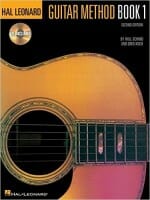
The second edition of this world-famous method by Will Schmid and Greg Koch is preferred by teachers because it makes them more effective while making their job easier. Students enjoy its easy-to-follow format that gives them a solid music education while letting them play songs right away. Book 1 provides beginning instruction including tuning, 1st position melody playing, C, G, G7, D7, and Em chords, rhythms through eighth notes, solos and ensembles and strumming.