M.Mus (U of T)
B.Mus (Oberlin)
Guitarist Gergely Szabo has an Advanced Diploma in Music Performance from Cambrian College where he majored in the classical guitar. Over his time there, he completed 2 years of comprehensive pedagogy courses. He also gained well grounded vocal skills, as well as basic knowledge on the piano. Outside of classical music, he exhibits a repertoire of skills and knowledge in playing the genres of rock, blues, and heavy metal music. He has experience in teaching the guitar and the ukulele to a range of people aged 6 to 54.
Gergely’s teaching methods include both the use of books and digital methods. The three main books he uses to teach guitar are as follows: “Guitar Method Book 1 by Will Schmid and Greg Koch,” “Four Star Sight Reading and Ear Tests RCM Level 1,” and “Classical Guitar Repertoire and Etudes RCM Level 1.” For teaching ukulele, he uses the book “Ukulele Songs for 1, 2, or 3 players by Elizabeth Ragsdale.” Aside from these, he frequently uses the Muse Score application as a play-along practicing tool.
Gergely’s passion for music and his dedication to growing the love of music in others are the biggest reasons why he teaches guitar and ukulele. His approach to teaching involves learning through play. The material he covers with his students is always delivered in a way that is highly interactive. Most of the assigned exercises he gives involve the elements of play that students can enjoy both in class and as homework.
Get to know Gergely…Beyond the Bio!
Coming soon!
Hobbies:
Musical influences:
Favourite food:
Least favourite food:
Favourite music:
Favourite album:
Favourite movie:
Favourite musical theatre/opera:
Best quote from your teacher:
Favourite quote:
Favourite book:
Latest Homework from Gergely
Is Gergely Your Teacher?
Sign up now to get your weekly assignments delivered, and never lose your homework sheet again!
Saturday, April 26
Tova
Xylo week: Cupid by 50/50 is now fully transcribed for you. Try to find all the notes at home and give your best try to learn the rhythm. When in doubt, try to count out loud in 8th notes (1 n 2 n 3 n 4 n), listening to the recording for answer is our last resort!
Rolls: I would like you to turn on metronome at around 80-90bpm, and play on 1 pitch (middle C for example) then play 1. 16th notes (4 notes a beat), 2. quintuplet (5 notes a beat, alternate between R and L on main beat, RLRLR LRLRL), if feeling capable, sextuplet (6 notes) The idea is to have control over when we are landing our roll and consistency in strokes (both in terms of timing and sound quality) avoid unevenness (e.g. LH softer than RH)
Jared
Bring me to life by Evanescence
we familiar ourselves up to bar 33. Great job dissecting such a complex groove. Work up to speed at home. We will try to play with recording for the section and read on next class. Also still try to spend some time planning the solo. A good solo doesn’t just come out of nowhere, but hard work!
Mario
Warm Up:
Triplet and double was superb today! Definitely seeing immense improvements with the relaxation aspect. We will keep using this as our warm up into the session
Drag: find a sweet spot between the clear three note (LL R) and the “french” way (buzz left R)
play around with both at home. for LL, use the same principle of practising doubles. Aim to do it in one movement instead of two taps. Explore how to recycle the bounce.
My Friend by RHCP
WE have familiarise ourselves with the tough spots in Page 1 and we are absolutely ready to play through some stuff next week. In the meantime, keep practising those transitions in chunks. Small chunks into large, then into phrases!
Start learning second page as we have today!
Do it slow!
Jonah
Material from Hannaford (snare drum and mallet or accessories) – The Simpson:
We explore where can we make good sounds on the xylophone, and the idea of playing on the edge of accidentals (sharp and flats), the tip of the edge has a more open sound than somewhere closer to the nodal point. Avoid nodal point at all cost.
Very tricky passages, but you quickly mastered how to play them. However always remember that to practise efficiently means doing it systematically and always strive to get repetition of the right notes.
Few things to remember are:
- position your right hand mallet below your left on the key so you don’t trip yourself going up the keyboard
- always observe the key signature and sharp flats
- when in doubt, block them in two, play it slow and slowly build up the muscle memory to play the passages
- for the repeating note passage, practise playing it with only RH then introduce LH after (with the idea of RH leading LH)
Assignments from April 26th
Hello!
Friendly reminder that our recital is next Sunday, May 4th at 1:30pm! It would be so great if you could attend, even if you are not performing!
Berke:
For this week, I challenge you to play Minuet in F Major for other people; friends, family, anyone who will listen. This will help you practice performing! When playing the Minuet, practice pushing through even if a mistake happens! Persevere to the end, then you can go back an address any errors. You can also record yourself so that you can listen back to what you just played. When listening back, ask yourself what you like about the performance and what you want to improve for next time, if anything. Also, when listening to yourself play, please be sure to follow along in the sheet music; this will help highlight any areas that need improvement. When practicing Moonlight Sonata this week, focus on bars 5 and 6. Practice the triads in the right hand and the melody of the right hand separately. Make sure to practice playing those triads with your first, third, and fourth finger as you will need the fifth finger to play the melody. Only when you are confident with the chords on their own should you add in the upper melody on the G#. When putting the two ideas together, practice at half the speed you can play the res of the song. Pay close attention to how each note fits together like a puzzle. When your fingers are comfortable playing both bars 5 and 6 all together, go back and play the all 6 bars together start to finish.
Great lesson today! I look forward to hearing you play more Moonlight Sonata next week.
Preferred Books for Gergely’s Students
Click to buy them here, and they’ll come right to your house! What could be easier?
Hal Leonard Guitar Method
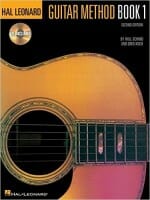
The second edition of this world-famous method by Will Schmid and Greg Koch is preferred by teachers because it makes them more effective while making their job easier. Students enjoy its easy-to-follow format that gives them a solid music education while letting them play songs right away. Book 1 provides beginning instruction including tuning, 1st position melody playing, C, G, G7, D7, and Em chords, rhythms through eighth notes, solos and ensembles and strumming.
Four Star Sight Reading and Ear Tests