M.Mus (U of T)
B.Mus (Oberlin)
Guitarist Gergely Szabo has an Advanced Diploma in Music Performance from Cambrian College where he majored in the classical guitar. Over his time there, he completed 2 years of comprehensive pedagogy courses. He also gained well grounded vocal skills, as well as basic knowledge on the piano. Outside of classical music, he exhibits a repertoire of skills and knowledge in playing the genres of rock, blues, and heavy metal music. He has experience in teaching the guitar and the ukulele to a range of people aged 6 to 54.
Gergely’s teaching methods include both the use of books and digital methods. The three main books he uses to teach guitar are as follows: “Guitar Method Book 1 by Will Schmid and Greg Koch,” “Four Star Sight Reading and Ear Tests RCM Level 1,” and “Classical Guitar Repertoire and Etudes RCM Level 1.” For teaching ukulele, he uses the book “Ukulele Songs for 1, 2, or 3 players by Elizabeth Ragsdale.” Aside from these, he frequently uses the Muse Score application as a play-along practicing tool.
Gergely’s passion for music and his dedication to growing the love of music in others are the biggest reasons why he teaches guitar and ukulele. His approach to teaching involves learning through play. The material he covers with his students is always delivered in a way that is highly interactive. Most of the assigned exercises he gives involve the elements of play that students can enjoy both in class and as homework.
Get to know Gergely…Beyond the Bio!
Coming soon!
Hobbies:
Musical influences:
Favourite food:
Least favourite food:
Favourite music:
Favourite album:
Favourite movie:
Favourite musical theatre/opera:
Best quote from your teacher:
Favourite quote:
Favourite book:
Latest Homework from Gergely
Is Gergely Your Teacher?
Sign up now to get your weekly assignments delivered, and never lose your homework sheet again!
Assignments from April 24th
Hello Everyone!
Friendly reminder that our student recital is scheduled for next Sunday, May 4th at 1:30pm. It would be so great if all of you could attend even if you are not performing!
Noreet:
I hope you are having a fabulous time in Europe!
Vida:
For this week, please have Vida practice Rhino in the Mud! This is a great option for the recital. Help Vida record herself playing the song so she can hear, then ask her what specifically she likes about what she is doing and if there are any areas she wants to improve upon or change. Also, talk to her about the recital. Please remind her that “performance” is a skill on its own and requires practice as well. The recital would be a great chance to practice performing for an audience. The deadline to sign up is this Tuesday, if Vida does decide she want to perform, feel free to reach out to me via opus and I will add her name to the list. Continue to practice Mr. McGill’s Boop Sha Bop. Encourage Vida to use the metronome to ensure her eighth notes are “balanced” and stay in tempo. Vida should also use the second note in bars 10-12 and 14 as a “launchpad” to the next set of eighth notes. We will talk more about this in class next week. I’ve also uploaded a video of a rhythm exercise to the google drive for Vida to practice. With one hand, Vida is to tap quarter notes and with her left hand tap eighth notes at the same time. We tried this in class together, (its very much like rubbing your tummy and patting your head at the same time). Try this at different tempos so Vida can feel how the eighth notes fit into the quarter note. Please help Vida to sight-read more of Under the Sea before reviewing the material she played for me in class. Aim to read and practice at least 4 new bars so that Vida can add on to what she has already learned. You can find the video of the rhythm exercise here.
Eva:
This week we sight-read the second phrase of Sailing in the Sun! Please help Eva review these notes at home and encourage her to play this phrase for you! You can also take turns reading and playing. Have Eva name the notes as you play them then switch and help Eva name the notes as she plays. When she feels confident playing the second phrase, challenge her to play both the first phrase and second phrase together. Eva can also finish the colouring sheet I sent home. Have her assign a colour to each note, then ask her to find that specific note for that chosen colour e.x colour each F Green! The notes on the colouring sheet are identical to Sailing in the Sun, feel free to use the music in the book for reference and clarification if needed as I know Emma’s writing can be messy.
Christian:
This week please practice forming and playing the chords in your left hand for the first 8 bars of How Long Will I Love You. Also, sight-read as much as of the right hand in the 3rd phrase as you can on your own. When practicing the chords in the right hand at the beginning, focus on connecting each chord, with or without the roll. Use the metronome to ensure you are holing the chords for their full length. When practicing Morning, isolate any areas where you are pausing or are unsure of the notes. Practice these areas and bars on their own before connecting them back into the rest of the song. Work towards playing the whole song smoothly from start to finish by practicing at a slow tempo and slowly getting faster with each repetition. You can use the metronome for this if you find that helpful.
Thank you everyone for your hard work this week! I’ve seen some exciting improvements across all lessons. Keep up the great work!
Assignments for the Week of April 23, 2025
Clara
Technical Exercises – A Major
- 1 octave scale, hands separately and together: practicing as solid blocked hand positions and stepping
- 1 octave triads – solid hands separately
- Finding separate root position, first inversion, and second inversion triads from the lap to the keyboard
- Moving back and forth between chord inversions, as well as ascending/descending through all inversions
Bartok – #7 hands together fully – practicing saying note names out loud
Melody in G Major – Focusing on dynamics overall
- Making sure our right hand is “singing” over our left hand! Sing along as a way to help bring it out in the fingers
- Keeping our left hand gentle (instead of thinking “loud-soft-loud-soft”, thinking a gentle “down-up-down-up”)
- Clear difference between mezzo-forte and mezzo-piano dynamics
- Watching out for decrescendos, as well as our ending ritardando
On the Trampoline
- Excellent work getting our time signature comfortable! Keep up with focus on this, especially in our last line as our right hand jumps around
- Focusing on the right hand ending, practicing moving back and forth between chords (focus on finger 5!)
- Dynamics at the end – crescendo to a full forte (don’t forget the left hand!) ending in a sudden mezzo-piano
The Storm – Thinking about our new composition idea!
- Thinking about what kind of scene/story you want to share with it – What kind of rain is there? Is there heavy thunder? Is there a lot of lightning? Is it a hailstorm? How fast is the wind? Is there a tornado with a herd of cows spinning around in it?
- Try writing all of this down in a short story, poem, couple of sentences; try drawing a picture of the storm
- Think about the kinds of sounds you might hear, or how they might sound on the piano
- Try drawing a visual score with shapes and lines that could represent your storm like we tried in lesson!
Hakim
Technical Exercises – A Major
- 1 octave scale hands separately and together, practicing as solid hand positions and stepping
- 1 octave triads, hands separately – solid and broken
- Ascending and descending
- playing through root position – first inversion – second inversion – root position
- Make sure you are using the same fingerings in solid and broken triads. Always using fingers 1 and 5 for outside notes
- Rh finger 2 only in first inversion, Lh finger 2 only in second inversion
Gymnopedie #1 – please make sure this is printed and brought to next week’s lesson! We want to make sure we are using consistent fingerings so things stick in the brain more efficiently, and this will help.
- Focusing on hands separate practice from measures 13-21, making sure we can comfortably play through this at least hands separately
- Trying to fit from the beginning to measure 21 fully hands together if you are up for it!
- Lh watching out for new hand positions (F#, B, E) in measures 17-20
- Make sure you know which chord our LH moves to on beat 2 of each measure
- Practice moving back and forth between bass notes and chords in the Lh to get them as comfortable as our introduction
- Watch out for Rh playing different notes measures 8-11 (A moves down to F#) and measures 16-19 (A moves up to C# moves up to F# leaps down to E)
- Rh moving on trying to read through measures 22-31, writing in note names with pencil
Preferred Books for Gergely’s Students
Click to buy them here, and they’ll come right to your house! What could be easier?
Hal Leonard Guitar Method
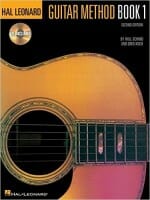
The second edition of this world-famous method by Will Schmid and Greg Koch is preferred by teachers because it makes them more effective while making their job easier. Students enjoy its easy-to-follow format that gives them a solid music education while letting them play songs right away. Book 1 provides beginning instruction including tuning, 1st position melody playing, C, G, G7, D7, and Em chords, rhythms through eighth notes, solos and ensembles and strumming.
Four Star Sight Reading and Ear Tests