
Bachelor of Fine Arts (York University)
Katie Thurman is a singer, pianist, accompanist, and teacher based in Toronto. Her passion for music has been with her since childhood, and she is excited to have recently completed her undergraduate degree in music at York University.
Trained classically in piano, she continues to explore other styles including pop and jazz, as well as write her own compositions. Her vocal training is in both classical and musical theatre styles, as well as lengthy choral experience both in and out of school.
Katie spent 6 years singing with WIBI A Cappella, a collegiate-based group, during her time at York, and is proud to have competed with them twice in the ICCA (the very competition the Pitch Perfect films were based on!). Currently, she sings with the Toronto-based That Choir.
Katie loves all types of music, but spends most of her time listening to pop, indie, and alt-pop records.
Katie also writes her own songs and is working towards putting together an EP. Aside from music, Katie’s other passions include baking, film, and psychology. She loves teaching and is always pushing herself to grow pedagogically and musically!
Get to know Katie…Beyond the Bio!
Hobbies: baking, watching movies/TV, writing, yoga, hiking
Musical influences: Classical: Natalie Dessay, Maria Callas/Pop: Arcade Fire, Lana Del Rey, BANKS, Florence & the Machine, Rhye
Favourite food: Pasta
Least favourite food: Seafood
Favourite music: pop & alt-pop, indie/folk, dance, and all things Celtic
Favourite song: currently “Favourite Boy” by Half Moon Run
Favourite movie: Eighth Grade
Favourite movie music: A Single Man, music composed by Abel Korzeniowski?
Favourite musical theatre/opera: Les Misérables
Best quote from your teacher: Vocal teacher: “Just go for it! We want to hear ‘Katie-and-a-half'”.
Favourite quote: Motivation comes from work
Favourite book: The Handmaid’s Tale
Best thing about teaching at ABC: I like sharing my knowledge with students, and I learn from them too!
Latest Homework from Katie
Is Katie Your Teacher?
Sign up now to get your weekly assignments delivered, and never lose your homework sheet again!
Saturday, October 10th
Jonah
“Triplets”
Jonah played more of Triplets and continues to make progress with his note reading. Although he feels that he is not reading quickly enough, I have already seen a clear improvement.
When reading:
- For notes using ledger lines, use a familiar A or C as a reference point.
- Find the highest and lowest notes in each passage first. Treat these as the boundaries so you are not searching beyond the necessary range.
- Look for repeated notes and recurring shapes.
- Ragtime melodies often contain repeated broken chords or arpeggios. Recognizing these patterns will make the passage much quicker to read.
- Mark any patterns you discover directly in the music with a pencil.
Goal for next class: Begin working into the next page.
Timpani
I marked Jonah’s Hannaford timpani score and explained how to follow the markings and time the tuning changes while playing.
Please review the score and bring any questions to our next lesson. If needed, we can eventually dedicate a lesson to working through the part on a full set of timpani.
Sam
“Holiday” by Green Day
This week, we focused on the eight-bar verse of “Holiday.”
Learning from the score seems to be adding some stress for Sam. Because he learns grooves quickly through listening and auditory memory, the score may sometimes feel unnecessary or distracting. However, developing comfort with drum notation will make it easier to understand larger structures, notice small variations and learn music independently.
The score does not need to remain in front of Sam at all times. Instead, use it to:
- Identify repeated patterns
- Mark sections that require extra attention
- Confirm details that may be missed when learning from a recording or cover video
- Review the structure before attempting to play from memory
Verse Structure
Think of the verse as an A–B structure.
In the A section:
- Bars 1 and 3 are the same.
- Bars 2 and 4 share the same rhythm but are orchestrated slightly differently.
In the B section:
- Bar 3 repeats bar 2.
- Bar 4 is a fill reminiscent of the sextuplet fill from the introduction.
Goal for this week: Learn all eight bars of the verse and become comfortable playing them without the music in the background.
Sam can also practise easier grooves from the Drumset Musician book while using the accompanying online recordings. This will allow him to use his strong ear while gradually strengthening his reading skills.
Dylan
Basic Rock Beat
Today, Dylan learned her first drum pattern: a basic eighth-note rock beat.
The parts are assigned as follows:
- Right hand: Hi-hat
- Left hand: Snare drum
- Right foot: Bass drum
Keep the right hand moving steadily on every eighth note. When counting the pattern as four evenly spaced notes:
- Play the bass drum on 1.
- Play the snare drum on 3.
Practise slowly and aim to keep every hi-hat note evenly spaced.
“Opalite” by Taylor Swift
We also began “Opalite.” Its groove is a variation of the basic rock beat:
- Play the hi-hat on every second eighth note.
- In the third bar of each four-bar phrase, add an extra bass-drum note on the fourth eighth note.
Practise the basic beat first, then add the variation once the coordination feels comfortable.
Please also work on the warm-up exercises written at the top of the handout.
Jack
“Enter Sandman” by Metallica
We have been working on the introductory groove from “Enter Sandman.” In class, we used Star Wars characters as a way to remember the drum pattern.
The groove is played mainly on the floor tom, which Jack knows as Tom 3.
Its structure is:
- Repeat the same main pattern for three bars.
- Play the short cymbal fill in the fourth bar.
Focus on remembering where you are within the four-bar phrase so that the fill always arrives in the correct bar.
Jack and Dylan can both practise their patterns on pillows before the family commits to getting a drum set. I would also like the siblings to perform their patterns for one another and support each other’s progress.
Preferred Books for Katie’s Students
Click to buy them here, and they’ll come right to your house! What could be easier?
Faber & Faber Piano Adventures

The 2nd Edition Primer Lesson Book introduces the keyboard, note values, and the grand staff. Students play in C 5-finger scale patterns, develop recognition of steps and skips, and learn letter names independent of finger number. Musicianship is built through the use of dynamics and coloristic experimentation with the pedal. The book is organized into units which represent the major concepts and skills. As new units are introduced, earlier concepts and skills are constantly reviewed.
Music for Little Mozarts
Lesson Book 1
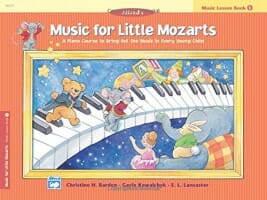
Lesson Book 1 is pre-reading. Concepts taught are: How to sit at the piano; Correct hand position; High and low; Loud and soft (forte and piano); Keyboard topography; Bar line and measure, Quarter, half, whole notes and rests; and Repeat signs.
Alfred's Adult Basic All-In-One

Alfred’s Basic Adult All-in-One Course is designed for use with a piano instructor for the beginning student looking for a truly complete piano course. It is a greatly expanded version of Alfred’s Basic Adult Piano Course that will include lesson, theory, and technique in a convenient, “all-in-one” format. This comprehensive course adds such features as isometric hand exercises, finger strengthening drills, and written assignments that reinforce each lesson’s concepts. There is a smooth, logical progression between each lesson, a thorough explanation of chord theory and playing styles, and outstanding extra songs, including folk, classical, and contemporary selections.
RCM Voice Repertoire

A Comprehensive Voice Series serves as the official resource for voice assessments of the Royal Conservatory Music Development Program. Featuring an outstanding selection of voice literature and supporting materials, this series offers a truly enriched learning experience to help ensure student success. As in previous editions, Resonance encompasses a rich and varied selection of Repertoire, Vocalises and Recitatives that students of all ages and voice types will find appropriate to their musical interests and level of technical ability.
Vocal Workouts for the Contemporary Singer

The vocal workouts in this much-anticipated follow-up to Peckham’s The Contemporary Singer are based on Berklee College of Music’s highly effective vocal method. This volume will help vocalists develop the voice through good vocal health, warm-up exercises, advanced techniques, stage performance advice and more. Includes companion online audio for ultimate interactive education!
Alfred's Teach Yourself to Sing

Learn to sing and open up a brand new world of musical knowledge with this exciting method from Alfred Music. Beginning with the fundamentals, you will learn about equipment used by singers, vocal health, and getting acquainted with reading music. You will then move right along to breathing, vocalizing, proper warm-ups, and singing songs, lesson by lesson, all while continuing to increase your knowledge of reading and understanding music. You will learn to sing an array of musical styles including pop, jazz, classical, and musical theater. Near the end of the book, you will be introduced to the idea of individual interpretation, which will help you color your songs with your own unique style. The book features a chord and scale chart for reference during and after your lessons.