

Bachelor of Fine Arts (York University)
Katie Thurman is a singer, pianist, accompanist, and teacher based in Toronto. Her passion for music has been with her since childhood, and she is excited to have recently completed her undergraduate degree in music at York University.
Trained classically in piano, she continues to explore other styles including pop and jazz, as well as write her own compositions. Her vocal training is in both classical and musical theatre styles, as well as lengthy choral experience both in and out of school.
Katie spent 6 years singing with WIBI A Cappella, a collegiate-based group, during her time at York, and is proud to have competed with them twice in the ICCA (the very competition the Pitch Perfect films were based on!). Currently, she sings with the Toronto-based That Choir.
Katie loves all types of music, but spends most of her time listening to pop, indie, and alt-pop records.
Katie also writes her own songs and is working towards putting together an EP. Aside from music, Katie’s other passions include baking, film, and psychology. She loves teaching and is always pushing herself to grow pedagogically and musically!
Get to know Katie…Beyond the Bio!
Hobbies: baking, watching movies/TV, writing, yoga, hiking
Musical influences: Classical: Natalie Dessay, Maria Callas/Pop: Arcade Fire, Lana Del Rey, BANKS, Florence & the Machine, Rhye
Favourite food: Pasta
Least favourite food: Seafood
Favourite music: pop & alt-pop, indie/folk, dance, and all things Celtic
Favourite song: currently “Favourite Boy” by Half Moon Run
Favourite movie: Eighth Grade
Favourite movie music: A Single Man, music composed by Abel Korzeniowski?
Favourite musical theatre/opera: Les Misérables
Best quote from your teacher: Vocal teacher: “Just go for it! We want to hear ‘Katie-and-a-half'”.
Favourite quote: Motivation comes from work
Favourite book: The Handmaid’s Tale
Best thing about teaching at ABC: I like sharing my knowledge with students, and I learn from them too!
Latest Homework from Katie
Is Katie Your Teacher?
Sign up now to get your weekly assignments delivered, and never lose your homework sheet again!
Saturday, Sept 19
Renaud
1. Equipment
Please purchase a pair of drumsticks and a practice pad.
Recommended stick brands include:
- Vic Firth
- ProMark
Look for sticks in either 5A or 7A size.
Recommended practice-pad brands include:
- Vic Firth
- Remo
- Evans RealFeel
If you decide to get a drum set, I recommend renting one from Long & McQuade for now rather than purchasing one immediately.
2. Basic Drum-Set Beat
Work on the basic beat notated on the handout.
Until a drum set is available, use pillows to represent the hi-hat and snare drum, and tap the bass-drum part with your foot.
If the full beat feels difficult, separate it into smaller instrument groups:
- Hi-hat and snare drum
- Snare drum and bass drum
- Bass drum and hi-hat
Practise each combination until it feels comfortable, then gradually put all three parts back together.
3. Practice-Pad Exercises
Work on the exercises found in the latter part of the handout. Play these on the practice pad and regularly check your technique against all the checkboxes provided.
The goal is not simply to finish each exercise. Listen and watch carefully to make sure you are meeting every technical goal before moving on.
Jonah
Congratulations to Jonah for a successful first go at an orchestral audition, and despite not making the group, Jonah should be proud of what he achieved. I would like to share some words from the instructor who audited:
“Jonah did fantastically at the audition. I hope that he received a note of positivity and appreciation from the management because I specifically asked them to reach out to him about that.
Jonah was extremely well prepared which gave an excellent first impression. He was a maybe for me, but unfortunately the level was too high after him and he got bumped out by 1 spot. I can’t take more than 5 and he was no. 6. I felt a little better when I saw that he was 13 because he would probably get a lot more out of the experience when he is a little older.
I really hope he keeps working and comes back to audition in the future. His overall energy level was a little down in terms of the repertoire. I didn’t feel a ton of musical connection, but he could’ve been nervous. Snare drum needed attention in terms of dynamics, but rhythm was solid. I think he really just needs to keep pushing. Lots of time left for him to develop and get in down the line!”
We will resume the mallet/drumming bi weekly module, and for this week on mallet, we started a ragtime from the “Xylophone Rags of George Hamilton Green” book.
https://drive.google.com/file/d/1LcvQkrNaUPDcf4i5Hdft4kkzqKFxQVYD/view?usp=drive_link
We will work on Triplets, P.50 on the pdf. Jonah please follow the sticking and use the blocking method to get used to the movements. Whenever there is a dyad (double stop), play out the top note, and we will talk more about the underlying melody next and how we should play it to the style of ragtime. Please work on the first two line, and note that the second line is the same as the first line in the first half of the phrase, so Jonah will only need to figure out the second half of that line.
Sam
Please use the following link for any of the class material in the future:
https://drive.google.com/drive/folders/1GdlS8_ljwuhMfCgquixFVbGJSHtKLZFG?usp=drive_link
I was absolutely blown away by Sam’s playing level, especially considering that he has only been playing the drums for three months! We will proceed with “Smells Like Teen Spirit” as our first project together.
Sam figured out the coordination very quickly. Our next goal is to understand how the pattern fits within the song’s timing and the underlying framework of the beat.
Although Sam may already be able to play along with parts of the song, understanding the counting and subdivision is essential. This will help him remain secure in the music and find his place again if he ever falls out of sync with the track.
Practise the first two bars with a metronome, beginning at a slow and comfortable tempo.
- Practise the first bar by itself.
- Practise the second bar by itself.
- Make sure the notes align with the correct subdivision.
- Once both bars feel comfortable with the metronome, connect them.
- Continue repeating the two-bar phrase until the pulse feels stable.
- Only then begin increasing the tempo gradually.
Accuracy and rhythmic understanding are more important than reaching the song’s full tempo right away.
If the first two bars are resolved quickly, begin working on the beat from the bridge section, found on line 4 of the handout.
Use the same process:
- Learn each bar separately.
- Practise slowly with a metronome.
- Check the counting and subdivision.
- Connect the bars only when each one feels secure.
- Gradually increase the tempo while maintaining a stable pulse.
Preferred Books for Katie’s Students
Click to buy them here, and they’ll come right to your house! What could be easier?
Faber & Faber Piano Adventures

The 2nd Edition Primer Lesson Book introduces the keyboard, note values, and the grand staff. Students play in C 5-finger scale patterns, develop recognition of steps and skips, and learn letter names independent of finger number. Musicianship is built through the use of dynamics and coloristic experimentation with the pedal. The book is organized into units which represent the major concepts and skills. As new units are introduced, earlier concepts and skills are constantly reviewed.
Music for Little Mozarts
Lesson Book 1
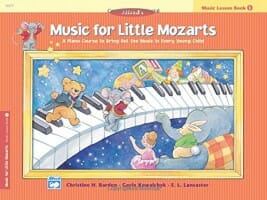
Lesson Book 1 is pre-reading. Concepts taught are: How to sit at the piano; Correct hand position; High and low; Loud and soft (forte and piano); Keyboard topography; Bar line and measure, Quarter, half, whole notes and rests; and Repeat signs.
Alfred's Adult Basic All-In-One

Alfred’s Basic Adult All-in-One Course is designed for use with a piano instructor for the beginning student looking for a truly complete piano course. It is a greatly expanded version of Alfred’s Basic Adult Piano Course that will include lesson, theory, and technique in a convenient, “all-in-one” format. This comprehensive course adds such features as isometric hand exercises, finger strengthening drills, and written assignments that reinforce each lesson’s concepts. There is a smooth, logical progression between each lesson, a thorough explanation of chord theory and playing styles, and outstanding extra songs, including folk, classical, and contemporary selections.
RCM Voice Repertoire

A Comprehensive Voice Series serves as the official resource for voice assessments of the Royal Conservatory Music Development Program. Featuring an outstanding selection of voice literature and supporting materials, this series offers a truly enriched learning experience to help ensure student success. As in previous editions, Resonance encompasses a rich and varied selection of Repertoire, Vocalises and Recitatives that students of all ages and voice types will find appropriate to their musical interests and level of technical ability.
Vocal Workouts for the Contemporary Singer

The vocal workouts in this much-anticipated follow-up to Peckham’s The Contemporary Singer are based on Berklee College of Music’s highly effective vocal method. This volume will help vocalists develop the voice through good vocal health, warm-up exercises, advanced techniques, stage performance advice and more. Includes companion online audio for ultimate interactive education!
Alfred's Teach Yourself to Sing

Learn to sing and open up a brand new world of musical knowledge with this exciting method from Alfred Music. Beginning with the fundamentals, you will learn about equipment used by singers, vocal health, and getting acquainted with reading music. You will then move right along to breathing, vocalizing, proper warm-ups, and singing songs, lesson by lesson, all while continuing to increase your knowledge of reading and understanding music. You will learn to sing an array of musical styles including pop, jazz, classical, and musical theater. Near the end of the book, you will be introduced to the idea of individual interpretation, which will help you color your songs with your own unique style. The book features a chord and scale chart for reference during and after your lessons.

