
Bachelor of Fine Arts (York University)
Katie Thurman is a singer, pianist, accompanist, and teacher based in Toronto. Her passion for music has been with her since childhood, and she is excited to have recently completed her undergraduate degree in music at York University.
Trained classically in piano, she continues to explore other styles including pop and jazz, as well as write her own compositions. Her vocal training is in both classical and musical theatre styles, as well as lengthy choral experience both in and out of school.
Katie spent 6 years singing with WIBI A Cappella, a collegiate-based group, during her time at York, and is proud to have competed with them twice in the ICCA (the very competition the Pitch Perfect films were based on!). Currently, she sings with the Toronto-based That Choir.
Katie loves all types of music, but spends most of her time listening to pop, indie, and alt-pop records.
Katie also writes her own songs and is working towards putting together an EP. Aside from music, Katie’s other passions include baking, film, and psychology. She loves teaching and is always pushing herself to grow pedagogically and musically!
Get to know Katie…Beyond the Bio!
Hobbies: baking, watching movies/TV, writing, yoga, hiking
Musical influences: Classical: Natalie Dessay, Maria Callas/Pop: Arcade Fire, Lana Del Rey, BANKS, Florence & the Machine, Rhye
Favourite food: Pasta
Least favourite food: Seafood
Favourite music: pop & alt-pop, indie/folk, dance, and all things Celtic
Favourite song: currently “Favourite Boy” by Half Moon Run
Favourite movie: Eighth Grade
Favourite movie music: A Single Man, music composed by Abel Korzeniowski?
Favourite musical theatre/opera: Les Misérables
Best quote from your teacher: Vocal teacher: “Just go for it! We want to hear ‘Katie-and-a-half'”.
Favourite quote: Motivation comes from work
Favourite book: The Handmaid’s Tale
Best thing about teaching at ABC: I like sharing my knowledge with students, and I learn from them too!
Latest Homework from Katie
Is Katie Your Teacher?
Sign up now to get your weekly assignments delivered, and never lose your homework sheet again!
Thursday, October 15th
Lukas
“More Than a Feeling”
This week, focus on playing the phrase beginning at bar 36 accurately. We worked through it during the lesson, and you can use the guitar line as a musical cue for how the drum phrase should be shaped.
Double-Stroke Coordination
Isolate the bar containing the left-hand double on beat 3, using bar 54 as an example.
Practise it in stages:
- Isolate the different instrument groups.
- Make sure the left-hand double is even.
- On beat 4, move your right hand quickly from the snare drum to the hi-hat.
- Repeat this movement until the transition feels smooth.
- Put the complete pattern back into context only after the coordination is secure.
Bar 90 to the End
For our next lesson, prepare the music from bar 90, following the musical interlude, through to the end of the song.
Pay particular attention to:
- Bars 99–100: Treat these as one two-bar phrase. The energy should continue beyond bar 100 and arrive on the downbeat of bar 101.
- Bar 103: Isolate and practise this bar separately.
- Bar 115: Isolate and practise this bar separately.
Finn
“Imposter”
Finn did a great job becoming familiar with the number system from 1 to 6. He was able to repeat the bass-line pattern first by reading the numbers and eventually through auditory memory.
During the lesson, Finn played the xylophone part while I accompanied him on the drums.
Finding Beat 4
Finn is still occasionally having difficulty locating beat 4. Remember that the four-sixteenth-note pickup:
- Begins precisely on beat 4 of the previous bar
- Contains four evenly spaced sixteenth notes
- Fills the entire fourth beat
- Leads directly into beat 1 of the following bar
Count steadily through the previous bar and avoid beginning the pickup early. Continue practising the bass line with Dad’s accompaniment so that the pickup becomes secure within the full phrase.
I have also written out the melody of the song, which we will begin learning next week.
Aleksander
“Smooth Criminal”
We saw major improvement in the pre-chorus pattern this week!
For the coming week, begin working from bar 40 onward. Much of this material is based on patterns from the first page, but you will occasionally encounter a more difficult fill at the end of a phrase.
We worked on examples in:
- Bar 45
- Bar 49
When approaching a new section:
- Identify the familiar groove.
- Isolate the fill at the end of the phrase.
- Learn its rhythm and sticking slowly.
- Practise entering and exiting the fill.
- Reconnect it to the surrounding music.
If possible, continue onto the third page and work through to the guitar solo. Spend some time investigating the difficult passages independently, and we will dissect any remaining trouble spots together next week.
Renaud
“Back in Black”
We had a shorter lesson today and will aim for a 45-minute lesson next week.
Our main focus was the AC/DC fill. Renaud learned the pattern quickly and played it steadily while I performed the melody on xylophone. We were even able to repeat the full phrase several times without stopping.
Next, we will:
- Play the pattern with the original song
- Listen for how many times it repeats
- Identify where the first variation appears
- Continue connecting the fill to the basic rock beat
Stick Control, Page 5
Continue working on the same Stick Control exercises assigned last week, focusing on the first column. Aim for even strokes, matching stick heights, relaxed movement and a steady pulse.
We will return to these exercises together during the next lesson.
Preferred Books for Katie’s Students
Click to buy them here, and they’ll come right to your house! What could be easier?
Faber & Faber Piano Adventures

The 2nd Edition Primer Lesson Book introduces the keyboard, note values, and the grand staff. Students play in C 5-finger scale patterns, develop recognition of steps and skips, and learn letter names independent of finger number. Musicianship is built through the use of dynamics and coloristic experimentation with the pedal. The book is organized into units which represent the major concepts and skills. As new units are introduced, earlier concepts and skills are constantly reviewed.
Music for Little Mozarts
Lesson Book 1
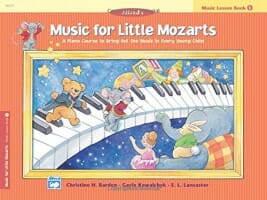
Lesson Book 1 is pre-reading. Concepts taught are: How to sit at the piano; Correct hand position; High and low; Loud and soft (forte and piano); Keyboard topography; Bar line and measure, Quarter, half, whole notes and rests; and Repeat signs.
Alfred's Adult Basic All-In-One

Alfred’s Basic Adult All-in-One Course is designed for use with a piano instructor for the beginning student looking for a truly complete piano course. It is a greatly expanded version of Alfred’s Basic Adult Piano Course that will include lesson, theory, and technique in a convenient, “all-in-one” format. This comprehensive course adds such features as isometric hand exercises, finger strengthening drills, and written assignments that reinforce each lesson’s concepts. There is a smooth, logical progression between each lesson, a thorough explanation of chord theory and playing styles, and outstanding extra songs, including folk, classical, and contemporary selections.
RCM Voice Repertoire

A Comprehensive Voice Series serves as the official resource for voice assessments of the Royal Conservatory Music Development Program. Featuring an outstanding selection of voice literature and supporting materials, this series offers a truly enriched learning experience to help ensure student success. As in previous editions, Resonance encompasses a rich and varied selection of Repertoire, Vocalises and Recitatives that students of all ages and voice types will find appropriate to their musical interests and level of technical ability.
Vocal Workouts for the Contemporary Singer

The vocal workouts in this much-anticipated follow-up to Peckham’s The Contemporary Singer are based on Berklee College of Music’s highly effective vocal method. This volume will help vocalists develop the voice through good vocal health, warm-up exercises, advanced techniques, stage performance advice and more. Includes companion online audio for ultimate interactive education!
Alfred's Teach Yourself to Sing

Learn to sing and open up a brand new world of musical knowledge with this exciting method from Alfred Music. Beginning with the fundamentals, you will learn about equipment used by singers, vocal health, and getting acquainted with reading music. You will then move right along to breathing, vocalizing, proper warm-ups, and singing songs, lesson by lesson, all while continuing to increase your knowledge of reading and understanding music. You will learn to sing an array of musical styles including pop, jazz, classical, and musical theater. Near the end of the book, you will be introduced to the idea of individual interpretation, which will help you color your songs with your own unique style. The book features a chord and scale chart for reference during and after your lessons.