

Does Music Really Strengthen the Parent-Child Bond?
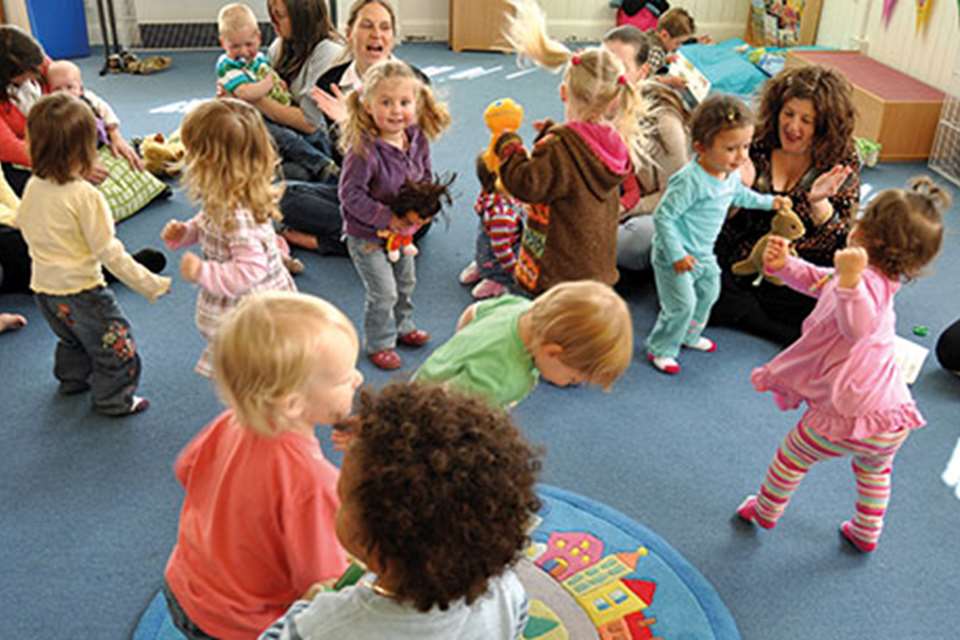
“Singing to your baby builds a bond.” “Music classes bring families closer.” You have probably heard claims like these. They sound true. They also sound like something nobody bothered to check. This article checks them. Parents ask us often: “Does making music together really build a stronger bond with my child?” This piece is part of a series. See also music and brain development, school performance, and self-discipline. This one asks a narrower question: does making music together build a closer bond than any other shared activity would? See our full Music Education Research hub for every study behind our program.
What “Communicative Musicality” Actually Describes
Long before a baby speaks, a parent and infant trade sounds back and forth. A parent coos. The baby gurgles. The parent responds with a rising pitch. The baby kicks in time. Researchers gave this pattern a name: “communicative musicality.” Their idea is that these early exchanges already have musical structure. They have pulse, like a beat. They have tone and phrasing. They have a shape that builds and settles, the way a piece of music does.
A widely cited UK paper (2018) laid this out, using close observation: frame-by-frame video and audio study of real parent-infant pairs. This is real, careful research. It is not a controlled experiment. Nobody randomly assigned some babies to musical interaction and others to a control group. The researchers describe a pattern they observe again and again. They do not, and could not with this method, prove that the musical quality of the exchange causes attachment. It may simply go along with it. Communicative musicality is a well-supported description of what early bonding often looks and sounds like. It is not proof that music itself drives the bond.
The Strongest Evidence Points to Synchrony, Not Music Itself
The most careful experiments here do not test music on its own. They test whether moving in time with another person, something music makes easy to do, changes how a child treats that person afterward.
A Canadian study (2014) tested 48 infants, each 14 months old. An assistant held each infant and bounced them gently to music, facing an adult who bounced either in time or out of time. Afterward, each infant watched that adult drop items and need help picking them up, alongside a different, neutral adult. Here is how often each group helped:
| Infant group | Helped the adult |
|---|---|
| Bounced in time with the adult | 50.6% of the time |
| Bounced out of time with the adult | 34.0% of the time |
A related Canadian paper, published the same year, found something more specific. Infants aimed their extra helpfulness at the exact adult they had bounced in time with. Not at people in general. Being in sync did not just put babies in a better mood. It marked one relationship as closer than others.
This matters for the bonding question because it points to a mechanism, not just a link. Music is one of the easiest ways for a parent and child to move in time together. But these two studies tested syncing with a stranger adult in a lab, not a parent at home. No study we found repeated this design with an infant’s real parent, then measured a lasting change in the relationship. The lab result is real, controlled proof that being in sync shapes an infant’s social behavior. Whether that scales up to family bonding over years is a reasonable idea. It is not something these studies actually tested.
Joint Music-Making Beats a Social Activity, But the Study Used Peers, Not Parents
A German study (2010) gets closer to answering a specific version of the bonding question. Is it music itself, or just any shared social activity, that builds closeness? Researchers there designed an experiment to separate those two options.
They recruited 96 four-year-olds, paired into 48 same-gender pairs who already knew each other from daycare. Each pair spent three minutes in one of two setups. In the musical setup, the two children sang a new song, played simple instruments, and danced around a pretend pond with an adult. In the non-musical setup, the pair did the exact same activity, with the same amount of talking, but no singing, dancing, or instruments. Afterward, researchers tested two things: would one child help the other after a staged accident, and would the pair choose to solve a task together rather than alone?
Children who had just made music together helped each other much more than children in the non-musical setup. They also chose the shared solution to the second task much more often. The two setups matched on social contact. They only differed in the presence of music. That makes this some of the cleanest evidence that music itself, not just shared activity, can boost teamwork in the short term.
The honest limit here matters. The “partners” were two four-year-old friends, not a parent and a child. Nothing in this design tested whether the same gap would show up between a parent and their own child, or whether it would last. It is real, controlled proof that music-making can beat an equally social non-musical activity for short-term teamwork between two people. It is not, on its own, proof about parent-child bonding.
Singing and a Drop in Stress Hormones, in One Specific Group
You may have heard that singing to a baby “releases oxytocin” and creates an instant bond. We could not find a careful, peer-reviewed study that directly measured oxytocin from singing together. That specific claim appears to run ahead of the evidence. What does exist is more modest. It measures cortisol, the body’s main stress hormone.
A randomized UK trial, published in 2025, tested a 10-week singing program against an active control activity, in 199 mothers with postnatal depression. The singing group showed lower depression scores at 20 and 36 weeks, and stuck with the program more. A companion UK study from the same trial, in 2026, measured cortisol in mothers and infants at home. The singing group showed a lasting drop in mothers’ cortisol by week 10. It also showed a rise in how closely the mother’s and infant’s cortisol rhythms tracked each other, a pattern researchers call cortisol synchrony.
This is real, physical evidence, not a vague wellness claim. It is also narrower than a headline like “singing helps you bond with your baby” suggests. The mothers in this trial had clinical postnatal depression, not a general group of parents. The outcome measured was cortisol synchrony and depression symptoms, not attachment directly. It is a genuine finding for one specific group of families. It does not prove singing works this way in parents without depression, or that the effect is unique to music rather than any calming group activity.
What the Music Together® Studies Do Not Show
Our companion article on Music Together® and early childhood programs covers two randomized US studies on that program. One on self-control at age three. One on parent-child conversation over a year. We checked both again here, looking for any direct measure of bonding, attachment, warmth, or synchrony. Neither study measured any of those things. The self-control study measured a child’s ability to wait before grabbing a snack. The language study measured back-and-forth talk and speech quality. Both are meaningful findings, but neither is a bonding measure, and neither study claims to be. Citing either as proof that Music Together® strengthens bonding goes beyond what the researchers tested.
Where the Evidence Runs Out
Put the honest picture together and a clear gap appears. Communicative musicality describes what early bonding often sounds like, through careful watching, but it is not a test of cause and effect. Synchrony experiments show a real causal link. Moving in time with someone makes a child treat that person as closer. But the tested partner was a lab assistant, not a parent. The German study is genuine evidence that music beats a matched social activity for teamwork, but the partners were young friends, not parent and child. The UK singing trial gives a real physical signal, but only in mothers with postnatal depression, and only for cortisol, not attachment.
No study we could find ran the exact test a parent would want answered. Take real parent-child pairs. Randomly assign some to regular shared music-making, and others to an equally warm non-musical activity, like reading or cooking together. Then measure attachment directly, over time. Until that study exists, the fair conclusion is that shared, in-sync time with a parent matters a great deal, and music is an unusually good, easy way to create it. Whether music adds something beyond any other warm shared activity is a real open question. See our companion piece on Music Together® and early childhood data for how our youngest students bond and learn. See early music exposure from birth to three for the earliest window.
Frequently Asked Questions
“Does singing to my baby release oxytocin and create an instant bond?”
We could not find a careful study that directly measured oxytocin from parent-infant singing. That claim seems to be a popular extension of real bonding research, not something a study proved. The real, checked finding is different. A 2026 UK study measured cortisol, the stress hormone. It found lower levels, and better mother-infant cortisol matching, in mothers who joined a 10-week singing program. But only in mothers with postnatal depression.
“Is there real proof that making music together builds a stronger bond than other shared activities?”
Not proof, specifically for parent-child pairs. A German study (2010) found that two young children who made music together helped and cooperated more afterward, than two children who did an equally social activity without music. That is genuine controlled proof that music itself can beat a matched non-musical activity for short-term teamwork. But the study tested four-year-old friends, not parents and their own children. So it does not directly prove the same gap exists in real families.
“What is ‘communicative musicality’ and is it backed by real research?”
It is a real, well-documented framework from UK researchers, built from close video study of actual parent-infant pairs. It describes how early back-and-forth exchanges between a parent and baby have musical qualities: a shared pulse, tone, and shape. It is careful, published research. But it is observational, not a randomized experiment. So it describes what bonding often looks like, rather than proving that its musical qualities cause the bond.
“Do the two Music Together® studies prove the program builds parent-child bonding?”
No. We checked both US studies again for this question. One measured a child’s self-control at age three. The other measured back-and-forth talk and speech quality over a year. Neither measured attachment, bonding, warmth, or relationship quality directly. Both are real findings about specific, different skills, not evidence about the bond itself.
Music Together® and Music Lessons at ABC Academy of Music
We think families deserve the real research, not a marketing slogan. The evidence does not prove that music-making uniquely builds bonding, beyond what any other warm, attentive shared activity would. It does show that shared, in-sync time with a parent matters, and music is one of the easiest, most enjoyable ways to create that kind of time. ABC Academy of Music offers Music Together® classes for babies, toddlers, and preschoolers, alongside instrument lessons for older children, at our studios in Lawrence Park, St. Clair West, Dufferin Grove and Oakwood, and Brampton. Browse our class schedule to find the right age group, visit our rates and payment page for current pricing, or contact us with any questions about getting started.
SOURCES:
- Malloch, S., and Trevarthen, C., “The Human Nature of Music,” Frontiers in Psychology, vol. 9, 2018, article 1680, https://doi.org/10.3389/fpsyg.2018.01680
- Cirelli, L.K., Einarson, K.M., and Trainor, L.J., “Interpersonal Synchrony Increases Prosocial Behavior in Infants,” Developmental Science, vol. 17, no. 6, 2014, pp. 1003-1011, https://doi.org/10.1111/desc.12193
- Cirelli, L.K., Wan, S.J., and Trainor, L.J., “Fourteen-Month-Old Infants Use Interpersonal Synchrony as a Cue to Direct Helpfulness,” Philosophical Transactions of the Royal Society B: Biological Sciences, vol. 369, no. 1658, 2014, article 20130400, https://doi.org/10.1098/rstb.2013.0400
- Kirschner, S., and Tomasello, M., “Joint Music Making Promotes Prosocial Behavior in 4-Year-Old Children,” Evolution and Human Behavior, vol. 31, no. 5, 2010, pp. 354-364, https://doi.org/10.1016/j.evolhumbehav.2010.04.004
- Bind, R.H., Lawrence, A.J., Estevao, C., Hazelgrove, K., Priestley, K., Rebecchini, L., Laijawala, R., Miller, C., Healey, A., Agwuna, J., Sevdalis, N., Bakolis, I., Davis, R., Lopez, M.B., Woods, A.J., Crane, N., Manoharan, M., Burton, A., Dye, H., Osborn, T., Greenwood, L., Perkins, R., Dazzan, P., Fancourt, D., and Pariante, C.M., “Clinical Effectiveness, Implementation Effectiveness and Cost-Effectiveness of a Community Singing Intervention for Postnatal Depressive Symptoms, SHAPER-PND: Randomised Controlled Trial,” The British Journal of Psychiatry, vol. 227, no. 6, 2025, pp. 836-845, https://doi.org/10.1192/bjp.2025.10377
- Kirkpatrick, M., Priestley, K., Bind, R.H., Rebecchini, L., Borsini, A., Estevao, C., Hazelgrove, K., Laijawala, R., Alford, S., Woods, A.J., Crane, N., Manoharan, M., Burton, A., Dye, H., Osborn, T., Greenwood, L., Dazzan, P., Fancourt, D., and Pariante, C.M., “Community Singing Intervention Reduces Maternal Salivary Cytokines and Enhances Maternal-Infant Cortisol Synchrony in Postnatal Depression: Biological Findings from the SHAPER-PND Trial,” Brain, Behavior, and Immunity, vol. 136, 2026, article 106600, https://doi.org/10.1016/j.bbi.2026.106600
- Smith, A.R., McGregor, C.M., Carr, K., et al., “The Impact of a Music Enrichment Program During Infancy and Early Toddlerhood on Effortful Control at Age 3: A Preliminary Investigation,” Infancy, vol. 29, no. 1, 2024, pp. 72-79, https://doi.org/10.1111/infa.12563
- Smith, A.R., Salley, B., Hanson-Abromeit, D., Paluch, R.A., Engel, H., Piazza, J., and Kong, K.L., “The Impact of a Community-Based Music Program During Infancy on the Quality of Parent-Child Language Interactions,” Child Development, vol. 95, no. 2, 2024, pp. 481-496, https://doi.org/10.1111/cdev.14005