M.Mus (U of T)
B.Mus (Oberlin)
Guitarist Gergely Szabo has an Advanced Diploma in Music Performance from Cambrian College where he majored in the classical guitar. Over his time there, he completed 2 years of comprehensive pedagogy courses. He also gained well grounded vocal skills, as well as basic knowledge on the piano. Outside of classical music, he exhibits a repertoire of skills and knowledge in playing the genres of rock, blues, and heavy metal music. He has experience in teaching the guitar and the ukulele to a range of people aged 6 to 54.
Gergely’s teaching methods include both the use of books and digital methods. The three main books he uses to teach guitar are as follows: “Guitar Method Book 1 by Will Schmid and Greg Koch,” “Four Star Sight Reading and Ear Tests RCM Level 1,” and “Classical Guitar Repertoire and Etudes RCM Level 1.” For teaching ukulele, he uses the book “Ukulele Songs for 1, 2, or 3 players by Elizabeth Ragsdale.” Aside from these, he frequently uses the Muse Score application as a play-along practicing tool.
Gergely’s passion for music and his dedication to growing the love of music in others are the biggest reasons why he teaches guitar and ukulele. His approach to teaching involves learning through play. The material he covers with his students is always delivered in a way that is highly interactive. Most of the assigned exercises he gives involve the elements of play that students can enjoy both in class and as homework.
Get to know Gergely…Beyond the Bio!
Coming soon!
Hobbies:
Musical influences:
Favourite food:
Least favourite food:
Favourite music:
Favourite album:
Favourite movie:
Favourite musical theatre/opera:
Best quote from your teacher:
Favourite quote:
Favourite book:
Latest Homework from Gergely
Is Gergely Your Teacher?
Sign up now to get your weekly assignments delivered, and never lose your homework sheet again!
Saturday, September 26th
Jonah
This week, I would like Jonah to continue working on “Triplets” with two types of supplemental exercises:
- The two pages from the Green Book with the corners folded
- The exercise notated on the staff paper
1. Green Book Exercises
When practising the two marked pages:
- Follow the written sticking carefully.
- Keep your hands and body loose.
- Treat the exercises as an opportunity to develop your reading.
- Continue looking at the music as you play rather than trying to memorize the patterns.
The goal is to become more comfortable reading and responding to the notation while maintaining relaxed, consistent movement.
2. Second-Line Groove
Practise the rhythm notated on the staff paper using a drum pad.
- Follow the written sticking.
- Accent the strokes marked with circles.
- Keep the unaccented notes lower and lighter so that the accents shape the groove clearly.
- Begin slowly and focus on producing the correct rhythm and character.
This pattern is known as a New Orleans traditional syncopated second-line groove. This type of rhythm is embedded in a great deal of ragtime music.
Listen to the following example to become familiar with how the groove should feel:
New Orleans Second-Line Groove Example
3. “Triplets”
For the piece itself, learn the notes through bar 21.
Many of these phrases begin almost identically but change during their second halves. Pay close attention to where each phrase begins to differ rather than assuming that the entire pattern repeats.
Also remember to:
- Observe all accidentals carefully.
- Follow the written sticking.
- Notice the relationship between the repeated and changing material.
- Shape the melody with the same sense of groove found in the second-line drum pattern.
The goal is not only to learn the correct notes, but also to make the music feel rhythmic and alive.
Sam
Sam is now maintaining the pulse very well from the introduction through the chorus. Today, we played with the track at 60% speed. The only place where Sam rushed slightly was the pre-chorus, which seemed to come from excitement rather than a problem with the coordination.
Continue aiming for a steady pulse at all times, and use the bass line as your rhythmic anchor.
Sam can currently play most of the song comfortably at approximately 145 BPM, while the full tempo is around 240 BPM. For now, rhythmic accuracy and stability remain more important than reaching the original tempo.
1. Bridge: Triplet Rhythm
The bridge appears to have been learned at a faster tempo before the underlying rhythm was fully understood. This week, use the exercise notated on the handout to compare the feeling of eighth notes and triplets.
Practise at approximately 135 BPM:
- Play the triplet exercise using only your hands.
- Make sure all three notes are evenly spaced.
- Slightly accent the first note of each beat. This will help drive the pattern forward and keep the rhythm even.
- Once the rhythm feels secure, practise it using the R-L-K coordination: right hand, left hand, kick drum.
- Maintain the same spacing when moving the pattern from the hands to the drum set.
Do not increase the tempo until the difference between eighth notes and triplets feels completely clear.
2. Paradiddles
Work on the paradiddle exercise written on the handout.
Using R L R R as an example, think of the first right-hand stroke as the main throwing motion. The final two right-hand notes should come from recycling the bounce created by that motion. At faster tempos, the first right-hand stroke may need slightly more energy to generate enough rebound for the following double.
Practise it in stages:
- Play R — R R, leaving space where the left hand will eventually go.
- Focus on using the first stroke to generate the final right-hand double.
- Add the left hand to create R L R R.
- Aim for four evenly spaced and evenly produced notes.
- Once this feels comfortable, replace the right hand with the right foot on the kick drum while keeping the left-hand note: K L K K.
Keep the movement relaxed and allow the rebound to do as much of the work as possible.
Thursday, September 24th
Lukas
“Hotel California”
We are seeing great improvement in maintaining the pulse. Last week’s practice approach has also helped you enter and exit the fills consistently while keeping them securely in the pocket.
A few reminders from our lesson:
- During the introduction, feel free to improvise on the cymbal.
- Save the thirty-second-note pattern for the fourth bar.
- Begin with a simple texture and gradually make it denser as you approach the verse.
- Experiment with striking the cymbal using different parts of the stick to produce different timbres.
For the open-and-closed hi-hat lick that first appears in bar 32:
- Work out the exact timing of the hi-hat opening and closing.
- Practise the lick slowly in a small section.
- Once it feels secure, practise entering and exiting the lick without disrupting the pulse.
At the bridge, play with a lighter touch—perhaps using only the tip of the stick. Even when adding musical details, maintaining a steady pulse should always remain the priority.
Goal for this week: Work through the guitar-solo section.
Stick Control
- Practise the first and second columns of the triplet page.
- Begin working on the sixteenth-note page, focusing on the first two exercises.
- For the right-hand-leading exercise, practise RLRL RRRR as eighth notes, playing the two patterns back-to-back.
- Do the same with the left hand: LRLR LLLL.
Finn
“Imposter”
Continue practising the four-bar phrase from “Imposter.” We have now worked out the fourth bar.
For the fourth bar:
- Practise the first two beats separately.
- Count the eighth-note subdivision carefully while working out the timing of the open and closed hi-hat.
- When played correctly, these first two beats should sound like the guitar riff.
- The final two beats use the same counting as beat 4 of the first bar.
When practising the beginning of the song, count “1-2-3-4” internally with each stick-click pattern. This will help you feel the sixteenth-note subdivision and prevent the introduction from becoming too fast.
Next week, we will aim to play the entire four-bar phrase repeatedly and fluently. Once that is secure, we will learn the guitar riff on xylophone and begin working on the chorus fill.
Aleksander
“Smooth Criminal”
This week, we focused on playing with the track at 0.65× speed, and Alex was able to stay with it throughout.
Pay particular attention to the rest beginning in bar 14. Observing the full value of this rest should allow the following pattern to line up properly with the bass line.
Once you reach the verse:
- Use a lighter touch.
- Avoid bringing out every note equally.
- Emphasize only the most important musical material.
- Keep the transitions clean, accurate, and smooth.
For this week, work independently on the pre-chorus section. Aim to bring it up to the same tempo at which you can currently play the opening. If that feels comfortable, you can also begin learning the first line of the chorus.
Zico
“Drum Corps on Parade”
We continued working through the piece and encountered several additional rudiments, including:
- No. 17: Double Paradiddle
- No. 19: Single Paradiddle-Diddle
We also discussed the longer phrases embedded within the piece, including the phrase around the end of line 4.
When working out these passages:
- Identify how the eight eighth notes are grouped.
- Use those groupings to understand the shape of the phrase.
- Bring out the grouping through your accents and phrasing rather than treating all eight notes equally.
Continue paying attention to the left-hand accent in the flamacue. The rudiment is sounding much more even, but the accent is an essential part of its character and must remain clearly audible.
Goal for this week: Work through to the end of the page.
Koel
“YYZ”
The B and C sections sounded awesome! The metronome work has clearly improved the evenness of the patterns and helped Koel maintain the pulse.
A few areas still need attention:
Second bar of the third line
Aim for greater clarity by closing the hi-hat more quickly. It may also help to begin with the hi-hat slightly less open so that it can close cleanly and immediately.
Second repeat in Section C
Continue working on entering and exiting this repeat at the original tempo.
- On the final beat, you may use R R for the two thirty-second notes on the floor tom.
- Emphasize each main beat to give yourself a clear anchor at the faster tempo.
- Practise the transition into and out of the repeat rather than working on the repeat only in isolation.
Since the remainder of the song is similar to the material already studied, try learning the rest of the tune before our next lesson. We will diagnose and work through any issues that arise.
Renaud
“Back in Black”
This week, we are expanding from the first basic drum beat into Renaud’s first song: “Back in Black” by AC/DC.
The song begins with the basic beat we have already learned. This pattern repeats three times before reaching the first fill.
For the fill:
- Play eighth notes during the first beat.
- Beginning on beat 2, switch to counting sixteenth-note subdivisions.
- Feel four subdivisions within each beat.
- Play the first two subdivisions of each four-note grouping.
Practise the fill slowly and make sure the rhythm is secure before connecting it to the basic beat.
Stick Control, Page 5
Begin working on the exercises in the first column of page 5. Apply the same principles and technical checklist introduced with last week’s handout:
- Keep the strokes even.
- Match the sound and height of both hands.
- Remain relaxed.
- Allow the sticks to rebound naturally.
- Maintain a steady pulse.
The material is available through the shared Drive.
https://drive.google.com/drive/folders/1eHr0E4xUVna54lEuGhrkCfz5ax61Aois?usp=drive_link
Preferred Books for Gergely’s Students
Click to buy them here, and they’ll come right to your house! What could be easier?
Hal Leonard Guitar Method
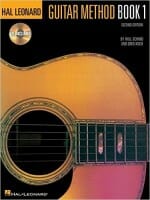
The second edition of this world-famous method by Will Schmid and Greg Koch is preferred by teachers because it makes them more effective while making their job easier. Students enjoy its easy-to-follow format that gives them a solid music education while letting them play songs right away. Book 1 provides beginning instruction including tuning, 1st position melody playing, C, G, G7, D7, and Em chords, rhythms through eighth notes, solos and ensembles and strumming.
Four Star Sight Reading and Ear Tests