M.Mus (U of T)
B.Mus (Oberlin)
Guitarist Gergely Szabo has an Advanced Diploma in Music Performance from Cambrian College where he majored in the classical guitar. Over his time there, he completed 2 years of comprehensive pedagogy courses. He also gained well grounded vocal skills, as well as basic knowledge on the piano. Outside of classical music, he exhibits a repertoire of skills and knowledge in playing the genres of rock, blues, and heavy metal music. He has experience in teaching the guitar and the ukulele to a range of people aged 6 to 54.
Gergely’s teaching methods include both the use of books and digital methods. The three main books he uses to teach guitar are as follows: “Guitar Method Book 1 by Will Schmid and Greg Koch,” “Four Star Sight Reading and Ear Tests RCM Level 1,” and “Classical Guitar Repertoire and Etudes RCM Level 1.” For teaching ukulele, he uses the book “Ukulele Songs for 1, 2, or 3 players by Elizabeth Ragsdale.” Aside from these, he frequently uses the Muse Score application as a play-along practicing tool.
Gergely’s passion for music and his dedication to growing the love of music in others are the biggest reasons why he teaches guitar and ukulele. His approach to teaching involves learning through play. The material he covers with his students is always delivered in a way that is highly interactive. Most of the assigned exercises he gives involve the elements of play that students can enjoy both in class and as homework.
Get to know Gergely…Beyond the Bio!
Coming soon!
Hobbies:
Musical influences:
Favourite food:
Least favourite food:
Favourite music:
Favourite album:
Favourite movie:
Favourite musical theatre/opera:
Best quote from your teacher:
Favourite quote:
Favourite book:
Latest Homework from Gergely
Is Gergely Your Teacher?
Sign up now to get your weekly assignments delivered, and never lose your homework sheet again!
Saturday, October 10th
Jonah
“Triplets”
Jonah played more of Triplets and continues to make progress with his note reading. Although he feels that he is not reading quickly enough, I have already seen a clear improvement.
When reading:
- For notes using ledger lines, use a familiar A or C as a reference point.
- Find the highest and lowest notes in each passage first. Treat these as the boundaries so you are not searching beyond the necessary range.
- Look for repeated notes and recurring shapes.
- Ragtime melodies often contain repeated broken chords or arpeggios. Recognizing these patterns will make the passage much quicker to read.
- Mark any patterns you discover directly in the music with a pencil.
Goal for next class: Begin working into the next page.
Timpani
I marked Jonah’s Hannaford timpani score and explained how to follow the markings and time the tuning changes while playing.
Please review the score and bring any questions to our next lesson. If needed, we can eventually dedicate a lesson to working through the part on a full set of timpani.
Sam
“Holiday” by Green Day
This week, we focused on the eight-bar verse of “Holiday.”
Learning from the score seems to be adding some stress for Sam. Because he learns grooves quickly through listening and auditory memory, the score may sometimes feel unnecessary or distracting. However, developing comfort with drum notation will make it easier to understand larger structures, notice small variations and learn music independently.
The score does not need to remain in front of Sam at all times. Instead, use it to:
- Identify repeated patterns
- Mark sections that require extra attention
- Confirm details that may be missed when learning from a recording or cover video
- Review the structure before attempting to play from memory
Verse Structure
Think of the verse as an A–B structure.
In the A section:
- Bars 1 and 3 are the same.
- Bars 2 and 4 share the same rhythm but are orchestrated slightly differently.
In the B section:
- Bar 3 repeats bar 2.
- Bar 4 is a fill reminiscent of the sextuplet fill from the introduction.
Goal for this week: Learn all eight bars of the verse and become comfortable playing them without the music in the background.
Sam can also practise easier grooves from the Drumset Musician book while using the accompanying online recordings. This will allow him to use his strong ear while gradually strengthening his reading skills.
Dylan
Basic Rock Beat
Today, Dylan learned her first drum pattern: a basic eighth-note rock beat.
The parts are assigned as follows:
- Right hand: Hi-hat
- Left hand: Snare drum
- Right foot: Bass drum
Keep the right hand moving steadily on every eighth note. When counting the pattern as four evenly spaced notes:
- Play the bass drum on 1.
- Play the snare drum on 3.
Practise slowly and aim to keep every hi-hat note evenly spaced.
“Opalite” by Taylor Swift
We also began “Opalite.” Its groove is a variation of the basic rock beat:
- Play the hi-hat on every second eighth note.
- In the third bar of each four-bar phrase, add an extra bass-drum note on the fourth eighth note.
Practise the basic beat first, then add the variation once the coordination feels comfortable.
Please also work on the warm-up exercises written at the top of the handout.
Jack
“Enter Sandman” by Metallica
We have been working on the introductory groove from “Enter Sandman.” In class, we used Star Wars characters as a way to remember the drum pattern.
The groove is played mainly on the floor tom, which Jack knows as Tom 3.
Its structure is:
- Repeat the same main pattern for three bars.
- Play the short cymbal fill in the fourth bar.
Focus on remembering where you are within the four-bar phrase so that the fill always arrives in the correct bar.
Jack and Dylan can both practise their patterns on pillows before the family commits to getting a drum set. I would also like the siblings to perform their patterns for one another and support each other’s progress.
Thursday, October 8th
Lukas
“Hotel California”
Congratulations on a beautiful and controlled play-through of “Hotel California.” The next step is to play everything with a lighter touch so that the drums support rather than overshadow the other instruments.
You did an excellent job coming to the surface during your solo moments in the guitar-solo section. With that, we are ready to begin our next song.
“More Than a Feeling” by Boston
You already have a solid foundation with this song. Our main technical focus will be the sixteenth-note bass-drum doubles and the doubles on the snare.
Whenever you play a double—with either the stick or bass-drum pedal—think toward the note that follows it. This will help:
- Even out the two notes of the double
- Generate the second rebound
- Keep the phrase moving forward
Practise the following exercise:
- Play L L R, with the left-hand notes on the snare and the right-hand note on another surface.
- Play a bass-drum double together with the two left-hand strokes.
- Place a slight emphasis on the first note of each double.
- Imagine the bounce moving toward the following right-hand note, almost like a small crescendo.
- Listen to the left-hand double and try to match that sound and spacing with the bass drum.
You can remove either the foot or the left hand whenever you need to practise one part separately.
Goal for this week: Learn through bar 39. Listen carefully to how the two-bar phrase beginning at bar 36 is shaped. Next class, we will work on recognizing musical cues and using them to guide your playing.
Finn
“Imposter”
The “band practice” with Dad clearly helped Finn maintain focus and keep time over multiple repetitions. Please continue this exercise, aiming to repeat the four-bar phrase more than four times without becoming lost.
Bass-Line Exercise
I have notated the bass line for Finn to learn on xylophone. It can also be practised at home using a keyboard or piano.
The notes are written:
- On the staff in treble clef
- As numbers from 1 to 6
The number system is:
- 1 = C
- 2 = D
- 3 = E
- 4 = F
- 5 = G
- 6 = A
Use the numbers to become familiar with the notes and their locations on the keyboard.
Dad can also call out four random numbers between 1 and 6 for Finn to find and play. This will help develop quicker note recognition without relying only on the memorized bass line.
From there, we may also learn the melody and eventually build a recording from scratch in which Finn performs all the musical layers.
Aleksander
“Smooth Criminal”
Continue working on the same material as last week, through bar 41.
Our main goal is to bring the pre-chorus pattern up to speed. Begin by isolating only the foot pattern:
- Keep the pulse steady.
- Open and close the hi-hat evenly with the eighth-note subdivision.
- Make sure each opening and closing happens at the correct rhythmic point.
- Add the hands only after the feet feel consistent.
I have also written a sticking for bar 33. Follow the sticking carefully and learn the rhythm accurately before increasing the tempo.
Koel
“YYZ”
You did a good job playing from the sixth repeat through to the end of the bridge. Your understanding of the bridge pattern has improved, but there are still a few details that require careful practice.
Bridge
In the dotted rhythm on the second line of the bridge:
- Play five floor-tom strokes leading into the crash.
- The crash should land on the “e” of beat 3.
- If helpful, use your left hand for the first crash stroke. The sticking can serve as a reminder of where the crash belongs within the subdivision.
A Section
Make sure you play the correct pattern every time. Some details tend to disappear when the tempo becomes faster, so practise slowly enough to confirm each bar before bringing it back up to speed.
Outro
Pay attention to the following areas:
- In the bar before the outro, begin the triplet with the left hand.
- Practise the second repeat of the outro carefully.
- Review the second-last line.
- Count the quarter-note rest for its full value.
- If helpful, play each beat with the bass drum while practising the lick so that the pulse remains clear.
Goal for next class: Prepare a complete play-through of the song.
Renaud
“Back in Black”
Welcome back, Renaud! Thank you for practising the rhythm of the AC/DC fill. We will now assign the different parts of that rhythm to the instruments of the drum set.
The fill appears every four bars.
Beginning of the Fill
For the first two eighth notes:
- Continue playing the hi-hat.
- Add the bass drum to the first eighth note.
“1–2–3” Groups
For the next three groups:
- 1: Snare drum
- 2: Hi-hat and bass drum together
- 3: Rest
Repeat this pattern three times.
For the final “1–2–3” group:
- 1: Snare drum
- 2: Snare drum
- 3: Rest
The three bars before the fill use the basic rock beat we have already studied. Practise combining three bars of the basic beat with the fill in the fourth bar.
Stick Control, Page 5
Continue working on the first column of page 5. Focus on even strokes, matching stick heights, relaxed movement and a steady pulse. We will study these exercises together during the next lesson.
Dalia — Sep 29th
Hi Dalia!
Nice meeting you yesterday! Here’s what to play this week.
Legend:
- The full dots are which frets to hold down
- The white dots are the open strings. No frets held down
- The X means you avoid playing that string
- SP = Strumming Pattern, D = Down, U = Up
- Rest = don’t play; be silent. Remember to use your hand to silence the strings
- RH = Right Hand
- LH = Left Hand
- LH fingers: 1 = index, 2 = middle, 3 = ring, 4 = pinky
Strumming Patterns
Play the following SP’s. Do each one over the following chords. One SP on only one chord at a time.
“Pineapple Rest Rest!” — D DU rest rest
“Watermelon Che-rry!” — DUDU D D
“Apples Peaches Plums and Pears!” — DU DU DU D
C

- That number 4 on the dot means to use finger 4 on your LH
- Put it on fret 3 of the A string
F

- Put finger 2 on fret 2 of the G string
- Put finger 1 on fret 1 of the E string
Dm

- Finger 2 on fret 2 of the C string
- Finger 1 on fret 1 of the E string
- This one is challenging because you have to avoid playing a string
- The challenge makes you a better ukulele player!
Thanks Dalia! See you next week!
Hudson — Sep 29th
Hi Hudson!
Nice meeting you yesterday! Here is what to do this week.
Memorize the string names
This link has all the string names. I’ll quiz you on which one’s which next week.
- “Eat A Darn Good Breakfast Everyday.” — This is the acronym that can help you memorize it
- “High E string” really means the one closer to the floor when holding the guitar. We speak upside-down in guitar because by higher, we mean higher pitched
Em (E minor) chord

This diagram represents the fretboard and the fingerings for this chord. LH (Left Hand) finger numbers:
- 1 = index
- 2 = middle
- 3 = ring
- 4 = pinky
The horizontal lines represent the frets.
^ This legend applies to the following chords I would also like you to play.
- SP (Strumming Pattern) to try on all the chords: D UD UDU
- D = Down, U = Up
E chord

C chord

- The X means that’s the string you don’t play
- This chord will be the most challenging due to the stretchy fingering and the string to avoid playing
Em pentatonic scale

The black dots on this diagram represent where to put your LH fingers down as you play this scale. The frets are vertical in this diagram — Sorry, I wasn’t able to access uniform direction diagrams this week.
- The grey dot is what most guitars have to label the frets 3, 5, 7, 9, and 12. They label these ones because these are very commonly used in scales on guitar
- The letters are the note names — You’ll start to memorize these as you progress on the guitar
- The E string that’s on the top of this diagram is the High E string — Again, it’s the one closest to the floor
Em pentatonic jam
Try playing any notes in any order from the scale above with this backing track. I know it will be quite challenging but the idea here is to start to acquaint yourself with the instrument more and more. https://www.youtube.com/watch?v=TSm2EhPZHFo
- Do not feel like you have to go as fast as this track. You can go twice as slow as it’s going. Or slower. You should get creative with what to play within the limits of what you have on your hands, here. That is, the notes you see in the scale above
- So: The only rule is to use the same notes as what you see in the scale above
Thanks Hudson. I’ll see you next week!
Preferred Books for Gergely’s Students
Click to buy them here, and they’ll come right to your house! What could be easier?
Hal Leonard Guitar Method
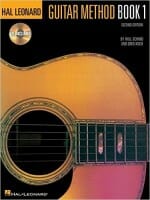
The second edition of this world-famous method by Will Schmid and Greg Koch is preferred by teachers because it makes them more effective while making their job easier. Students enjoy its easy-to-follow format that gives them a solid music education while letting them play songs right away. Book 1 provides beginning instruction including tuning, 1st position melody playing, C, G, G7, D7, and Em chords, rhythms through eighth notes, solos and ensembles and strumming.
Four Star Sight Reading and Ear Tests