M.Mus (U of T)
B.Mus (Oberlin)
Guitarist Gergely Szabo has an Advanced Diploma in Music Performance from Cambrian College where he majored in the classical guitar. Over his time there, he completed 2 years of comprehensive pedagogy courses. He also gained well grounded vocal skills, as well as basic knowledge on the piano. Outside of classical music, he exhibits a repertoire of skills and knowledge in playing the genres of rock, blues, and heavy metal music. He has experience in teaching the guitar and the ukulele to a range of people aged 6 to 54.
Gergely’s teaching methods include both the use of books and digital methods. The three main books he uses to teach guitar are as follows: “Guitar Method Book 1 by Will Schmid and Greg Koch,” “Four Star Sight Reading and Ear Tests RCM Level 1,” and “Classical Guitar Repertoire and Etudes RCM Level 1.” For teaching ukulele, he uses the book “Ukulele Songs for 1, 2, or 3 players by Elizabeth Ragsdale.” Aside from these, he frequently uses the Muse Score application as a play-along practicing tool.
Gergely’s passion for music and his dedication to growing the love of music in others are the biggest reasons why he teaches guitar and ukulele. His approach to teaching involves learning through play. The material he covers with his students is always delivered in a way that is highly interactive. Most of the assigned exercises he gives involve the elements of play that students can enjoy both in class and as homework.
Get to know Gergely…Beyond the Bio!
Coming soon!
Hobbies:
Musical influences:
Favourite food:
Least favourite food:
Favourite music:
Favourite album:
Favourite movie:
Favourite musical theatre/opera:
Best quote from your teacher:
Favourite quote:
Favourite book:
Latest Homework from Gergely
Is Gergely Your Teacher?
Sign up now to get your weekly assignments delivered, and never lose your homework sheet again!
Homework for May 6-13
Nova
Rec min to practice: 15-20 per day
What to practice: Mixed up Man, If I Were a Rich Man
How to practice:
Mixed up Man- Pay attention to rhythmic pattern throughout. The main melody is played with right hand leading first, the second time either left hand leading. Practice hands separate slowly first, then hands together when ready.
If I Were a Rich Man- Pay attention to fingering in all the different scales. Chromatic scale and minor scale are new.
How parents can support practice: Listen and guide them as needed.
Maya
Rec min to practice: 5-10 min per day
What to practice: Baby Bear, Autumn Song
How to practice:
Baby Bear- practice with visual aide (CDECEDC paper) and try to eventually be able to play without it.
Autumn Song- practice transitions between right hand and left hand. Line 2 is a repetition of line 1.
How parents can support practice: Supervise, especially the difficult passage in Baby Bear. I created the visual side but the goal is that she will eventually be able to rely on looking at the music and not need it.
Saturday, May 9th
Jack
We continued building upon Imperial March and now heading into the second phrase. I introduced the black keys as the “higher ground” in comparison to the white keys. We will continue to observe if Jack is interested to dive more into xylophone playing and note reading.
Nova
We started the session with more Stick Control practise. I have attached a link to the e-book version of the book. We will spend more time on page 14, with now a bigger focus on the rolls. A good way to practise stick control is also to combine two similar lines together, eg. playing line 9 after line 1. Regarding the note reading exercise, we touched on syncopation and dotted rhythm this week. We will talk more about that next week. For Sparkle, we are onto bar 59-62. We mentioned how the phrase has its own melody, and this particular line shares a similar melody as the phrase before. Pay attention to that during practising, and we will connect some phrases together next lesson and perhaps introduce some new material.
https://drive.google.com/file/d/1ADGiCCfAkWJGercA3ivs8DTQwjXziGzk/view?usp=sharing
Adam
Since Adam still doesn’t have access to his drumset, instead of learning a new song, we talked about some new rhythmic concept. Today it was triplets. We used the handout Stick Control p.14 to build that concept. Adam can either focus on line 1 and 2, or simply practise the few lines I wrote on his hand out this week.
https://drive.google.com/file/d/1ADGiCCfAkWJGercA3ivs8DTQwjXziGzk/view?usp=sharing
Jonah
During today’s online lesson, we worked through verse 2 of the new song Super Bad. We did a shorter lesson this week so we will compensate that 10 minutes in next week’s lesson.
Efe – Jan 24th
Hi Efe and family! Wishing you guys a great week! Here is what to look at this week.
Em (E minor) pentatonic scale
Memorize the new frets added to this scale. — This Google Drive shows the frets.
https://drive.google.com/drive/folders/1faNAHa6PfakFLpwZRjcAnOtmbvmd74Os?usp=drive_link
Play with this scale over this backing track. The same as before. Slow Em Blues backing track
Experiment with:
- Different speeds. There is no such thing as “too slow” for this.
- Pull-offs
- Palm-muting
- Bending
- Vibrato
- Different rhythms
- The limiting yourself rule. Take any set of rules to limit yourself with. For example, play only two notes. Yes, its boring; but 2 things will come out of that: 1, you will get creative with what cool things you can do with only two notes. You would be amazed at how much you can actually make with just two possibilities of notes. You’ll make things up that you never thought of, and that you never thought you could do. But you can. Don’t underestimate the possibilities of using only two notes. 2, if you really can’t resist the temptation to play other notes, then this is okay, too. Playing this limiting game will inevitably make your mind think of other cool possibilities of notes to play. Feel free to get creative with this :) This, too, is a fascinating thing to see. Let yourself do it and don’t be afraid!
- And also the powerchords. Any of the notes of this scale on the lowest 3 strings (remember, we speak upside down in guitar :) can help you make a powerchord. The only one I want you to refrain from playing is the D5 chord; I haven’t explained that one yet.
— For the 0-fret root note powerchords A5 and E5. They’re named with fives because this chord only has the fifth of that letter. In these two cases: a’s fifth is e, and e’s fifth is b. the 0, the 2, and the 2. Ideally use fingers 2 and 3 for each of those chords.
— 3pm to 6pm type strumming. Remember: this is mostly because of follow through. — IF it’s not too uncomfortable, have your finger 3 touch the string below it. It will mute the string below. So, hitting four strings at once is now something you can do, since the fourth string won’t ring.
You don’t have to do all of the techniques listed here. But what I do want you to do is spend 15 minutes on the 2-notes-only game. Then 15 minutes on the game wherein you start with 2 notes, but allow yourself to play other ones if you feel the urge to do so.
Have fun with it!
A different guitar
As I explained, I strongly encourage you to go and get a guitar that is both smaller and has nylon strings. The current guitar has too many drawbacks that are preventing Efe from being able to progress efficiently. It is good for him to practice bending and vibrato, which a nylon string guitar would indeed not be a helpful guitar for. But besides that, its strings are just too heavy to be able to play most things we’ll be covering in class. Including Smells Like Teen Spirit.
The options you could look for:
Acoustic nylon string guitar
- Nylon strings — these are light compared to the steel strings
- Usable for multiple genres of music
- Good for long term pedagogical use — that is, it’s technically a better choice in terms of being able to play in (some) more genres. Things like classical and flamenco music are playable on this instrument. The electric guitar won’t be as good for this.
Electric guitar
- Varying gauges of steel strings — start with “nines.” (The music stores will know what you mean if you say this.) This is one of the most common gauges of strings and they’re quite light to play on.
- Bends and vibrato are much more doable.
- Great for additional effects to play with; like pedals and harmonics.
- Good for long term use in the following genre groups: rock, jazz, country. There are many, many sub-genres of these three groups. So this type of guitar is great for all of these things; it just won’t be able to fulfill all the needs that classical and/or flamenco music need.
- Knowing you, Efe, I think you are more interested in these types of music rather than classical or flamenco music.
For now, you don’t need a guitar that has more than 19 frets.
The music store I go to is called Snider School of Music, and it’s just north of Yonge and Lawrence. 3225 Yonge St, Toronto, ON M4N 2L3
This store may still give the option of giving them the guitar to be sold, through which you’ll get the majority of that money when the guitar is sold.
Their prices are usually cheaper than chains like Long & McQuade. Plus, if you get one that’s used, it will be even cheaper.
Renting a guitar is another option.
If getting a different guitar is not possible right now, the I understand. If this is the case then I’m going to think of a new solution.
Smells Like Teen Spirit — I have purposely left out Smells Like Teen Spirit this week, as it is not a reasonable thing to practice with your current guitar.
This was an awesome class today, Efe. Make sure you have fun with these improvisation games! See you in a week!
Efe – Jan 17th
Hi Efe! Wishing you and your family a great weekend. Here’s what I’d like you to work on this week.
This Google Drive will have all the required material for this week. I’m having a delay right now. Everything will be there during the day on Sunday, January 18th. Efe – Jan 17th
Regarding my notes on last semester’s student report, I’ve implemented a plan here that gets you to practice a half hour a day.
Experimenting with new Powerchords — 5 minutes
For these, remember to use fingers 1 and 4 on your Left Hand. — Only use fingers 1 and 4 for the powerchords I give you for now. (There are powerchords with more notes in the actual chord, but I’m not going into that this week. I just want you understanding the most basic type of powerchord for now; we’ll get to those other ones later.)
- Play them anywhere on the bottom 4 strings. (E, A, D, G.) Don’t go up to the B or high E string with these; we’ll talk about those strings next time.
- ^ This is to say: Find the notes of this scale on the bottom 3 strings only. From here, you have to play that chess-like game I told you about :) which is when you start from the root note (the chord’s letter name), and then move 2 frets sideways and then 1 fret up.
Smells Like Teen Spirit — 15 minutes
There’s a video of me demonstrating the main riff of this song at 60BPM; half the original speed. Dedicate some time to playing this riff on repeat; exactly as you see me doing here.
- Don’t worry about the percussive picking you see in this video. As I told you in class, I’ll be showing you that technique a little later.
- There are 2 pictures in this week’s Google Drive that pertain to this song. 1: the 4 main powerchords that are played in this song. 2: the G powerchord. Be mindful of this chord. So many guitarists overlook this chord in this song.
- Make sure you’re sticking to the exact same strumming pattern that I’m using in the video.
E minor pentatonic scale — 10 minutes
- The Backing Track: Backing track in E minor
- There is a picture of the additional frets I’ve added to this scale.
— Well done on memorizing this. Keeping playing around with this over the backing track.
— Feel free to add vibrato on any of the notes in this scale so far. Remember your term, the “wiggle” :) this is what I’m referring to.
— We’re forgetting about the B major chord for now. I was mistaken in attempting to push you to learn this chord; it’s a bit high-level for you right now. You’ll get there eventually.
— Play the E minor, E major, and G major chords over this.
Final words
A little bit of practice everyday is far better than a huge amount of practice in one day. I’m strictly stopping you from doing a ridiculous amount of of practice in one day, because I don’t want you to risk hurting your hands. This is, indeed, a risk that some guitarists overlook and end up hurting their hands with.
It was a good lesson today, Efe. Thank you for your hard work. See you in a week!
Preferred Books for Gergely’s Students
Click to buy them here, and they’ll come right to your house! What could be easier?
Hal Leonard Guitar Method
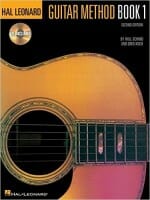
The second edition of this world-famous method by Will Schmid and Greg Koch is preferred by teachers because it makes them more effective while making their job easier. Students enjoy its easy-to-follow format that gives them a solid music education while letting them play songs right away. Book 1 provides beginning instruction including tuning, 1st position melody playing, C, G, G7, D7, and Em chords, rhythms through eighth notes, solos and ensembles and strumming.